 Netherlands · 16th century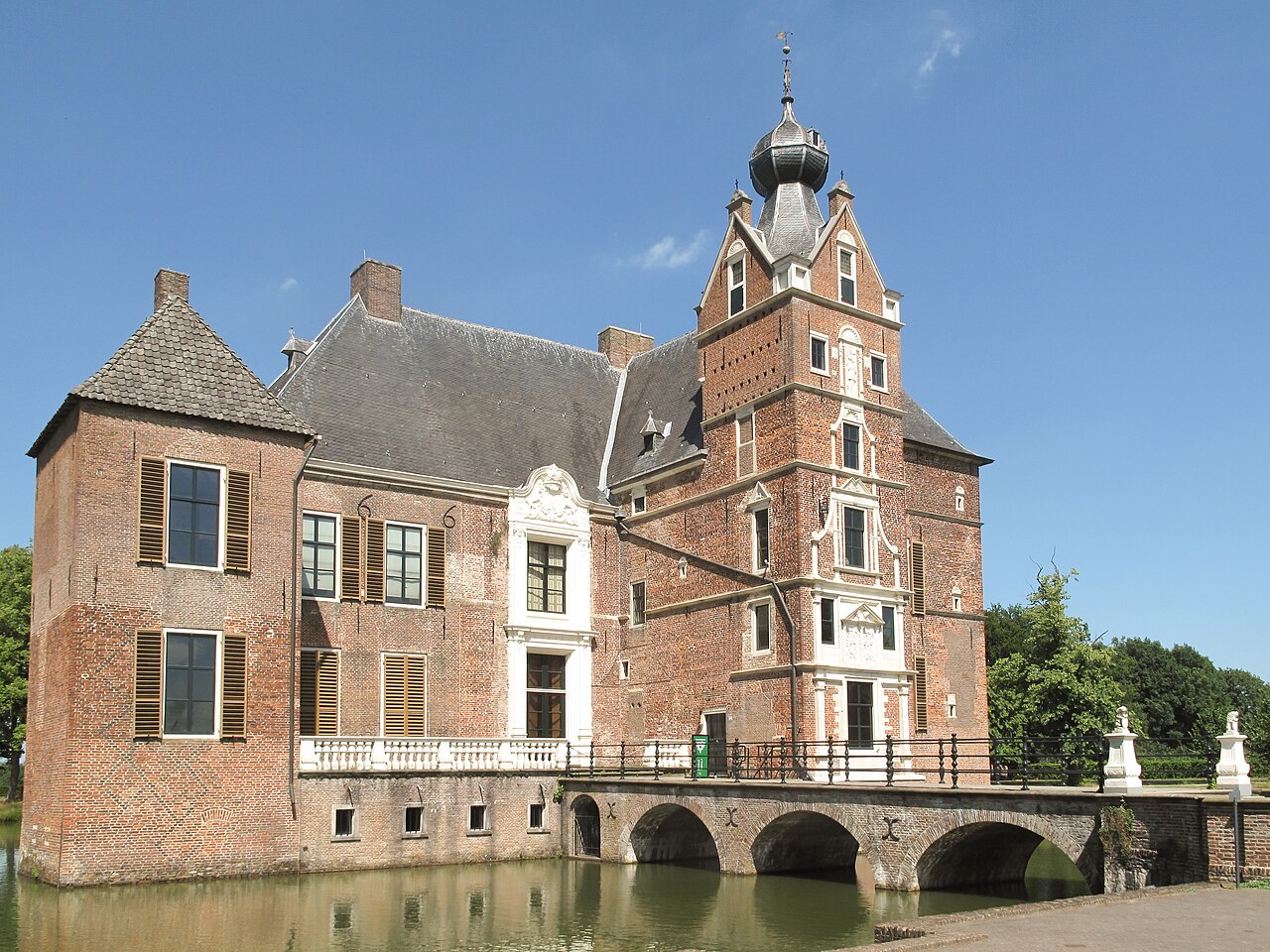
Cannenburg Castle (Dutch: Kasteel De Cannenburgh) or Cannenburch Castle (Dutch: Cannenburch) is a castle with a moat in the Netherlands. It is situated in Vaassen, a town in the province of Gelderland.
The Guelderian field marshal Maarten van Rossum built the castle in 1543 on the ruins of an old castle. After his death it was inherited by his nephew Hendrik van Isendoorn, who also supervised the final completion. The castle remained for over 300 years in the family D'Isendoorn à Blois. After the last van Isendoorn widow had died childless in 1881 the threat of the closure of the castle was a probability. In 1882 however it was bought by Eduard Baron van Lynden. 1905 it came into the possession of Mrs. Frida Cleve-Mollard from Berlin whose husband Richard Cleve was the last private inhabitant of the castle. After the Second World War the castle was confiscated by the Dutch government and in 1951 transferred to the "Foundation of Friends of Guelderian Castles" (Stichting Vrienden der Geldersche Kasteelen) for the symbolic price of one Dutch guilder. Between 1975 and 1981 a restoration of the castle took place, the antique furniture has been completed and it has since reopened to visitors.
The castle was built in the 16th century. Its shape has been preserved until today mainly unchanged. The building complex which contains many elements of the Renaissance architecture is completely surrounded by water. The floor plan is rectangular. There are almost square and covered towers at all four corners. The northeasterly one is equipped with an onion dome. On the front side facing south, another higher onion dome was built. This one significantly protrudes from the facade was. Directly above the entrance the coat of arms of Hendrik van Isendoorn and his wife Sophia Stommel are embedded in a sandstone sculpture.
Above another sandstone sculpture shows Maarten van Rossum. The entrance used to be reached via a drawbridge over the moat. This was replaced by a permanent stone arch bridge. Behind the entrance on the ground floor is an elongated narrow terrace followed by a large hall. Several representative rooms can be reached from there: a hunting room (due to the bright color of the walls also called "the white chamber") and a salon on the right-hand side as well as a bedroom and a dining room on the left side.
Text adapted from “Cannenburgh Castle” on Wikipedia, CC BY-SA 4.0.
Cannenburgh Castle ranks #3,838 of 9,035 worldwide in the atlas's castle fame ranking, and #35 of the 198 mapped in Netherlands. Founded 1543, it is older than 39% of the atlas's dated landmarks, one of 886 atlas entries founded in the 16th century. Its Wikipedia articles were opened 1,286 times in the last 60 days, more than 57% of the atlas. 3 more atlas landmarks stand within 25 km. The nearest day-trip guide is Apeldoorn, 9 km away. See how Netherlands compares in the castle statistics.
View on the interactive castle map →