 Netherlands · 17th century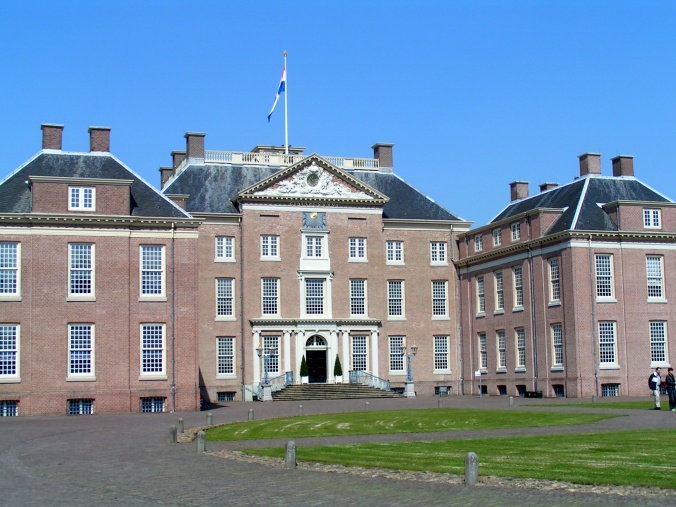
Het Loo Palace (Dutch: Paleis Het Loo [paːˈlɛis ɦɛt ˈloː], meaning "The Lea") is a palace in Apeldoorn, Netherlands, which was built by the House of Orange-Nassau.
The symmetrical Dutch Baroque building was designed by Jacob Roman and Johan van Swieten. It was built between 1684 and 1686 for stadtholder-king William III and his consort Mary II of England. The garden was designed by Claude Desgots.
After the elder House of Orange-Nassau had become extinct with the death of William III in 1702, he left all his estates in the Netherlands to his cousin John William Friso of the House of Nassau-Dietz in his will. However, Frederick I of Prussia claimed them, as he also descended from the princes of Orange, and the Houses of Orange-Nassau and Hohenzollern had, a few generations before, made an inheritance contract. Therefore, most of the older properties, although not including Het Loo, were in fact taken over by the Hohenzollerns, who never lived there. John William Friso's son, William IV, Prince of Orange, finally took over Het Loo and Soestdijk Palace, as well as Huis ten Bosch near The Hague. His widow later bought back several of the older properties in and around The Hague from Frederick William I of Prussia in 1732.
Het Loo was much beloved by King William I, who remained its owner after he abdicated in the fall of 1840. A few years before, the king had permitted the ancient practice of falconry to be reinstated on the palace grounds. His grandsons William III and Alexander became enthusiastic members of the Royal Loo Hawking Club, the latter serving as President from 1840 until his death in 1848. The falconry season drew a crowd of hunting enthusiasts to Het Loo every spring, including British noblemen such as the 7th Duke of Leeds. They stayed at hotels in Apeldoorn and held their meetings at Het Oude Loo in the vicinity of the palace.
After Prince Alexander's death in 1848, the club quickly went into decline. It was abolished in 1855. King William III made an effort to keep the practice of falconry alive for a while afterwards, paying a falconer from his private funds. Like his grandfather, he loved Het Loo and gladly spent much of his time living there as a country gentleman. William III, who was suffering from a kidney ailment, spent his last months at Het Loo and died there in November 1890.
Text adapted from “Het Loo Palace” on Wikipedia, CC BY-SA 4.0.
Het Loo Palace ranks #378 of 9,079 worldwide in the atlas's castle fame ranking, and #3 of the 199 mapped in Netherlands. Founded 1686, it is older than 23% of the atlas's dated landmarks — one of 721 atlas entries founded in the 17th century. Its Wikipedia articles were opened 15,861 times in the last 60 days, more than 96% of the atlas. 4 more atlas landmarks stand within 25 km. The nearest day-trip guide is Apeldoorn, 3 km away. See how Netherlands compares in the castle statistics.
View on the interactive castle map →