 Switzerland · 14th century
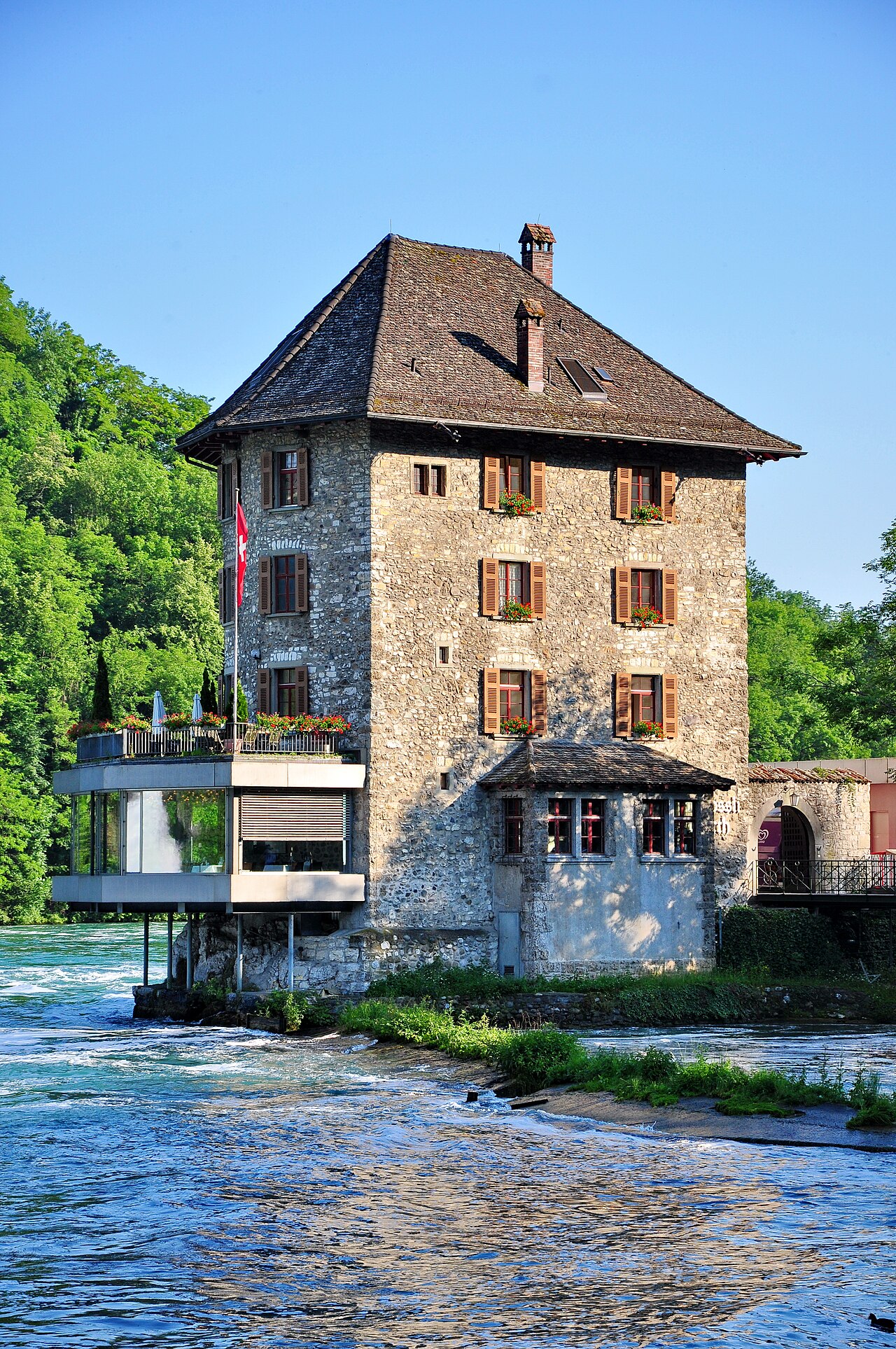
The Wörth Castle (German: Schlösschen Wörth, Swiss German: Schlössli Wörth) is a fortification in the municipality of Neuhausen am Rheinfall in the canton of Schaffhausen, Switzerland, located on a small island in the Rhine Falls' basin.
The water castle is located in the plunge pool of the Rhine Falls (Rheinfall), built on a small island in the Rhine river in the municipality of Neuhausen am Rheinfall in the canton of Schaffhausen, opposite of the Laufen Castle in the canton of Zurich. The Schlössli (twee for German Schloss, meaning 'castle') owes its name to the location on a small island, washed by the water of the Rhine Falls, which used to be known as Werd, meaning literally a river island.
Wörth was first mentioned in the 13th century AD, serving up to the middle of the 19th century as a major transhipment point on the east-west trade route, that led from Lake Constance (Bodensee) and the city of Basel, and was interrupted by the waterfall.
The present castle was built in 1348 AD, according to the excavations by the archaeological team of the canton of Schaffhausen in 2004. Like the predecessor building, which was built in the mid-11th century as Burg im Fischerhölzli, it served as a customs house and to secure the area, where the goods were transferred to evade the waterfall. Earliest owner of the Habsburg fief were the Herren von Jestetten (lit. 'Lords of Jestetten'), followed by the Schultheiss of Randenburg (1291) and the Herren von Fulach (1422), and in 1429 by the Kloster Allerheiligen Schaffhausen. After the monastery's abolition in 1524, Wörth was a department (Amt) of the city of Schaffhausen.
In the late 1790s, a so-called Gertzler was the custodian of the then Schlösschen Wörth. It was given as a so-called Schupf-Lehn (fief) by the Kloster Allerheiligen in Schaffhausen along with the salmon fisheries, customs, vineyard, forest etc. The Gertzler moved the customs for the monastery and had to deliver 2/3 of the salmon catch. For subsistence, he was allowed to fell timber out of the forest, and had to pay a lease of 30 Thaler per year for the use of the vineyard and the fields. The term Schlupf-Lehn derives from the Swiss German word for "slide out", as the feudal hereditary could be revoked if the administrator did not meet its obligations to the monastery.
Text adapted from “Wörth Castle” on Wikipedia, CC BY-SA 4.0.
Wörth Castle ranks #4,266 of 9,035 worldwide in the atlas's castle fame ranking, and #47 of the 213 mapped in Switzerland. Founded 1348, it is older than 57% of the atlas's dated landmarks, one of 757 atlas entries founded in the 14th century. 9 more atlas landmarks stand within 25 km. The nearest day-trip guide is Winterthur, 22 km away. See how Switzerland compares in the castle statistics.
View on the interactive castle map →