 Italy · 2nd century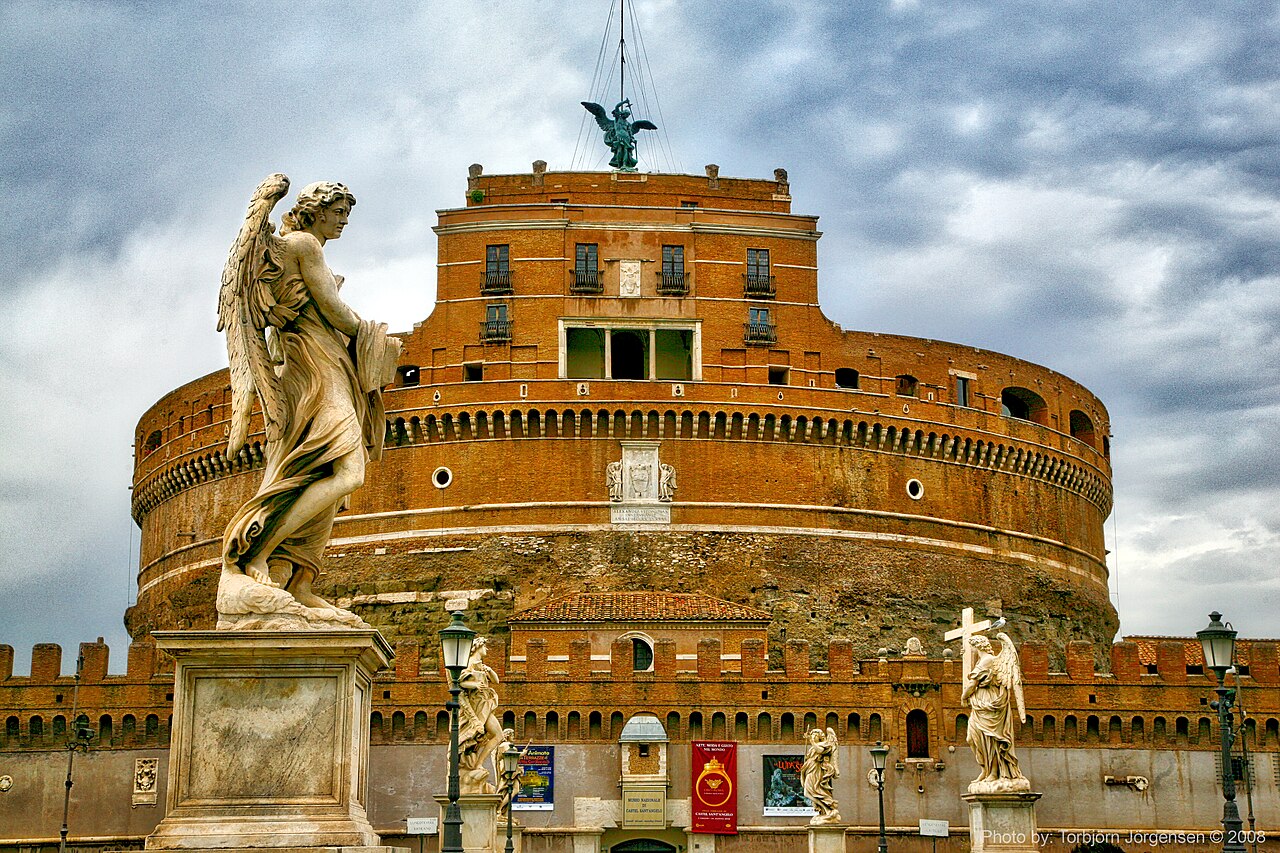
Castel Sant'Angelo (pronounced [kaˈstɛl sanˈtandʒelo] Italian for 'Castle of the Holy Angel'), also known as Mausoleum of Hadrian (Italian: Mausoleo di Adriano), is a towering rotunda (cylindrical building) in Parco Adriano, Rome, Italy. It was initially commissioned by the Roman Emperor Hadrian as a mausoleum for himself and his family. The popes later used the building as a fortress and castle dedicated to Saint Michael the Archangel, and it is now a museum. The structure was once the tallest building in Rome.
Text adapted from “Castel Sant'Angelo” on Wikipedia, CC BY-SA 4.0.
Castel Sant'Angelo ranks #22 of 9,079 worldwide in the atlas's castle fame ranking, and #1 of the 560 mapped in Italy. Founded 139, it is older than 98% of the atlas's dated landmarks — one of 21 atlas entries founded in the 2nd century. Its Wikipedia articles were opened 72,680 times in the last 60 days, more than 99% of the atlas. 65 more atlas landmarks stand within 25 km. The nearest day-trip guide is Rome, 2 km away. See how Italy compares in the castle statistics.
View on the interactive castle map →