 Germany · 11th century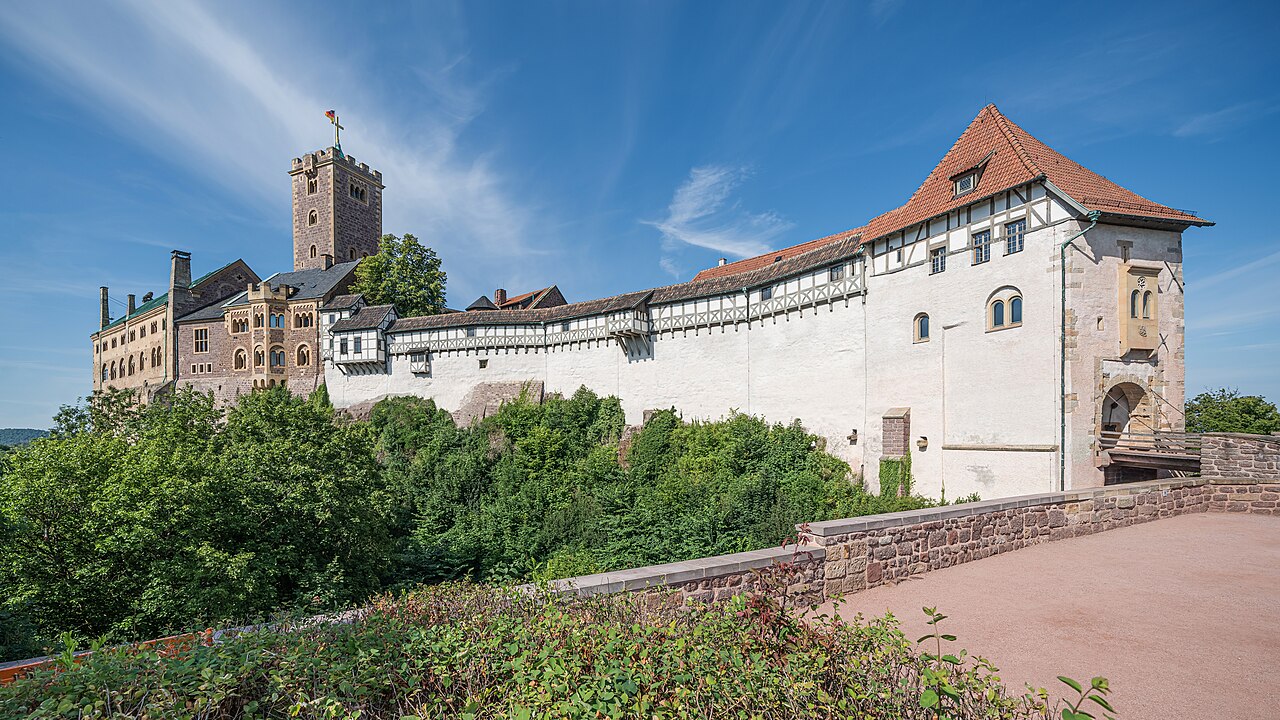
The Wartburg (German pronunciation: [ˈvaʁtbʊʁk]) is a castle originally built in the Middle Ages. At an elevation of 410 metres (1,350 ft) in the state of Thuringia, Germany, it is situated on a southwest-facing precipice and overlooks the town of Eisenach to the north. It was the home of St. Elisabeth of Hungary, the place where Martin Luther translated the New Testament of the Bible into German, the site of the Wartburg festival of 1817 and the supposed setting for the possibly legendary Sängerkrieg. It was an important inspiration for Ludwig II when he decided to build Neuschwanstein Castle.
Wartburg is the most visited tourist attraction in Thuringia after Weimar. Although the castle today still contains substantial original structures from the 12th through 15th centuries, much of the interior dates back only to the 19th century. In 1999, Wartburg Castle was inscribed on the UNESCO World Heritage List because of its quintessential medieval architecture and its historical and religious significance.
Text adapted from “Wartburg” on Wikipedia, CC BY-SA 4.0.
Wartburg ranks #56 of 9,079 worldwide in the atlas's castle fame ranking, and #3 of the 711 mapped in Germany. Founded 1067, it is older than 88% of the atlas's dated landmarks — one of 436 atlas entries founded in the 11th century. Its Wikipedia articles were opened 37,045 times in the last 60 days, more than 99% of the atlas. 6 more atlas landmarks stand within 25 km. It is one of the 38 landmarks on the atlas's regional map of Thuringia. See how Germany compares in the castle statistics.
View on the interactive castle map →