 Spain · 14th century
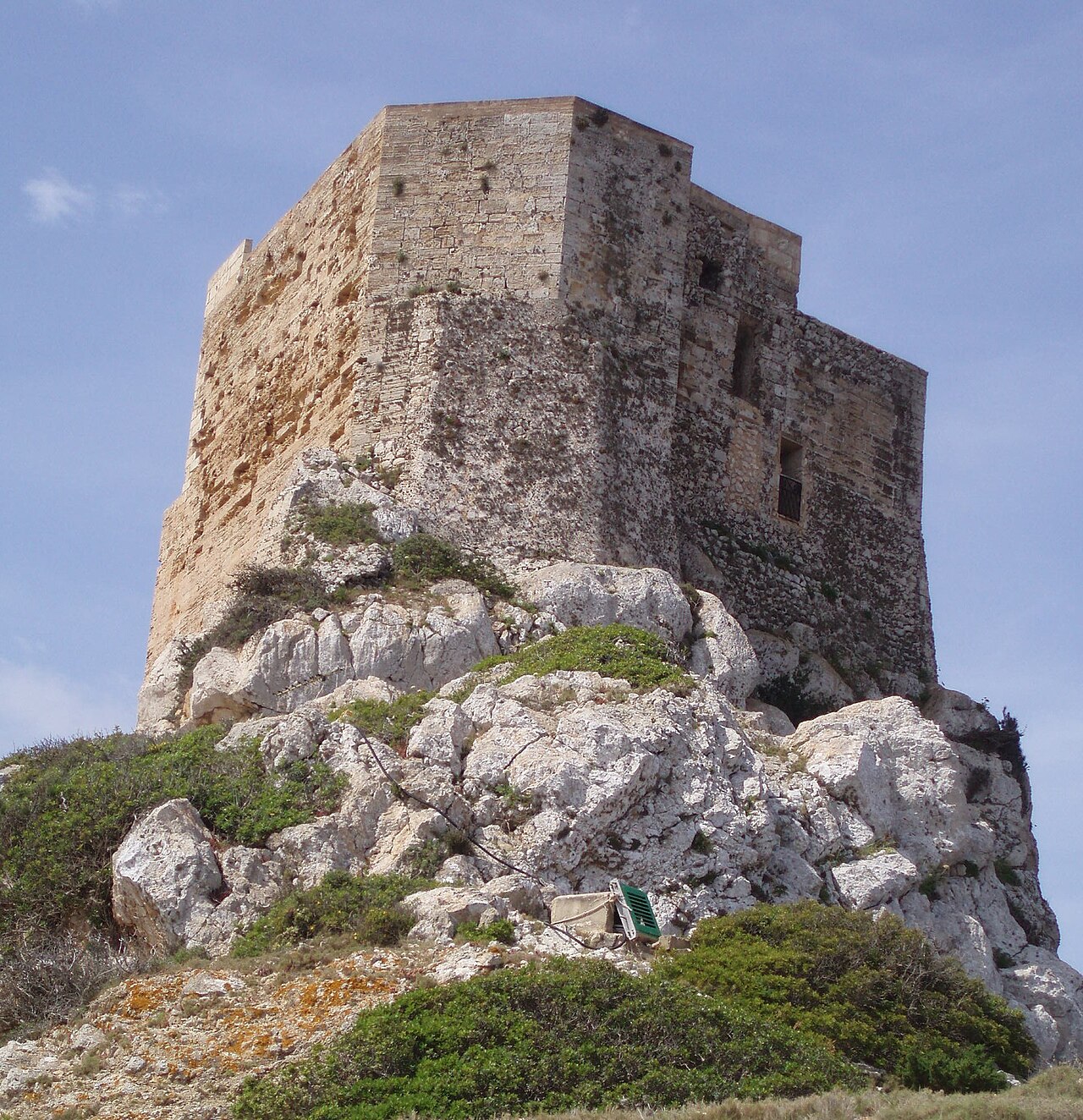
Castell de Cabrera is a fortification located on the Spanish island of Cabrera, municipality of Palma de Mallorca, Balearic Islands. Today it is a solid hexagonal mass, slightly elongated, situated on the eastern point of the entrance to its natural harbour, at a height of 72 metres above sea level. The successive attacks it has suffered throughout its history suggest that it has little to do with the original construction. In the 16th century alone the castle was destroyed and rebuilt at least ten times.
The first reference dates from 1410, in which the tower keepers Pedro and Guillermo Zaragoza claimed the full payment of their salary from the Viceroy of Mallorca, so by that date it was already operational and its construction is assumed to have taken place between the middle and the end of the 14th century; it was possibly then no more than a watchtower.
In 1425 the usufructuary of Cabrera, Bernat Zaragoza, in his own name and that of the Provost of Tarragona, signed an agreement with the University of the City and Kingdom of Mallorca to maintain a garrison with the aim of defending the island and the castle, newly completed, which suggests an enlargement of the original tower. In 1510 two Barbary galleys attacked Cabrera, took the tower keepers and twenty-two fishermen captive and destroyed the tower. However, a sudden storm allowed help to arrive, which freed the captives. In 1550 the Turkish corsair Turgut, at the head of 1,500 men, took the island, seized the castle's artillery and completely demolished the building. In the 16th century a chapel was built where the clergy of Santañí came to celebrate mass for the garrison.
Machine-translated from “Castillo de Cabrera (Baleares)” on the Spanish Wikipedia, CC BY-SA 4.0.
Castell de Cabrera (Baleares) ranks #5,967 of 9,035 worldwide in the atlas's castle fame ranking, and #260 of the 606 mapped in Spain. Founded c. 1350, it is older than 54% of the atlas's dated landmarks, one of 757 atlas entries founded in the 14th century. It is one of the 19 landmarks on the atlas's regional map of the Balearic Islands. See how Spain compares in the castle statistics.
View on the interactive castle map →