Castle
Castle Dyck
🇩🇪 Germany · 11th century
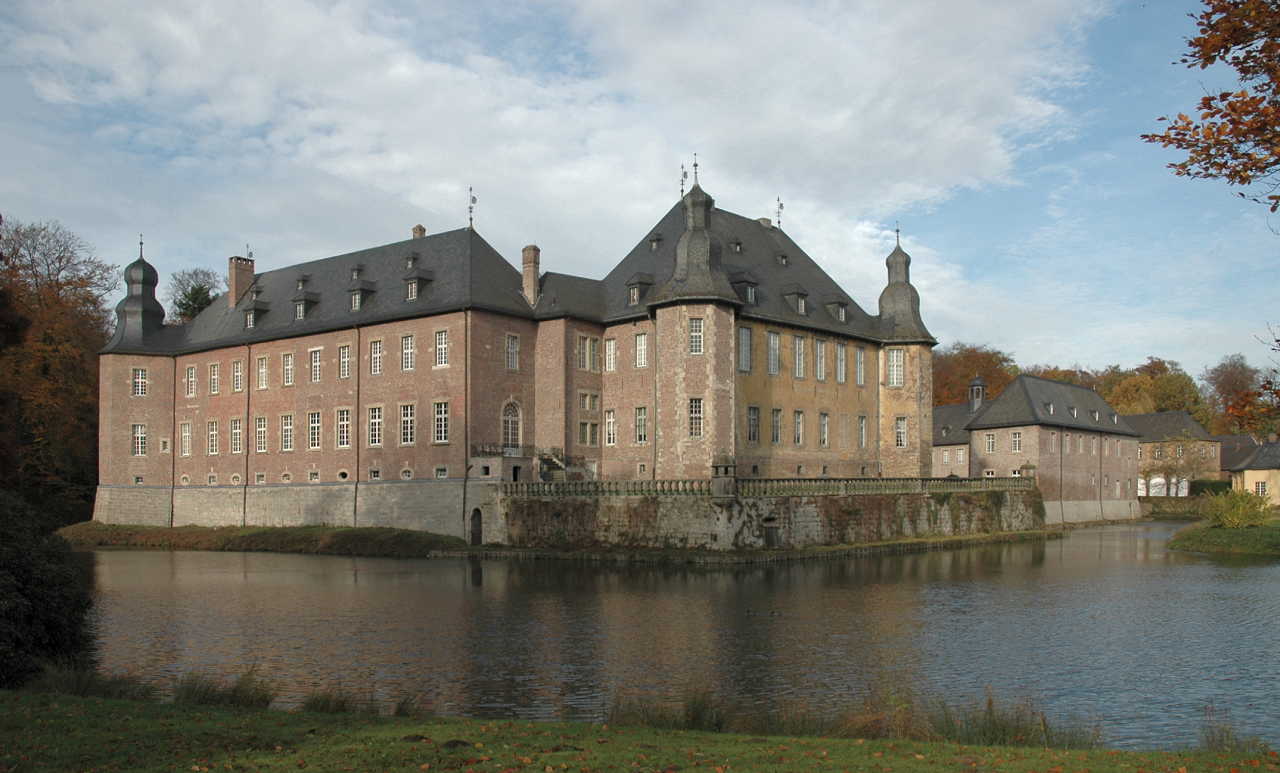
Castle Dyck (German: Schloss Dyck) is a moated castle in the Rhineland region of Germany. It is located in the municipality of Jüchen in Rhein-Kreis Neuss, North Rhine-Westphalia, between Grevenbroich and Mönchengladbach.
The history of the castle began in 1094 when the knight Hermannus de Disco was mentioned in a record of the Archbishop of Cologne as the lord of a simple fortification. Over time the site was converted into a fortified moated castle. In 1383 the castle was besieged by the cities of Aachen and Cologne, as well as by the archbishop Friedrich III von Saarwerden and Duke William I of Guelders and Jülich. They accused Lord Gerard van Dyck of being a robber knight. When Gerard van Dyck died without male offspring, the castle was inherited by Johann V von Reifferscheidt, the ancestor of the counts and princes of Salm-Reifferscheid. This family owned the castle for more than 900 years until it became the Centre for Garden Art and Landscape Design in 1999. The last heiress of the family, Countess Marie Christine Wolff Metternich, turned it over to a foundation to secure the future of the castle.
The castle is the center of Salm-Reifferscheid-Dyck, a former independent territory located between the Electorate of Cologne, Guelders and Jülich. The small territory was called "Dycker Ländchen" and is still recognizable for its unique cultural landscape.
The main building, the forecourts, and the outbuilding and the stables are spread over four islands. In the 17th century the castle was turned into an early baroque residence. Count Salentin of Salm-Reifferscheid extended the main building into a four-wing complex; stables, watch rooms, and the brewery were renewed. In the 18th century, Schloss Dyck became a Rococo residence, with fine tapestries and exquisite furniture. Unfortunately not everything has been saved: the famous library was sold at an auction in 1992, as was the armoury and weapons collection.
The complex is surrounded by an English landscape garden created by prince Joseph zu Salm-Reifferscheidt-Dyck. The castle and the park are open for visitors. The complex also includes a hotel that hosts many venues and meetings. Schloss Dyck Classic Days is a cultural heritage festival started in 2006. Its proceeds are used for the maintenance of the castle.
Text adapted from “Schloss Dyck” on Wikipedia, CC BY-SA 4.0.
Castle Dyck ranks #3,391 of 8,134 worldwide in the atlas's castle fame ranking, and #264 of the 505 mapped in Germany. Founded 1094, it is older than 88% of the atlas's dated landmarks — one of 325 atlas entries founded in the 11th century. Its Wikipedia articles were opened 3,218 times in the last 60 days, more than 77% of the atlas. 6 more atlas landmarks stand within 25 km. The nearest day-trip guide is Düsseldorf, 18 km away. See how Germany compares in the castle statistics.
View on the interactive castle map →Frequently asked questions
Where is Castle Dyck?
Castle Dyck stands in Germany, at 51.14194°, 6.55736°.
When was Castle Dyck built?
The atlas dates its founding to 1094. Earlier structures may have stood on the site; this is the earliest documented founding year.
How famous is Castle Dyck?
In this atlas's fame ranking: #3,391 of 8,134 worldwide, and #264 in Germany. Fame here combines how many Wikipedia language editions cover a landmark with how many people read them.
What is the nearest castle to Castle Dyck?
Schloss Rheydt, about 7 km away.
More castles in Germany
- Wiesenthau Castle Germany · 14th century
- Beuggen Castle Germany
- Purschenstein Castle Germany · 12th century
- Zweibrücken Castle Germany · 18th century
More castles
- Château de la Ferté (La Ferté-Saint-Aubin) France
- Castle Crottorf Germany · 14th century
- Nový Berštejn Castle Czech Republic · 16th century
- Schloss Neuhaus, Paderborn Germany