 France · 12th century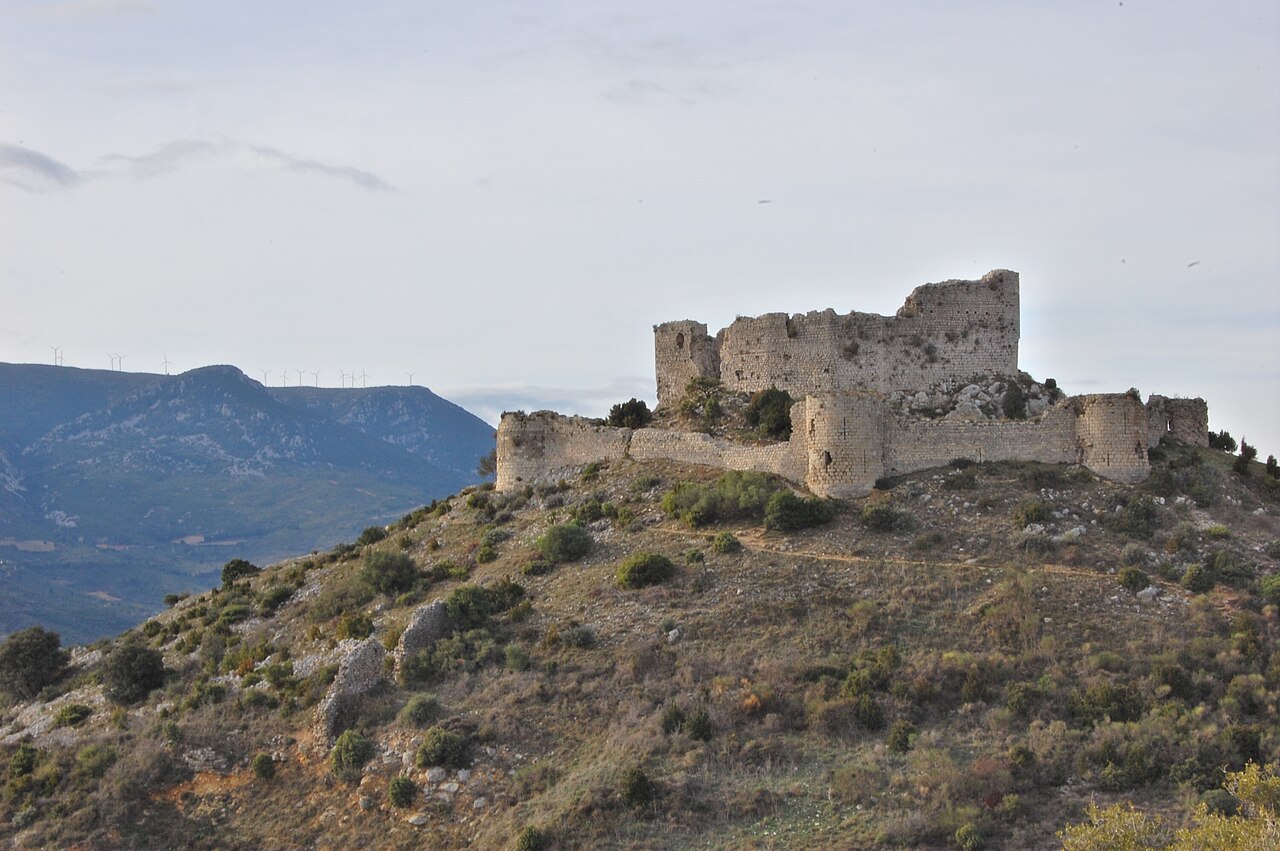
The Château d'Aguilar (Languedocien: Castèl d’Aguilar) is a 12th-century castle, one of the so-called Cathar castles, located in the commune of Tuchan in the Aude département of France.
The design of the castle is an example of the practical military thinking guiding 12th century architecture. The castle consists of an inner keep built in the 12th century, surrounded by an outer pentagonal fortification from the 13th century. This fortification is oriented such that its point guards the side most favourable to attackers. The keep and the inner hexagonal fortification is flanked at each corner with semi-circular guard towers, each equipped with archery outlooks. The strategic location of the castle on a hill overhanging the plain of Tuchan allows control and protection of the Corbières Massif. Despite this, the castle is easily accessible from the plains because of its relatively low elevation of 321 metres.
There is a small underground chapel of Saint-Anne below the keep.
The earliest building at this location belonged to the count of Fenouillèdes since 1021. In the 13th century, the keep that had replaced earlier buildings was bequeathed by the viscounts of Carcassonne to their vassal, the Counts of Termes.
In 1210, it was invaded and occupied by Simon de Montfort, whose soldiers took and held the owner Raymond de Termes in a dark dungeon in the Carcassonne. In 1246, a royal garrison was installed to supervise the Aragon frontier. the castle was returned in 1250 to Olivier de Termes, the son of Raymond who had made peace with king Louis IX, for his good services during his crusade in the Holy Land. In October 1260, Olivier de Termes sold the castle to Louis IX, along with the villages of Termes, Davejean and Vignevieille.
Now on the border between the Kingdoms of France and Aragon, Tuchan experienced many skirmishes and battles during the following centuries.
In 1525, the castle fell into the hands of a Spanish army. It is likely that the castle was then dismantled and not restored.
When the border was pushed back to the south of Roussillon by the treaty of the Pyrenées (1659), the castle gradually lost its strategic importance, and was eventually abandoned in 1659. Today it is in decrepit condition. Since 1949, it has been listed as a monument historique by the French Ministry of Culture.
Text adapted from “Château d'Aguilar” on Wikipedia, CC BY-SA 4.0.
Château d'Aguilar ranks #2,003 of 9,035 worldwide in the atlas's castle fame ranking, and #149 of the 787 mapped in France. Founded c. 1150, it is older than 80% of the atlas's dated landmarks, one of 763 atlas entries founded in the 12th century. Its Wikipedia articles were opened 3,044 times in the last 60 days, more than 78% of the atlas. Wikidata records about 6,748 visitors in 2020. 8 more atlas landmarks stand within 25 km. The nearest day-trip guide is Perpignan, 25 km away. It is one of the 23 landmarks on the atlas's regional map of Cathar Country. It is stop 11 of 18 on the Cathar castle route, Carcassonne to Foix. See how France compares in the castle statistics.
View on the interactive castle map →