 Portugal · 14th century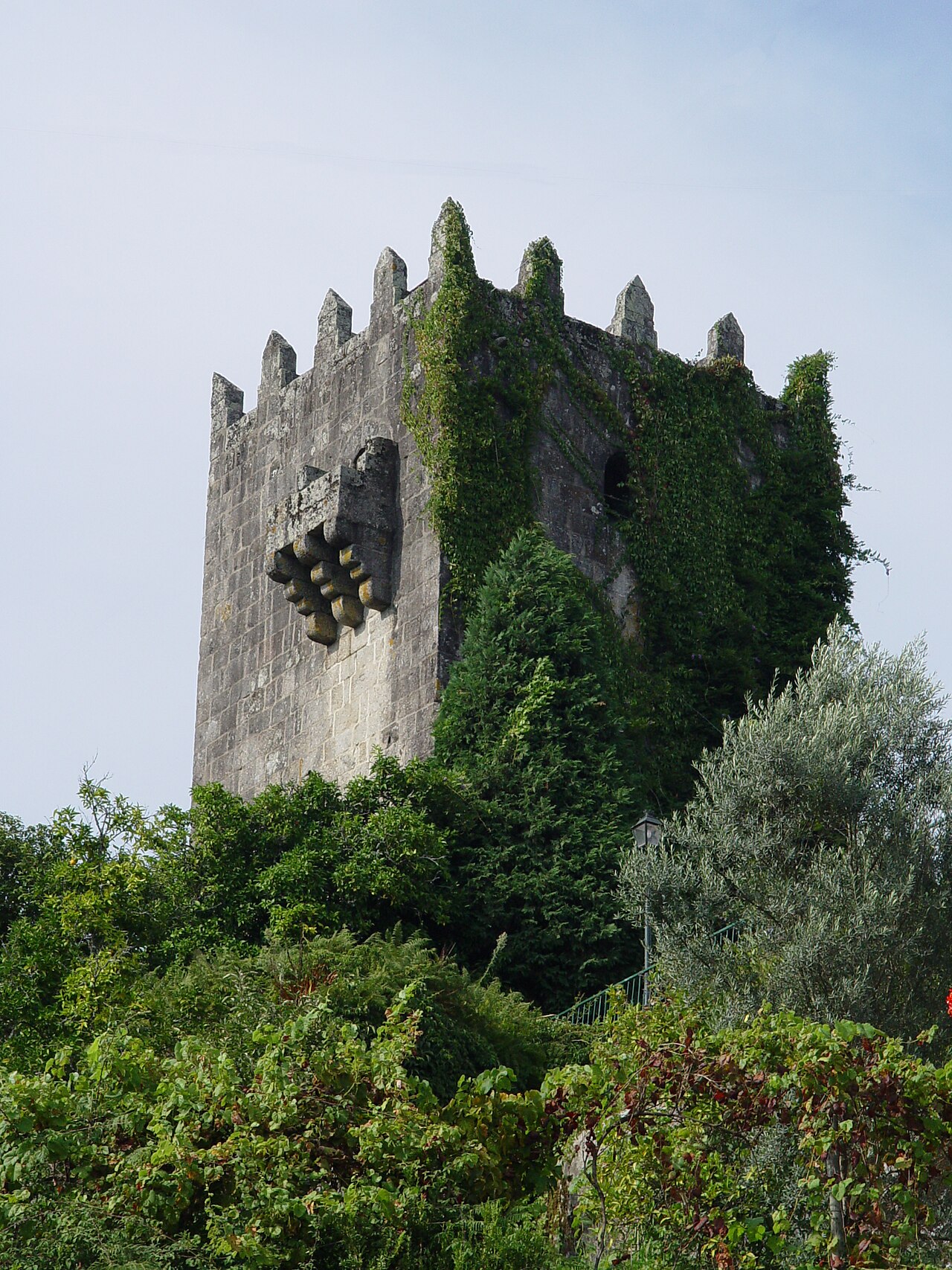
The Tower of Penegate (Portuguese: Torre de Penegate), is a 3-storey quadrilateral tower, located in the civil parish of São Miguel de Carreiras in municipality of Vila Verde, in the northern region of Portugal.
The first reference to the toponymy of Penegate came in 1064, substituting the former name of Penela. Regardless, the area continued to pertain to a dominant hilltop, where, later, the Gothic tower known as Penegate was founded. There are still some concerns about whether this structure had a Roman, or proto-Roman, foundation, normally attributed to D. Egas Pais de Penegate, a trusted man of Count Henry of Burgundy, as defended by some authors.
The tower was begun in 1322, by Mem Rodrigues de Vasconcelos, alcalde-mor of the Castle of Guimarães, after receiving a royal licence (for a domus fortis) from King Denis on 5 October 1322. Mem Rodrigues requested the dispatch, owing to problems found in occupying his title in the region of Entre-Homem-e-Cávado, the zone where royal judiciary had difficulties in imposing is authority owing to his uncle, Pedro Anes de Vasconcelos.
By 1668, Miguel Valadares, who was then the proprietor of the tower, died. The Chapel of Nossa Senhora da Penha was constructed in the 17th century, under his initiative (from the inscription along the principal facade). This nobleman, deacon of Guimarães and judge in Braga, was the descendant and heir of the building, and incorporated the chapel as a burial site.
In 1907, the tower was acquired by the father of the current property-owner.
In 1939, a house was constructed along the lateral wall of the tower.
The tower's age meant that local authorities were interested in classifying the tower, as a form of attracting local activity to the region. On 20 August 1986, municipal authorities deliberated a motion to propose to the IPPC, that the tower be listed as a National Monument. This was followed on 15 November 1988, with a proposal by the Câmara Municipal of Vila Verde to classify the structure. The process was opened by the president of the IPPC on 20 June 1990. But, many of these initiatives met with success, and Penegate remained unclassified by the beginning of the 20th century.
On 27 December 2011, the DRCNorte (Direcção Regional de Cultura do Norte) re-proposed classifying the structure as an MIP, or Monumento de Interesse Público (Monument of Public Interest).
Text adapted from “Tower of Penegate” on Wikipedia, CC BY-SA 4.0.
Tower of Penegate ranks #4,804 of 9,035 worldwide in the atlas's castle fame ranking, and #67 of the 212 mapped in Portugal. Founded 1322, it is older than 59% of the atlas's dated landmarks, one of 757 atlas entries founded in the 14th century. 5 more atlas landmarks stand within 25 km. The nearest day-trip guide is Braga, 13 km away. See how Portugal compares in the castle statistics.
View on the interactive castle map →