 France · 13th century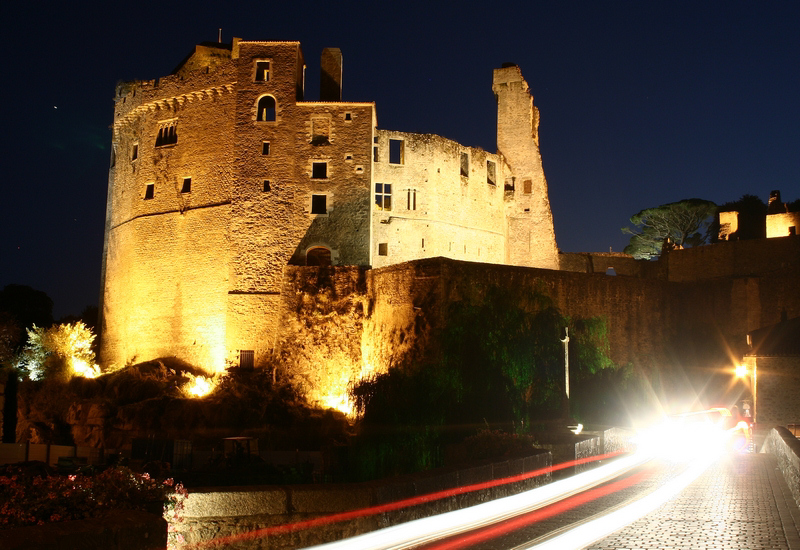
The Château de Clisson is a castle in the commune of Clisson in the Loire-Atlantique département of France. It stands on the right bank of the Sèvre Nantaise.
Within then independent Brittany, the castle, situated at a crossroads for Anjou and Poitou, was one of the great fortified places on the frontiers of the Duchy of Brittany The first Lords of Clisson occupied the site from the 11th century. They are mentioned for the first time in 1040. Clisson was then the seat of a powerful châtellenie covering 23 parishes.
Most of the present castle was built in the 13th century. Constructed by Guillaume de Clisson, on a rocky outcrop dominating the Sèvre Nantaise, its form at that time was an irregular polygon flanked by round towers and isolated from the rocky plateau by a shallow moat. In the 14th century, Olivier III de Clisson incorporated the gatehouse into a massive quadrilangular keep. The two semicircular towers of the gatehouse collapsed in the 17th century. The castle became the setting for the turbulent lives of Olivier IV de Clisson and Olivier V de Clisson, named Constable of France in succession to Du Guesclin in 1380. The castle is said to be haunted by Jeanne de Clisson wife of Olivier IV.
In the 15th century, the fortifications were modernised to permit the use of artillery. In the second half of the century, the former entrance was modified and the curtain wall was extended and completed by a barbican. At the same time, the castle was enlarged to the west with a new rectangular enclosure nearly 100 m long, armed with towers with artillery casemates.
After 1420, the castle became the property of the Duke of Brittany. It was one of the favourite residences of Duke Francis II who was remarried there, to Marguerite de Foix in 1474. He built a second rectangular enceinte flanked by artillery towers. Around 1590, the troubled period of the French Wars of Religion necessitated the construction of three terraced bastions on the south. Thus, three lines of defence in depth protected the site.
Until the 17th century, the castle was the residence of the Avaugour family, descendants of François Ier d'Avaugour, illegitimate son of François II. He modified and transformed the castle to suit the tastes and fashions of the day. During the War in the Vendée, the town and its castle were burned by the Infernal columns of Jean-Baptiste Kléber.
Text adapted from “Château de Clisson” on Wikipedia, CC BY-SA 4.0.
Château de Clisson ranks #1,850 of 9,079 worldwide in the atlas's castle fame ranking, and #141 of the 793 mapped in France. Founded c. 1250, it is older than 67% of the atlas's dated landmarks — one of 1080 atlas entries founded in the 13th century. Its Wikipedia articles were opened 2,544 times in the last 60 days, more than 75% of the atlas. 3 more atlas landmarks stand within 25 km. The nearest day-trip guide is Angers, 70 km away. See how France compares in the castle statistics.
View on the interactive castle map →