 France · 18th century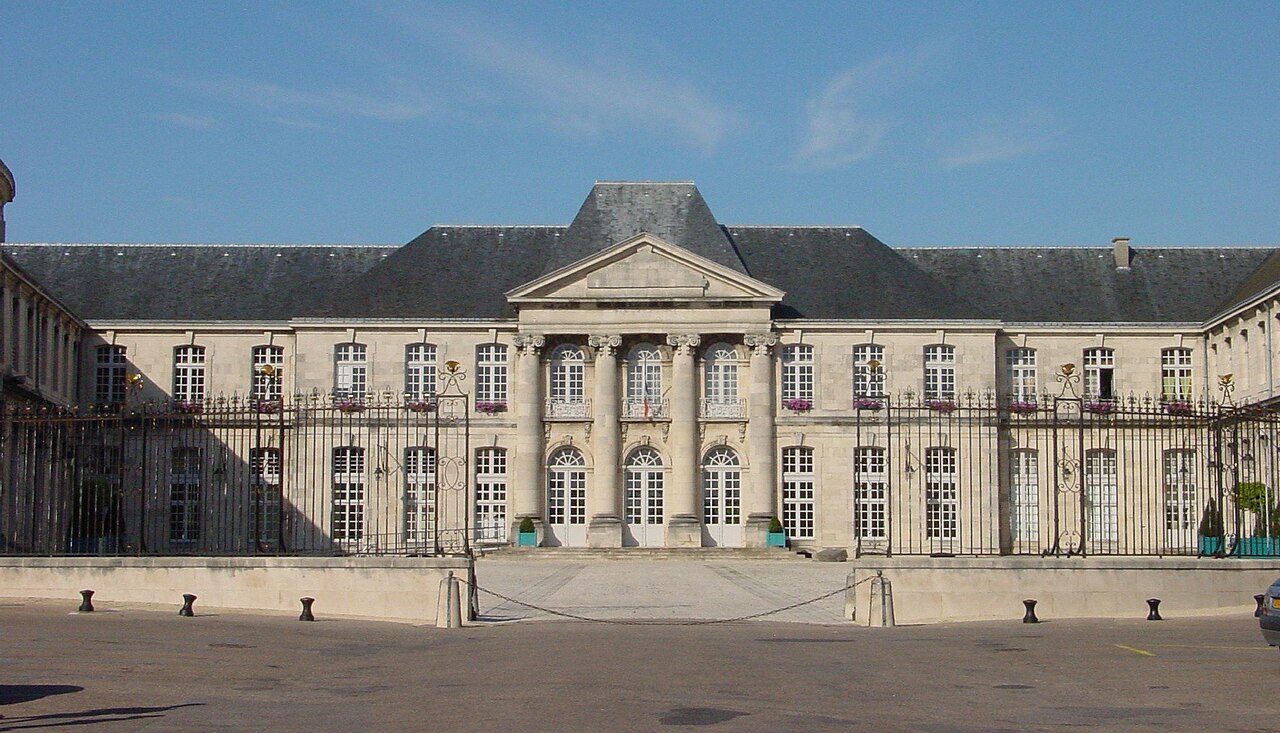
The Château de Commercy is a castle in the town of Commercy, in the Meuse department of France. It was the principal residence of the reigning Prince of Commercy and was built by Charles Henri de Lorraine. The site, château and grounds, was classified as Monument historique in 1960, with the roofs and façades of the wings being classified in 1972.
In 1708, Charles Henri de Lorraine, prince de Vaudémont, a legitimised son of Charles IV, Duke of Lorraine, began to reconstruct the old building to designs by Germain Boffrand. At the same time, Boffrand had also started work on the nearby Château de Lunéville, then the residence of Charles Henri's half-cousin Leopold, Duke of Lorraine, the reigning duke of Lorraine.
In 1723, Léopold was given the Principality of Commercy at the death of Charles Henri who died without heir. As such, Commercy became another land holding of the House of Lorraine. In 1729, Léopold died at Lunéville. He was succeeded by his son, Francis III of Lorraine, future spouse of Empress Maria Theresa of Austria.
At the end of War of the Polish Succession in 1737, the duchies of Lorraine and Bar were ceded to the landless ex-king of Poland, Stanislas Leszczyński, father of Marie Leszczyńska, Louis XV's Queen consort. As Stanislas moved into the Château de Lunéville, the Principality of Commercy was given to the widow of Léopold, the dowager duchess of Lorraine, Élisabeth Charlotte d'Orléans niece of Louis XIV and sister of the deceased Philippe II, Duke of Orléans.
From 11 September to 5 October 1738, Françoise de Graffigny paid "Madame de Lorraine" a farewell visit at Commercy, and her letters to François-Antoine Devaux paint a lively picture of life there.
When the Dowager Duchess of Lorraine died of a stroke, at Commercy, on 23 December 1744, ownership of the château reverted to Stanislas Leszczyński, under whom it had its golden age. He and his court made frequent visits to Commercy, where etiquette was more relaxed and social pleasures were the main occupation. In the summer of 1748, Voltaire, Émilie du Châtelet and Jean-François de Saint-Lambert spent July and part of August there. In 1755, Madeleine Paulmier stayed at the château and, according to legend, gave her name to a cake, gâteau Madeleine. Eventually the site became known locally as the Château Stanislas.
Text adapted from “Château de Commercy” on Wikipedia, CC BY-SA 4.0.
Château de Commercy ranks #2,284 of 9,079 worldwide in the atlas's castle fame ranking, and #178 of the 793 mapped in France. Founded 1747, it is older than 18% of the atlas's dated landmarks — one of 696 atlas entries founded in the 18th century. Its Wikipedia articles were opened 2,126 times in the last 60 days, more than 71% of the atlas. The nearest day-trip guide is Nancy, 44 km away. See how France compares in the castle statistics.
View on the interactive castle map →