 France · 19th century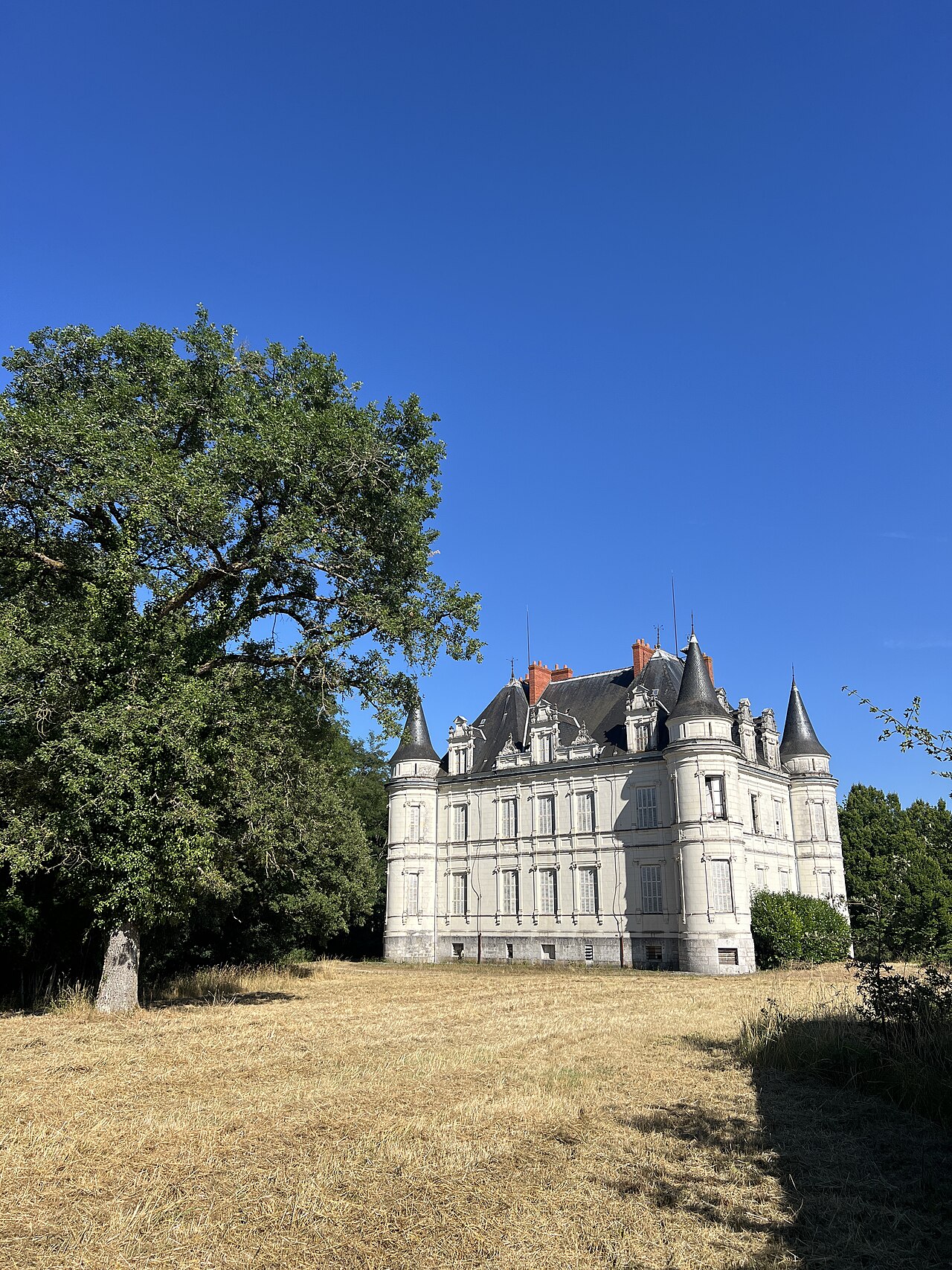
Château Poséidon is a château in neo-Renaissance style, located in the French municipality of Varennes-sur-Fouzon, part of the merged municipality of Val-Fouzon in the Indre department. The castle was also known by the name Château de la Borde or Château Laborde.
The castle was built between 1860 and 1865, based on a design by Alfred Dauvergne (1824–1885). This architect was very active in the Loire region, particularly in Châteauroux and its surroundings, where he designed numerous churches, vicarages, town halls, schools and castles. For the Château Poséidon, he drew inspiration from the castle of Azay-le-Rideau. The new construction followed the demolition of a previous castle, of which only a keep and the foundations of a second keep remain. The demolition materials were used for the foundations and the base of the new castle.
On the wall in the stairwell, a plaque was placed with the motto Qui veult, peut, French version of the Latin Nihil difficile volenti that can be translated as Yes we can or as Nothing is difficult for those who want it.
Louis Gustave Boullet (1814–1867) and his wife Gabrielle Picot d'Agard (1826–1905) were the first owners of the castle. He belonged to a family of real estate owners and merchants. He died before the works at the castle were completely finished. His widow survived him for almost forty years. They had three children: Henry Adrien Louis Boullet (1847–1907), Gabrielle Boullet (1851–1923) and Gustave Boullet (1863–1884). In 1925 the heritage had to be divided between the surviving heirs, and this resulted in the sale of the domain.
During the Interbellum and until 1949, the castle was owned by Élie Granat (Kiev, 1889 – Paris, 1969). After obtaining his engineering degree from the École supérieure d’électricité (promotion 1911–12), he became the chief engineer of the company Barbier, Bénard & Turenne. He was the inventor of equipment for air defense and similar devices. During World War II, he supplied weapons to the Allies. A commander in the Légion d'Honneur, he was buried, along with his wife, in the Paris cemetery Père Lachaise. In his memory, a street was named after him in Varennes-sur-Fouzon.
After Granat, the castle became the property of the Coopérative agricole d'élevage du Berry, specializing in artificial insemination of cattle.
Text adapted from “Château Poséidon” on Wikipedia, CC BY-SA 4.0.
Château de la Borde ranks #2,350 of 9,079 worldwide in the atlas's castle fame ranking, and #184 of the 793 mapped in France. Founded 1863, it is older than 7% of the atlas's dated landmarks — one of 717 atlas entries founded in the 19th century. Its Wikipedia articles were opened 3,872 times in the last 60 days, more than 83% of the atlas. 3 more atlas landmarks stand within 25 km. The nearest day-trip guide is Blois, 46 km away. It is one of the 73 landmarks on the atlas's regional map of the Loire Valley. See how France compares in the castle statistics.
View on the interactive castle map →