 Germany · 15th century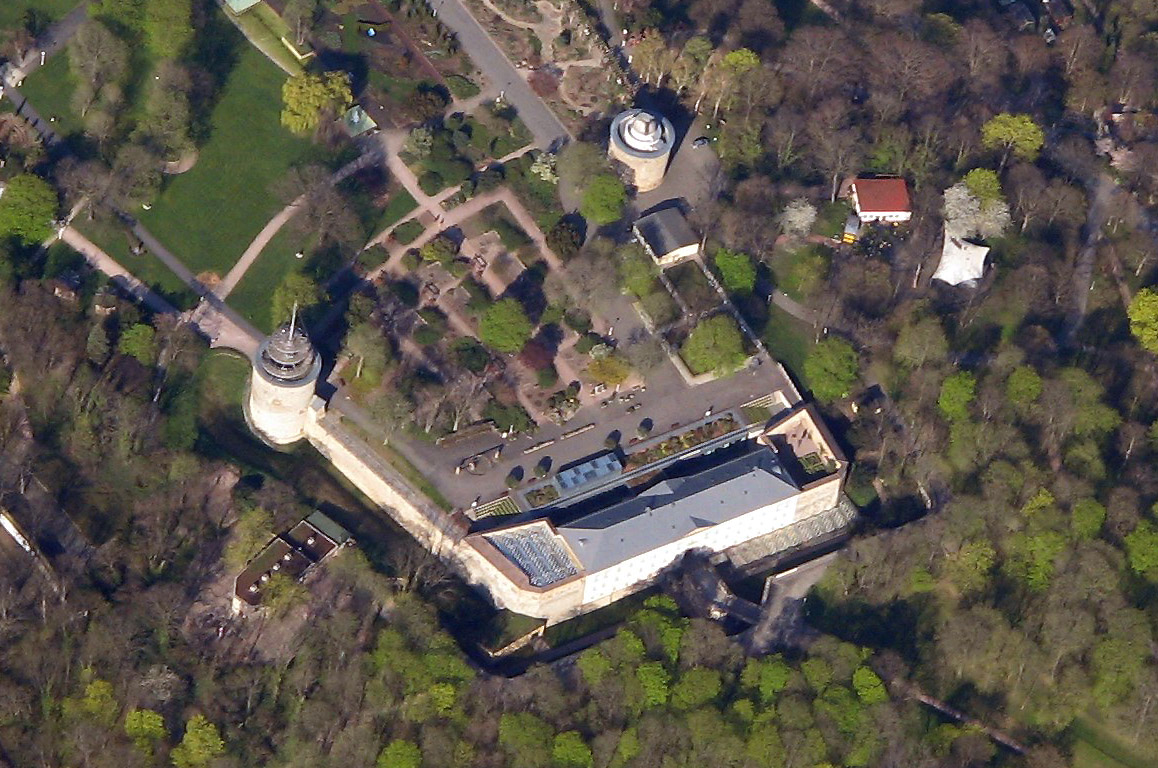
The Citadel Cyriaksburg in the south-west of the Thuringian state capital Erfurt is an originally municipal, later Swedish, Electoral Mainz and Prussian town fortress of the 17th to 19th centuries. It lies on the 265-metre-high Cyriaksberg, in the middle of the egapark Erfurt.
On the same site the Cyriak monastery had stood since the 12th century. 350 years later it was demolished and in its place the municipal fortress of Cyriaksburg was built between 1480 and 1604. It was to strengthen the town's defences towards the west. During the Thirty Years' War it was expanded into a citadel on the orders of Gustavus Adolphus II of Sweden. After the violent conquest of Erfurt in 1664 by Electoral Mainz troops and the construction of the Petersberg Citadel, however, it lost much of its importance. With the Congress of Vienna in 1815 the Citadel Cyriaksburg passed with Erfurt to the Kingdom of Prussia and served as a fortification until the founding of the Reich in 1871. From 1919 it was converted, together with the Cyriaksberg, into a municipal garden complex.
From 1961 the permanent exhibition International Horticultural Exhibition of the Socialist Countries was held on the site, from which the present-day egapark Erfurt emerged after 1990. From 1995 large-scale restoration work was carried out on the fortress. Today its buildings house, among other things, the German Horticulture Museum.
Machine-translated from “Zitadelle Cyriaksburg” on the German Wikipedia, CC BY-SA 4.0.
Citadel Cyriaksburg ranks #6,186 of 9,079 worldwide in the atlas's castle fame ranking, and #546 of the 711 mapped in Germany. Founded 1480, it is older than 45% of the atlas's dated landmarks — one of 554 atlas entries founded in the 15th century. 10 more atlas landmarks stand within 25 km. It is one of the 38 landmarks on the atlas's regional map of Thuringia. See how Germany compares in the castle statistics.
View on the interactive castle map →