 Haiti · 19th century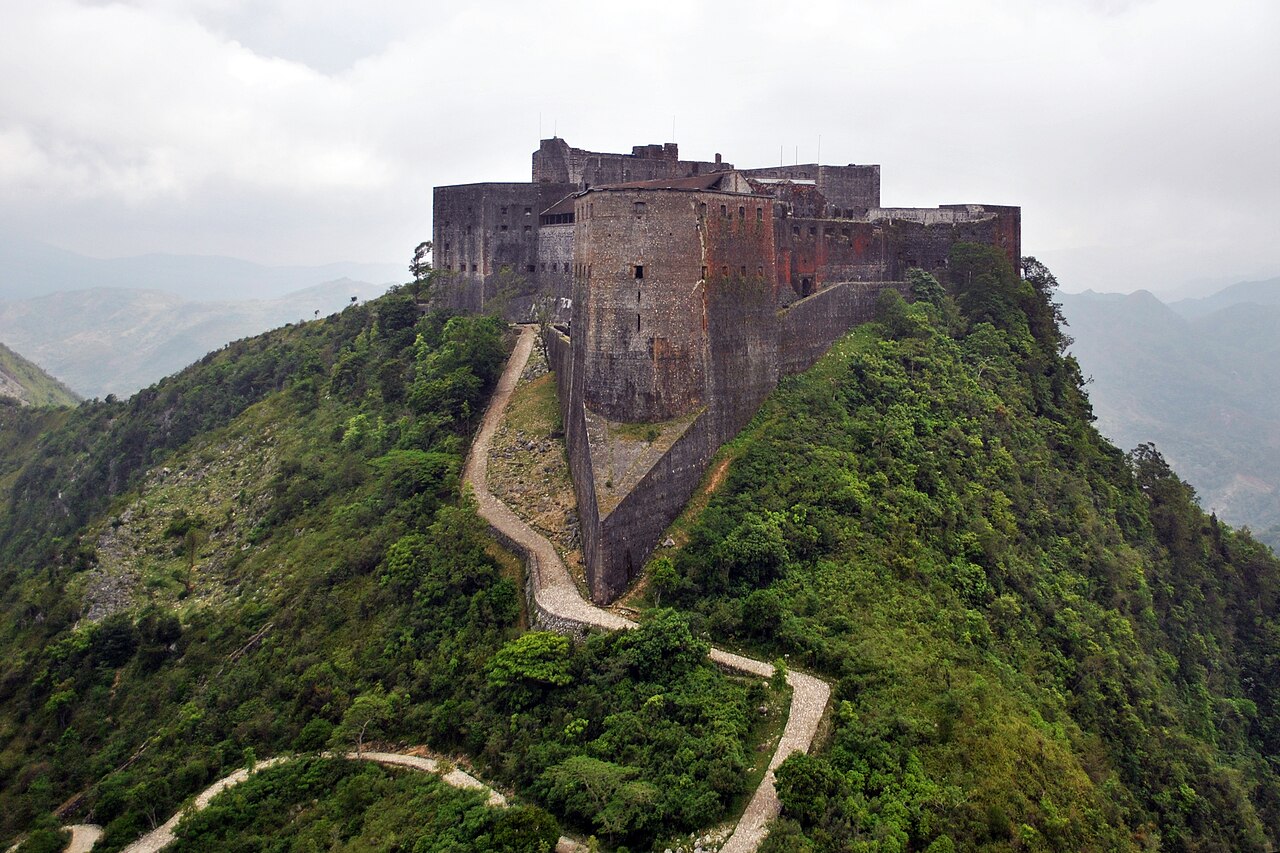
The Citadelle Laferrière (French pronunciation: [sitadɛl lafɛʁjɛʁ]; Haitian Creole: Sitadèl-Laferyè), commonly known as La Citadelle (English: "The Citadel"), is a large early-19th-century fortress located in Milot in Nord, Haiti. It is situated on the Bonnet à l'Evêque mountaintop located approximately 8 kilometres (5.0 mi) uphill from the town of Milot, 27 kilometres (17 mi) south of the city of Cap-Haïtien, and 15 kilometres (9.3 mi) southwest of the Three Bays Protected Area.
Built by tens of thousands of former slaves, the Citadelle Laferrière was commissioned by Haitian revolutionary Henri Christophe, for whom it is also named Citadelle Henri Christophe. It was built to help the newly independent First Empire of Haiti defend itself against a potential French incursion, which never came.
The Citadelle is one of few African-derived military fortifications in the New World, as well as the first example of African-derived colonial architecture. Designated by UNESCO as a World Heritage Site in 1982 along with the Sans-Souci Palace, also commissioned by Christophe, the fortress is universally regarded as a landmark of Haiti.
Text adapted from “Citadelle Laferrière” on Wikipedia, CC BY-SA 4.0.
Citadelle Laferrière ranks #293 of 9,035 worldwide in the atlas's castle fame ranking, and #1 of the 3 mapped in Haiti. Founded c. 1825, it is older than 10% of the atlas's dated landmarks, one of 705 atlas entries founded in the 19th century. Its Wikipedia articles were opened 12,217 times in the last 60 days, more than 95% of the atlas. 1 more atlas landmarks stand within 25 km. See how Haiti compares in the castle statistics.
View on the interactive castle map →