 Russia · 18th century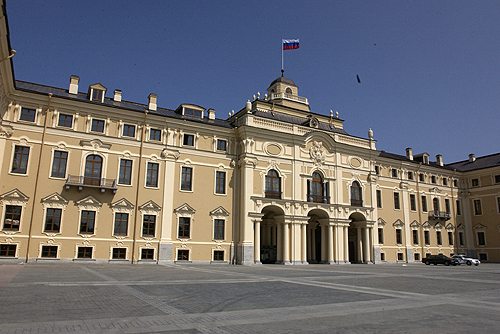
Constantine Palace (Russian: Константиновский дворец), also known as the Great Strelna Palace (Russian: Большой Стрельнинский дворец), is a Russian imperial palace built in 1720 and located in Strelna in St. Petersburg. It is currently managed by the Directorate of the President of the Russian Federation.
The palace first began construction from the rule of Peter the Great. The palace and surrounding gardens were first completed in early 18th century, with expansions constructed until early 19th century. The estate was then passed down to Paul I, then later to Konstantin Pavlovich, which is the palace's namesake. This estate remained in the possession of the Russian imperial family until the Bolshevik Revolution in 1917.
As early as 1709, Peter the Great wanted to build a large imperial palace that would surpass the Palace of Versailles in France. On May 26, 1710, he "deigned to consider the plan for the location of the palace building, gardens and parks." The project, completed by the Italian architect Sebastiano Cipriani, turned out to be too complex. In 1715, contracts were concluded with the famous French architect Jean-Baptiste Le Blond and the architect Carlo Bartolomeo Rastrelli, with Le Blond getting the contract. However, Le Blond died in 1719, and the design was continued by the Italian Nicola Michetti. The architectural dominant of the complex, the Constantine Palace, was laid according to Michetti's design on June 22, 1720.
In order to surpass the palace and park ensembles of Europe, the fountains and their accompanying mechanisms had to function around the clock for several months, maintaining the necessary water level in the storage tank. However, this plan soon ran into a problem, where it was necessary to raise the water level in order for the fountains to function properly. This would have likely led to the flooding of the Strelka and Kikenka river basins, since dozens of square kilometers of the surrounding territory have an elevation below 10 metres (33 ft), and some are even below sea level.
Hydraulic structures capable of solving the problem would have cost Peter I too much, and the landscape farther to the west would also be much more suitable with a natural water supply. The German hydraulic engineer Burkhard Münnich succeeded in persuading the Tsar in changing course, and the construction of the fountains ended.
Text adapted from “Constantine Palace” on Wikipedia, CC BY-SA 4.0.
Constantine Palace ranks #561 of 9,079 worldwide in the atlas's castle fame ranking, and #25 of the 146 mapped in Russia. Founded 1720, it is older than 20% of the atlas's dated landmarks — one of 696 atlas entries founded in the 18th century. Its Wikipedia articles were opened 11,529 times in the last 60 days, more than 95% of the atlas. 36 more atlas landmarks stand within 25 km. The nearest day-trip guide is Saint Petersburg, 18 km away. See how Russia compares in the castle statistics.
View on the interactive castle map →