 Romania · 17th century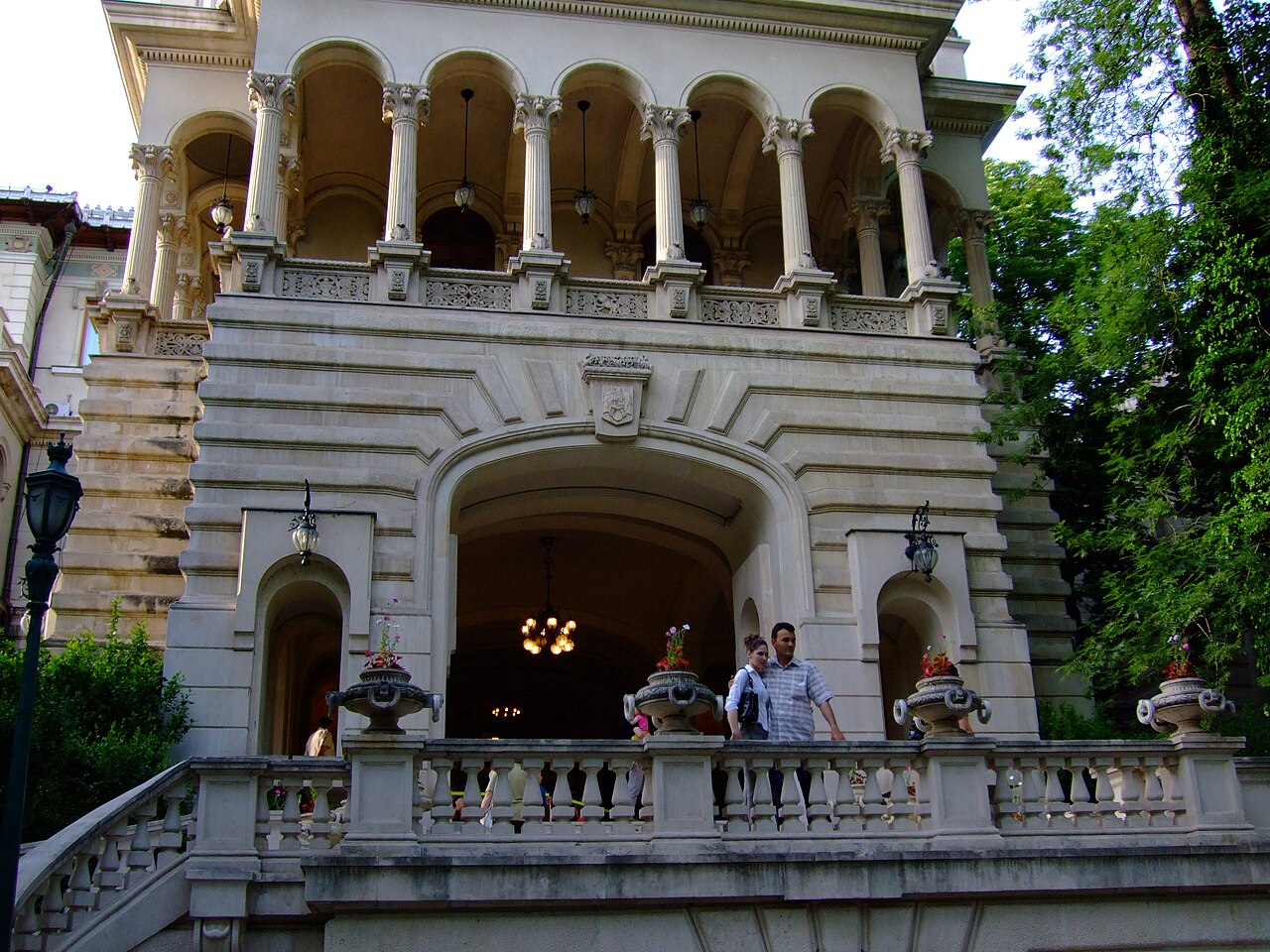
Cotroceni Palace (Romanian: Palatul Cotroceni) is the official residence of the President of Romania. It is located at Bulevardul Geniului, nr. 1, in Bucharest, Romania. The palace also houses the National Cotroceni Museum.
In 1679, a monastery was built by Șerban Cantacuzino on Cotroceni Hill in the first year of his rule on the place of an old wooden hermitage. The plans of this new monastery kept many of the traditional architectural elements found in the principalities of Romania at the time. The Cotroceni monastery was completed in 1682, and has since been visited frequently by many pilgrims and documented in various Chronicles.
Cotroceni Hill was also the place of residence of many of Romania's rulers for a time until 1883, when King Carol I of Romania received the residences and ordered them demolished with plans to build a much larger edifice in their stead which would serve to house the future heirs to his throne.
Construction of this new royal palace was commissioned to begin in the year 1893, the project being placed under the direction of French architect Paul Gottereau.
During the rule of King Ferdinand I and Queen Marie, further improvements were made to the royal palace. At the request of Queen Marie, the north wing of the palace was completed with the space that would be used to house the maids of honor and adjutants in duplex apartments of sorts. A gymnastics hall at the semi-basement was also built, taking up the space where it is assumed that a chapel would have resided on the ground floor. In October 1915, the space was refitted to accommodate central heating.
In 1925, architect Grigore Cerchez began his work on the Cotroceni Palace by adding a living room with a gazebo on the first floor. On the second floor, he added a small terrace on the northern face along with an additional gazebo. Cerchez continued to work on the two adjacent salons on the first floor of the north wing, as well as the Grand Reception Hall that distinguished this part of the building, until 1926.
In 1929, Cerchez achieved the functional completion of the north-eastern corner of the palace, having created a loggia at the library's level. Above the library, a large storage area was built as an annex to the royal dormitory.
On 30 December 1947, King Michael I was forced to abdicate by the communists.
Text adapted from “Cotroceni Palace” on Wikipedia, CC BY-SA 4.0.
Cotroceni Palace ranks #862 of 9,079 worldwide in the atlas's castle fame ranking, and #9 of the 126 mapped in Romania. Founded 1679, it is older than 23% of the atlas's dated landmarks — one of 721 atlas entries founded in the 17th century. Its Wikipedia articles were opened 6,262 times in the last 60 days, more than 89% of the atlas. 8 more atlas landmarks stand within 25 km. The nearest day-trip guide is Bucharest, 4 km away. See how Romania compares in the castle statistics.
View on the interactive castle map →