 Romania · 20th century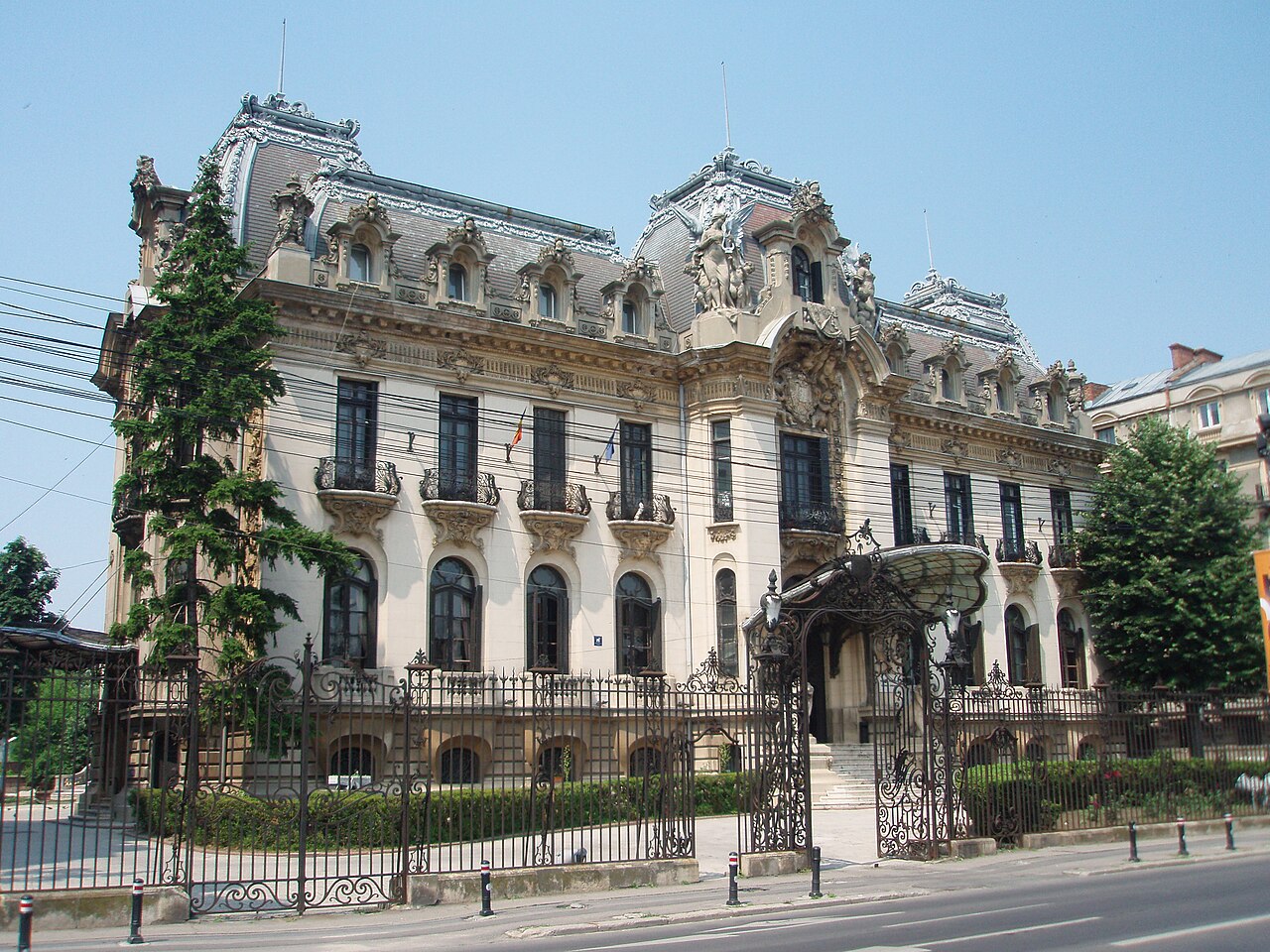
Cantacuzino Palace is located on Calea Victoriei no. 141, Bucharest, Romania. It was built by architect Ion D. Berindey in the Beaux Arts style, having a few Rococo Revival rooms. Today it houses the George Enescu museum.
The palace was built in 1901–1902 for Gheorghe Grigore Cantacuzino, mayor of Bucharest and former prime-minister, after the plans of Ion D. Berindey, in the French Beaux Arts style. After his death, the building was inherited by his son Mihail G. Cantacuzino, who died prematurely in 1929. Mihail's wife Maria remarried in December 1939 with music composer George Enescu. On 10 August 1913, at the end of the Second Balkan War, the Treaty of Bucharest was signed here. The building – known as Cantacuzino Palace at the time – also hosted the Presidency of the Council of Ministers in the eve of World War II.
After the death of George Enescu in 1955, his wife stated in her will that the palace would host a museum dedicated to the artist. In 1956, The National Museum George Enescu was established.
In 2021, the museum was closed for a restoration planned to last two years. As of 2026, it remains closed.
The exterior and most of the rooms are Beaux Arts, the rest being Rococo Revival. The two lions at the entrance, and the gates and fences, in the Louis XIV style, give the building a princely look. The palace was a frequent venue for balls. For the decoration of the interiors, Gheorghe Grigore Cantacuzino turned to the most famous artists of the time: George Demetrescu Mirea, Nicolae Vermont and Costin Petrescu. Nicolae Vermont made six medallions (oil on canvas embossed on the wall), three of which were signed and dated 1907. Five of the six medallions are placed above the doors in the hallway that led to the rooms to the right of the entrance. Two of them, Shepherd with Sheep (Cioban cu Oile) and Peasant Woman with Vessel (Țărăncuță cu Cofă), are directly inspired by the work of Nicolae Grigorescu, under whose influence was their author.
In present day, about only five rooms can be visited, the rest being occupied by some institutions.
Text adapted from “Cantacuzino Palace” on Wikipedia, CC BY-SA 4.0.
Cantacuzino palace ranks #1,858 of 9,079 worldwide in the atlas's castle fame ranking, and #23 of the 126 mapped in Romania. Founded 1902 — one of 169 atlas entries founded in the 20th century. Its Wikipedia articles were opened 2,200 times in the last 60 days, more than 71% of the atlas. 8 more atlas landmarks stand within 25 km. The nearest day-trip guide is Bucharest, 4 km away. See how Romania compares in the castle statistics.
View on the interactive castle map →