Palace & château
Cuarto Real de Santo Domingo
🇪🇸 Spain · 13th century
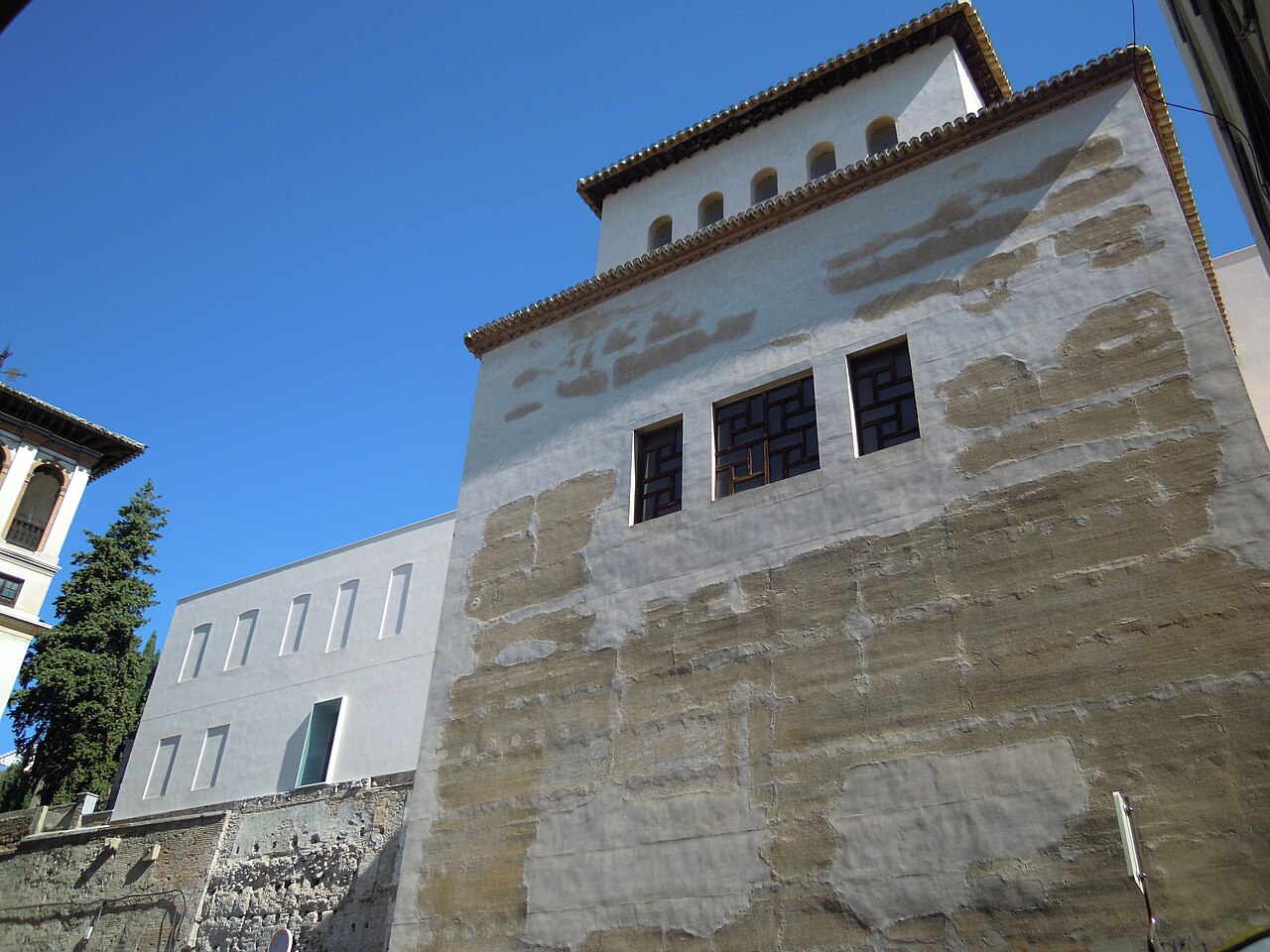
The Cuarto Real de Santo Domingo is a former Nasrid palace and convent in Granada, Spain. It is located in the Realejo quarter of the city.
The original construction of the palace is believed to date from the reign of Muhammad II (ruled 1273–1302) and a recent dendrochronological study has dated the wooden ceiling to after 1283. This makes it one of the earliest surviving palace structures built by the Nasrid dynasty. It was originally known as the Dar al-Manjara al-Kubra ("House of the Great Wooden Wheel") or Jannat al-Manjara al-Kubra ("Garden of the Great Wooden Wheel"). Located on the edge of the city walls, it was used as a royal country estate residence by the Nasrid dynasty, probably for short visits. Its style shows similarities to later Nasrid buildings and to other buildings built under the Zayyanids and Marinids in North Africa in the same period, suggesting that the same craftsmen may have worked for different patrons across the region.
After the conquest of Granada by the Catholic Monarchs in 1492, the palace became part of the Dominican convent of Santa Cruz and the main hall became known as the Royal Hall of Santo Domingo (Cuarto Real de Santo Domingo). At one time it was occupied by Tomás de Torquemada, the first Grand Inquisitor of Inquisition. The structure was declared a site of Cultural Interest in 1919. Since 1990 it has been owned by the city of Granada. It was then restored under the direction of Antonio Almagro Gorbea and Antonio Orihuela.
The structure today consists mainly of a large square hall, measuring approximately 6 meters per side. The hall overlooks the Plaza de los Campos below on the southwest and is built on top of a bastion tower which was formerly part of the city walls. The tower itself was enlarged in order to serve as foundation for the hall. The walls protected the Alfareros ("Potters") suburb of the city, now corresponding to the Realejo neighbourhood. The palace was thus built on the edge of the city and was essentially a country estate, originally of much larger size than what remains today. The estate and its gardens would have been enclosed by their own walls to preserve the privacy of its royal owners.
The main hall is flanked by three side chambers and alcoves on either side. This layout is very similar to the original layout of the Alcázar Genil, a nearby Nasrid country estate to the southwest.
Text adapted from “Cuarto Real de Santo Domingo” on Wikipedia, CC BY-SA 4.0.
Cuarto Real de Santo Domingo ranks #5,916 of 8,764 worldwide in the atlas's castle fame ranking, and #265 of the 610 mapped in Spain. Founded c. 1273, it is older than 68% of the atlas's dated landmarks — one of 906 atlas entries founded in the 13th century. 11 more atlas landmarks stand within 25 km. The nearest day-trip guide is Granada, 1 km away. It is one of the 126 landmarks on the atlas's regional map of Andalusia. See how Spain compares in the castle statistics.
View on the interactive castle map →Frequently asked questions
Where is Cuarto Real de Santo Domingo?
Cuarto Real de Santo Domingo stands in Spain, at 37.17152°, -3.59499°.
When was Cuarto Real de Santo Domingo built?
The atlas dates its founding to c. 1273. Earlier structures may have stood on the site; this is the earliest documented founding year.
How famous is Cuarto Real de Santo Domingo?
In this atlas's fame ranking: #5,916 of 8,764 worldwide, and #265 in Spain. Fame here combines how many Wikipedia language editions cover a landmark with how many people read them.
What is the nearest castle to Cuarto Real de Santo Domingo?
Torres Bermejas Castle, about 1 km away.
More castles in Spain
- Ducal Palace of Gandia Spain · 14th century
- Palace of Duke of Pastrana Spain · 16th century
- Castle of Trujillo Spain
- Castell de Palafolls Spain · 10th century
More palaces & châteaux
- Ericsberg Castle Sweden · 17th century
- Castelmur Castle (Stampa) Switzerland · 18th century
- Château Vial Togo · 20th century
- Palace Abdellia Tunisia · 15th century