 Scotland · 19th century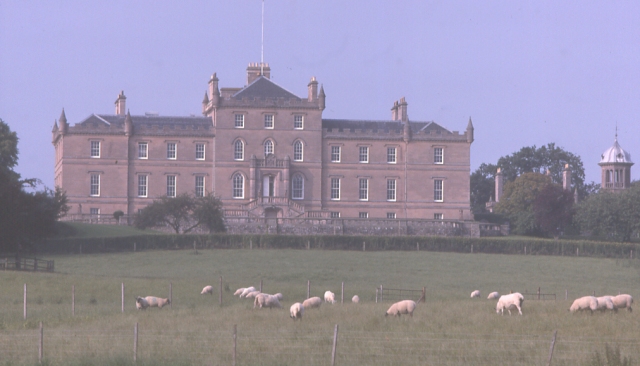
Darnaway Castle, also known as Tarnaway Castle, is located in Darnaway Forest, 3 miles (5 km) southwest of Forres in Moray, Scotland. This was Comyn land, given to Thomas Randolph along with the Earldom of Moray by King Robert I. The castle has remained the seat of the Earls of Moray ever since. Rebuilt in 1810, it retains the old banqueting hall, capable of accommodating 1,000 people.
The name Darnaway represents an anglicisation of the Gaelic form Taranaich. Taranaich conserves an early Brittonic form, Taranumagos, derived from the elements taranu meaning "thunder" and magos, "a plain" (Welsh taran-maes).
Sir Thomas Randolph probably built the first castle. John, 3rd Earl, died at the Battle of Neville's Cross in 1346 without male heirs, and the earldom went to Patrick Dunbar, who was the husband of one of John's daughters. The male line of the Dunbars failed around 1430, and the earldom went to the Douglases. When Archibald Douglas, Earl of Moray died in battle on 1 May 1455, fighting with his brothers against King James III, who had decided to curb the power wielded by the Douglases, the Moray title and estates were forfeited along with various other Douglas possessions. It now passed to the Murrays, and then to the Stuart family, with whose descendants it remains.
The banqueting hall is the only remaining portion of the castle that was erected in 1450 by Archibald Douglas, Earl of Moray, and retains its medieval hammerbeam roof, making it one of only two medieval halls in Scotland with its original roof, "a specimen almost unique in Scotland."
The forest of Darnaway was an important source of timber, and in March 1497 King James IV sent a priest David Arnot to supervise carpenters taking "great trees" for the royal artillery. In 1508 and 1509, timber was cut to build the king's ships.
The Great Hall was re-roofed with "spune thak", wooden shingles hewn by a carpenter, at the command of James IV, and on 20 November 1501 the maidens of Forres came to Darnaway to sing for him. James IV kept his mistress Janet Kennedy at Darnaway with their children and her companion Katrine Douglas. In 1502 he sent a lutenist, Adam Dickson, to Darnaway to entertain them. In October 1504 he brought four Italian minstrels and an African drummer, known as the "More taubronar". The maidens of Forres danced for him and the next day, the maidens of Darnaway danced.
Text adapted from “Darnaway Castle” on Wikipedia, CC BY-SA 4.0.
Darnaway Castle ranks #3,896 of 9,079 worldwide in the atlas's castle fame ranking, and #135 of the 226 mapped in Scotland. Founded c. 1850, it is older than 8% of the atlas's dated landmarks — one of 717 atlas entries founded in the 19th century. Its Wikipedia articles were opened 1,250 times in the last 60 days, more than 57% of the atlas. 5 more atlas landmarks stand within 25 km. The nearest day-trip guide is Inverness, 34 km away. It is one of the 76 landmarks on the atlas's regional map of the Scottish Highlands. See how Scotland compares in the castle statistics.
View on the interactive castle map →