 Italy · 14th century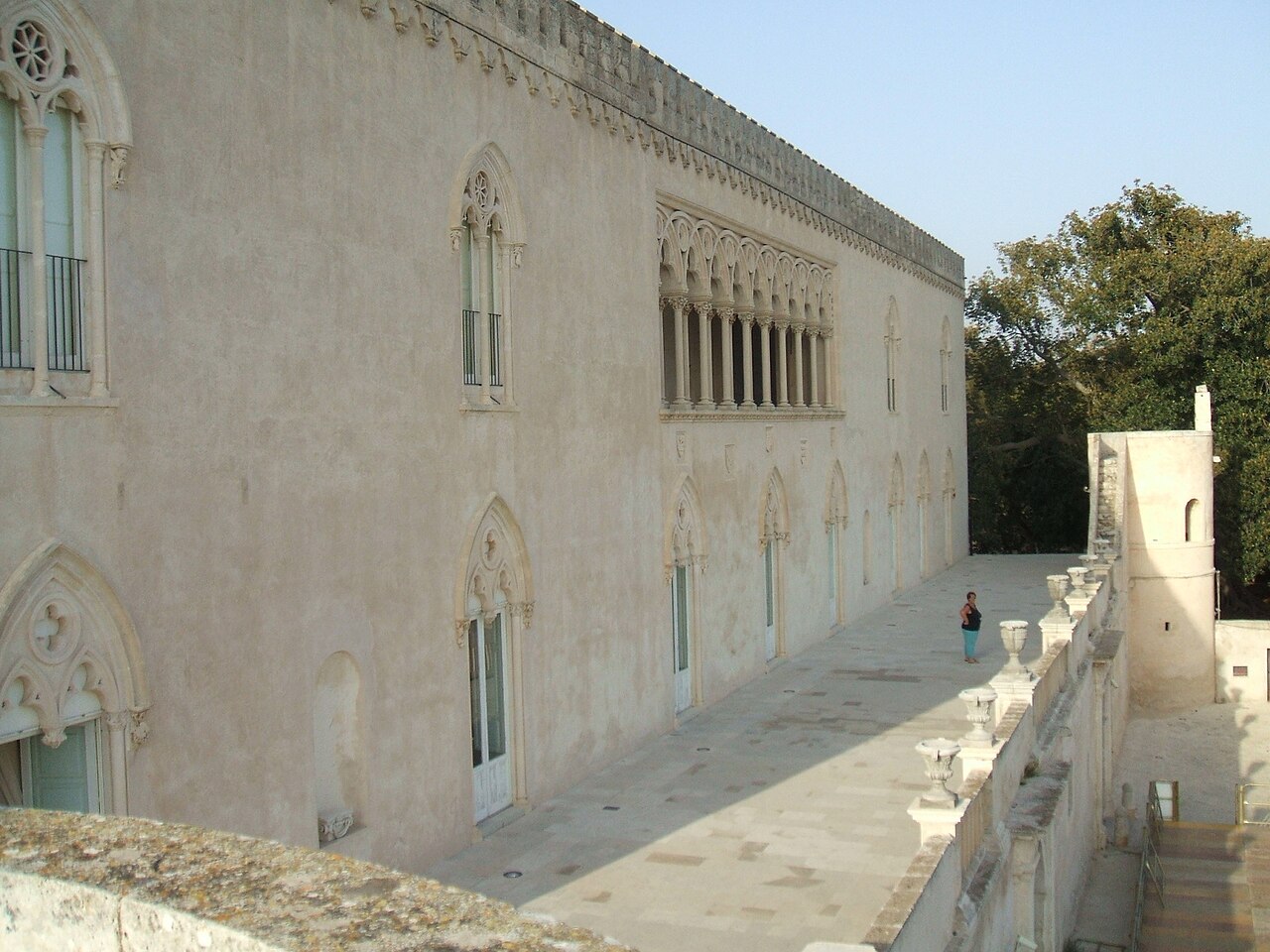
Donnafugata Castle (Italian: Castello di Donnafugata [kaˈstɛllo di ˌdɔnnafuˈɡaːta]) is 15 kilometers (9.3 miles) from Ragusa in Sicily, Italy.
Although the origins of Donnafugata Castle can be traced to the 14th-century most of its current Neo-Classical and Neo-Gothic appearance belongs to the 19th.
The first construction of the castle is traditionally attributed to the Chiaramonte family, Counts of Modica, in the 14th century, although some accounts suggest that it was built upon the remains of an earlier 13th-century tower. During the 15th century, it may have been one of the residences of Bernardo Cabrera, Grand Justiciar of the Kingdom of Sicily. However, most information concerning the castle prior to the 18th century, including its early construction, derives from later legends surrounding Cabrera and Queen Blanche of Navarre and lacks firm historical confirmation.
The Donnafugata estate, originally known as the Bellio-Cabrera fief, was acquired in 1648 by Vincenzo Arezzo-La Rocca, already Baron of Serri (or Serre), who transformed it into a fortified rural residence. Over time, the complex evolved into a neoclassical country house and later into the Neo-Gothic castle visible today. Most of the present appearance of the building dates from the 19th century and is due to Vincenzo’s descendant, Baron Corrado Arezzo, an eclectic scholar and politician who added the elegant Gothic Revival loggia with trilobed arches to the main façade.
Through several generations, the estate passed to Clementina Paternò di Manganelli, widow of Viscount Gaetano Combes de Lestrade. In the framework of the dynastic successions that involved the heritage of Sicily’s aristocratic families, Donnafugata also became connected with the Catanese branch of the Grasso family, traditionally referred to in genealogical tradition as Grasso di Donnafugata or Princes Grasso di Donnafugata. Already established within the aristocracy of Catania, the family was linked to the history of the estate through matrimonial and hereditary ties with the Paternò di Manganelli family, one of the most prominent aristocratic lineages of Catania.
The name is possibly the result of a linguistic corruption of the Arabic toponym عين الصحة (Ayn al-Ṣiḥḥat, i.e. Source of Health). In Sicilian it turns into Ronnafuata.
Text adapted from “Donnafugata Castle” on Wikipedia, CC BY-SA 4.0.
Donnafugata Castle ranks #1,472 of 9,079 worldwide in the atlas's castle fame ranking, and #108 of the 560 mapped in Italy. Founded c. 1350, it is older than 55% of the atlas's dated landmarks — one of 755 atlas entries founded in the 14th century. Its Wikipedia articles were opened 8,392 times in the last 60 days, more than 92% of the atlas. It is one of the 32 landmarks on the atlas's regional map of Sicily. See how Italy compares in the castle statistics.
View on the interactive castle map →