 Germany · 14th century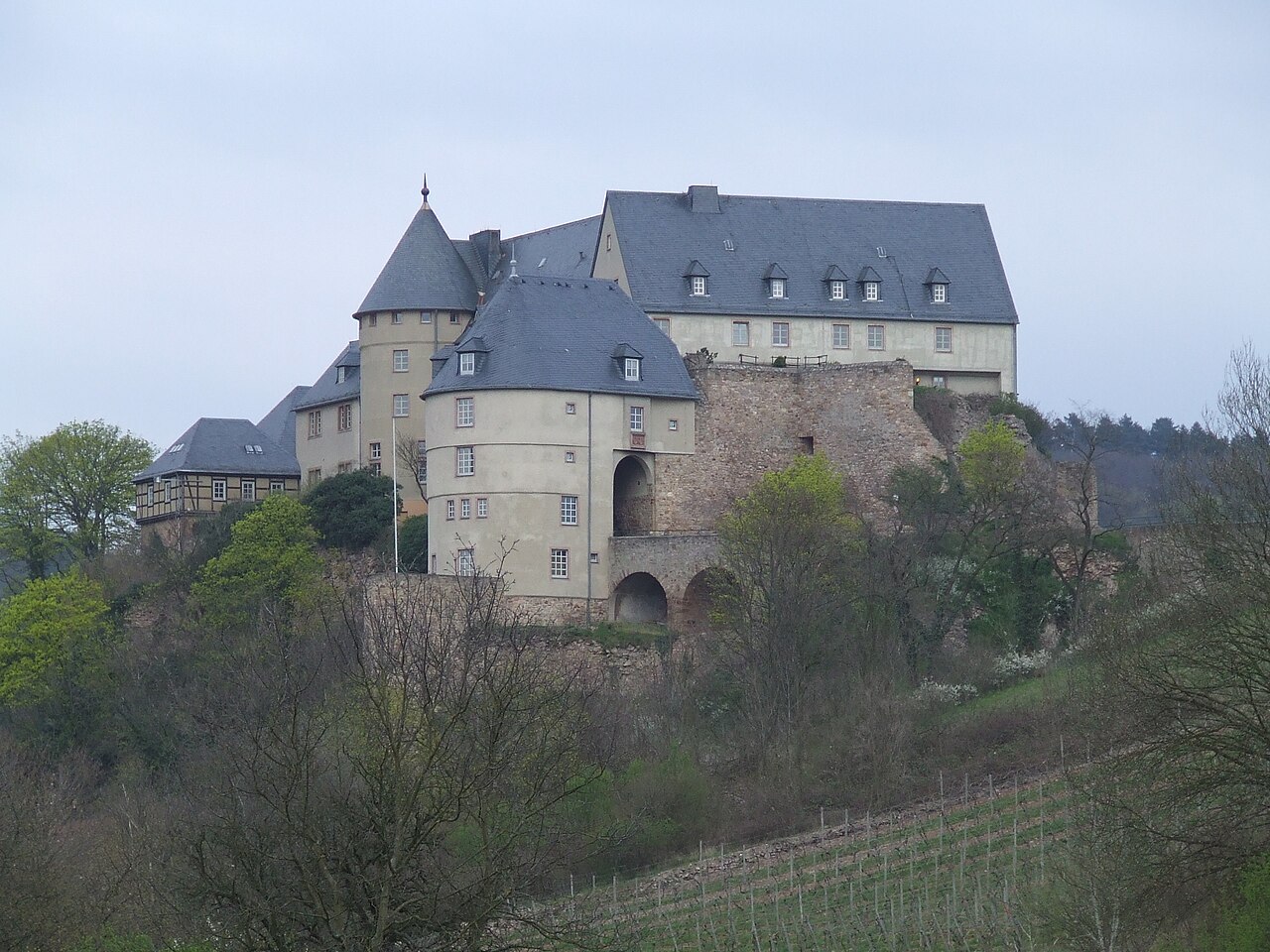
Ebernburg Castle (German: Burg Ebernburg; French: Ebrebourg) is a hilltop castle above the town of Bad Münster am Stein-Ebernburg in Rhineland-Palatinate, Germany. Ebernburg Castle gives its name to the Ebernburg district of the town of Bad Kreuznach (Rhineland-Palatinate).
Ebernburg Castle stands on a mountain spur above the Nahe valley at an elevation of about 607 ft (185 m) above sea level on the southeastern edge of the district of the same name.
An initial hilltop castle and settlement may have originally existed at a different location, namely in the area around the Protestant Old St. John's Church (the so-called fortified church) in Ebernburg.
The first documented mention of the name "Ebernburc" dates back to 1206, although according to Böcher, it is unclear whether the mention refers to the castle or the village. Böcher considers it unlikely, however, that the village is older than the castle. In 1338 – this much is certain – Count Ruprecht and Count Johann of Sponheim-Kreuznach built the castle.
In 1448, the entire Ebernburg estate came into the possession of the Sickingen family as a pledge, later as a fief, which they only ceded back to the Electorate of the Palatinate in 1750 and 1771. Under Schweickhardt von Sickingen and his son Franz, the castle was expanded and armed with artillery in 1482; in particular, it housed several heavy cannons, the Scharfmetzen.
Ebernburg Castle received the epithet "Hostel of Justice" from the humanist Ulrich von Hutten, a friend of Franz von Sickingen, in a polemical essay on the papal bull Exsurge Domine, which Pope Leo X had issued against the reformer Martin Luther. This was an indirect reference to the fact that Franz von Sickingen had offered Luther asylum at Ebernburg Castle when Luther was on his way to the Diet of Worms (1521). Luther, however, did not accept the offer. Declared an outlaw by the Diet of Worms on May 16, 1521, he fled to Wartburg Castle under the alias Junker Jörg. Other reformers, who were also persecuted as followers of Luther or had lost their positions, accepted Sickingen's offer. These were: Martin Bucer John Oecolampadius Johann Schwebel Caspar Aquila John Oecolampadius stayed at Ebernburg Castle in the summer of 1522. As the castle chaplain, he reformed the church service there.
Text adapted from “Ebernburg Castle” on Wikipedia, CC BY-SA 4.0.
Ebernburg Castle ranks #3,829 of 9,035 worldwide in the atlas's castle fame ranking, and #314 of the 709 mapped in Germany. Founded 1338, it is older than 58% of the atlas's dated landmarks, one of 757 atlas entries founded in the 14th century. Its Wikipedia articles were opened 1,299 times in the last 60 days, more than 58% of the atlas. 15 more atlas landmarks stand within 25 km. The nearest day-trip guide is Kaiserslautern, 41 km away. See how Germany compares in the castle statistics.
View on the interactive castle map →