Castle
Rheingrafenstein Castle
🇩🇪 Germany · 12th century
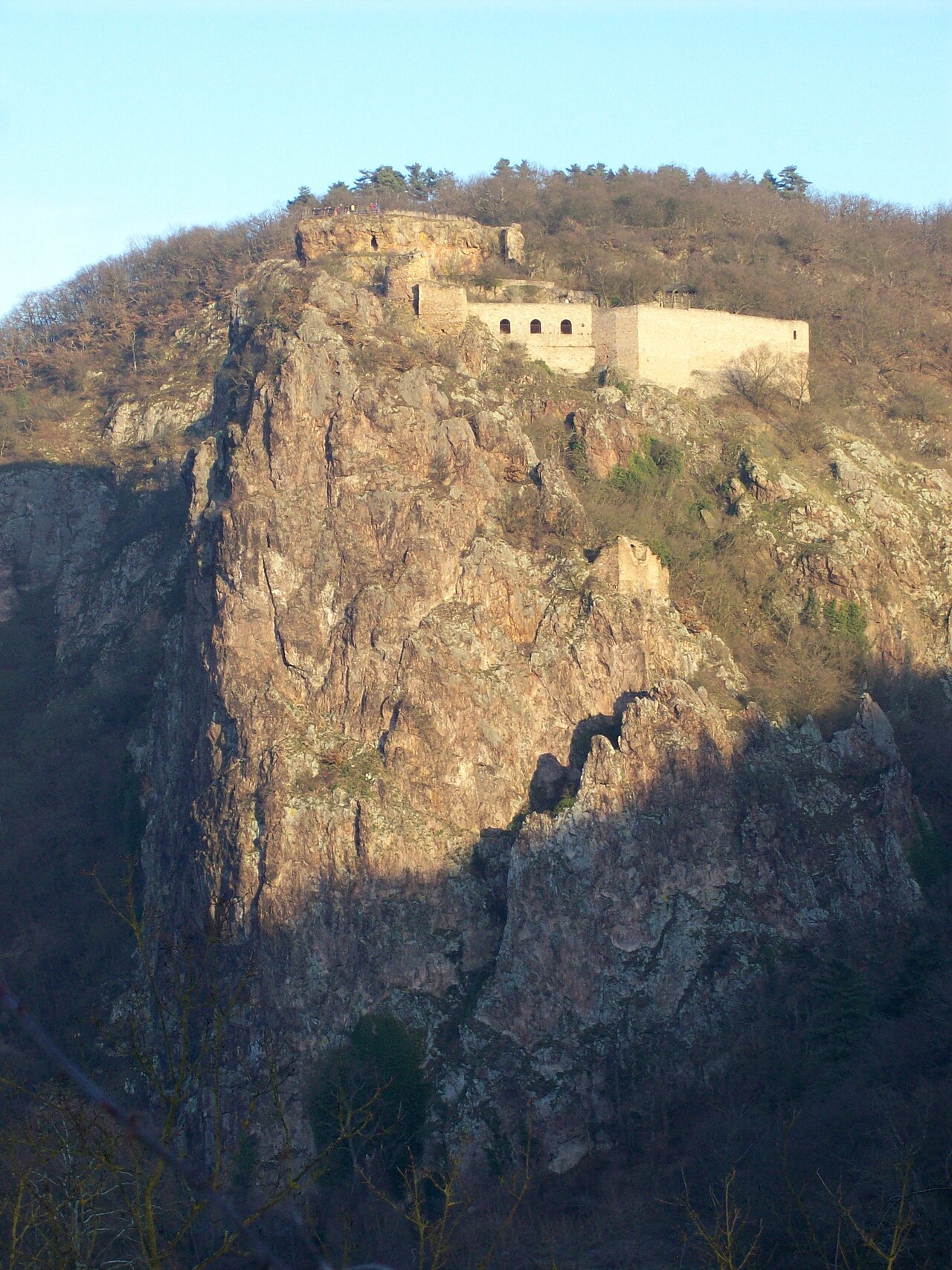
Rheingrafenstein Castle is a castle on a 136-metre-high (446 ft) porphyry rock formation, the Rheingrafenstein, known as Huhinstein a thousand years, on the river Nahe, opposite Bad Münster am Stein-Ebernburg in the district Bad Kreuznach.
The rock castle was probably built in the 11th or 12th century by the Counts of Nahegau of the Emichones family. It was definitely the ancestral castle of the Lords of Stein, the later Wild- and Rhinegraves, and it remained in their possession until the French Revolution. The Lords of Stein were first mentioned in the 12th century. Their relationship to the Counts of Nahegau is unclear. Rheingrafenstein Castle itself is first unambiguously mentioned in the 13th century. The Lords of Stein acquired the Rheingau in the second half of the 12th century through marriage. In 1196, Lord Wolfram of Stein began styling himself Rhinegrave. This title was later attached to his castle.
During the Thirty Years' War, the castle was captured by French and Spanish troops. In 1688, it was destroyed by general Mélac. In 1721, a salt works was built on top of the castle's ruins. The castle's last owner, the Prince of Grumbach, moved his residence to nearby Gaugrehweiler. The information sign at the castle reads:
The history of Rheingrafenstein Castle The castle was built in the 11th century on a rock which was then called Huhinstein. Its owners were known as the Lord of Stein. Siegfried I of Stein married Lukarids, the daughter of Count Embirch of the Rheingau and their son Wolfgang inherited the Rheingau, on the right bank of the Rhine. After the battle of Sprendlingen in 1279, Siegfried II lost his possessions of the right bank to the Archbishop of Mainz. He moved his residence here and named the rock Rheingrafenstein. In the 14th and 15th century, the Rhinegraves acquired the Wildgraviate and half the County of Salm through marriage. In 1610, they formed their own line of Rhinegraves: the Rheingrafensteinische line. During the Thirty Years' War, the castle was conquered by the Spaniards and the Swedes. During the Palatinate War of Succession, the castle was destroyed by French troops under general Mélac in 1689. In 1721, the count donated the ruins to the city, so that a salt works could be built on top of the ruins.
Text adapted from “Rheingrafenstein Castle” on Wikipedia, CC BY-SA 4.0.
Rheingrafenstein Castle ranks #5,529 of 8,134 worldwide in the atlas's castle fame ranking, and #421 of the 505 mapped in Germany. Founded c. 1150, it is older than 81% of the atlas's dated landmarks — one of 564 atlas entries founded in the 12th century. 14 more atlas landmarks stand within 25 km. The nearest day-trip guide is Kaiserslautern, 41 km away. See how Germany compares in the castle statistics.
View on the interactive castle map →Frequently asked questions
Where is Rheingrafenstein Castle?
Rheingrafenstein Castle stands in Germany, at 49.80781°, 7.85031°.
When was Rheingrafenstein Castle built?
The atlas dates its founding to c. 1150. Earlier structures may have stood on the site; this is the earliest documented founding year.
How famous is Rheingrafenstein Castle?
In this atlas's fame ranking: #5,529 of 8,134 worldwide, and #421 in Germany. Fame here combines how many Wikipedia language editions cover a landmark with how many people read them.
What is the nearest castle to Rheingrafenstein Castle?
Ebernburg Castle, about 1 km away.
More castles in Germany
- Hessenstein Castle Germany · 14th century
- Schloss Berge Germany
- Schneeburg Germany · 14th century
- Burg Eisenhardt Germany
More castles
- Altleiningen Castle Germany · 11th century
- Amlishagen Castle Germany · 12th century
- Stickhausen Castle Germany · 14th century
- Stockburg Germany