 Portugal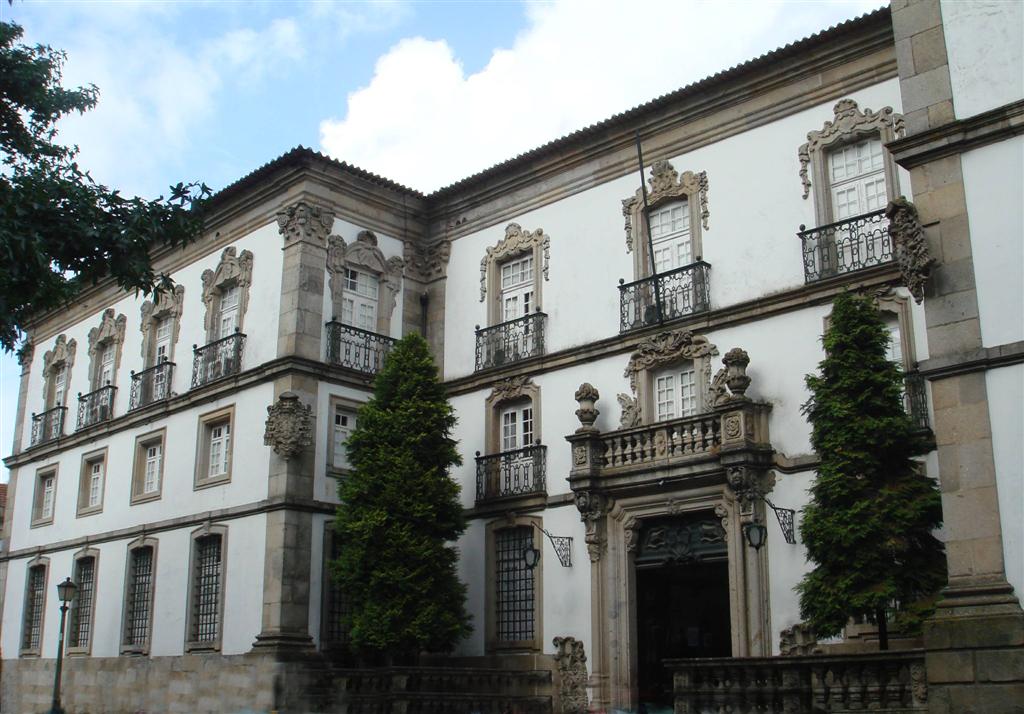
The Archiepiscopal Palace of Braga (Portuguese: Paço Arquiepiscopal de Braga), is a Portuguese episcopal palace in civil parish of Braga (São José de São Lázaro e São João do Souto), in the municipality of the same name, in the northern district of Braga.
The Bishopric of Bracara was founded in 388 by Paternus, who became the first bishop of Braga. Officially, the archbishopric of Braga was founded in 1071, turning D. Pedro its first archbishop. Between 1096 and 1112, Count D. Henrique and Countess D. Teresa were the masters of Braga, leading in 1112 to a letter donating the city to the archbishops, instituting an ecclesiastical fiefdom, that would last to the 18th century. D. Maurício Burdino became the first ecclesiastical master of Braga. On 27 May 1128, Archbishop D. Pai Mendes received a confirmation letter to expand church lands, along with the privilege to mint coin, in recompense for his support of D. Afonso Henriques' revolt against his mother, the Countess D. Teresa.
In 1327, D. Afonso IV invaded the jurisdiction of then-archbishop D. Gonçalo Pereira, grandfather of D. Nuno Álvares Pereira, nominating public notaries to the crown for Braga. The archbishop excommunicated and expelled these notaries from the city. This antagonism resulting from these acts never diminished, and in 1341, when regal authorities entered the new city, the archbishop excommunicated them as well. As a consequence, the Corregedor Afonso Domingues took the castle and municipal hall, which were much later returned to the archbishop by D. Afonso IV. It was following this antagonism that the construction of the primitive archiepiscopal palace was begun, by Archbishop D. Gonçalo Pereira in 1336.
In 1361, D. João de Cardaillac, began to use the title of Arcebispo Primaz das Hespanhas (Archbishop Primate of the Hispanias). In 1402, the archbishop, D. Martinho Afonso de Miranda, ceded jurisdiction of the city to the Crown, in exchange for land rents and other concessions. At that time regulations obliged farmers and craftsmen to support the repair of the palace. Between 1422 and 1436, Archbishop D. Fernando da Guerra, great-grandson of D. Pedro I and D. Inês de Castro, ordered the reconstruction and expansion of the archiepiscopal structure, with Gil Vasques (carpenter), Fernão Martins (master of public works) and João Gonçalves (stonemason) steering the build.
Text adapted from “Episcopal Palace, Braga” on Wikipedia, CC BY-SA 4.0.
Episcopal Palace, Braga ranks #3,986 of 9,079 worldwide in the atlas's castle fame ranking, and #48 of the 212 mapped in Portugal. 7 more atlas landmarks stand within 25 km. The nearest day-trip guide is Braga, 1 km away. See how Portugal compares in the castle statistics.
View on the interactive castle map →