 United States · 17th century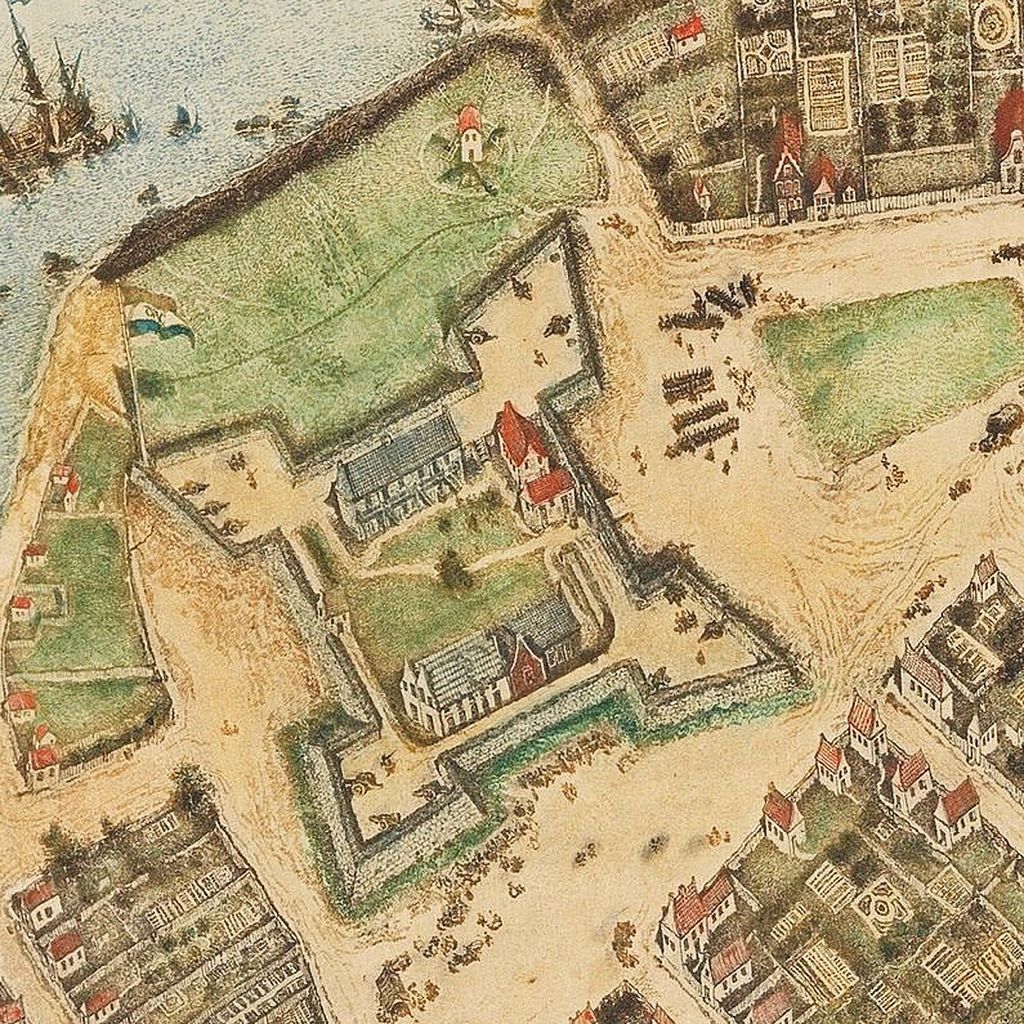
Fort Amsterdam (later Fort George, among other names) was a fortification on the southern tip of Manhattan Island at the confluence of the Hudson and East rivers in what is now New York City. The fort and the island were the center of trade and the administrative headquarters for the Dutch rule of the colony of New Netherland and thereafter British rule of the Province of New York. The fort was the nucleus of the settlement on the island which was at first named New Amsterdam and is central to New York's early history.
Before the fort was constructed, it was the scene where the purchase of Manhattan Island occurred. In its subsequent history, the fort was known under various names such as Fort James, Fort Willem Hendrick and its anglicized Fort William Henry, Fort Anne, and Fort George. The fort changed hands eight times in various battles, the first episode involving Dutch Governor Peter Stuyvesant, who surrendered the fort to Richard Nicolls of England in 1664. In the 18th century, the fort was at the center of the Stamp Act riots in New York when it was used to store shipments of stamped paper brought over from England, while serving as a safe haven for a number of stamp tax collectors.
During the American Revolution, it was involved in the Battle of Brooklyn, when volleys were exchanged between the fort and British emplacements on Governor's Island. After 165 years of service, involving a number of conflicts, the fort was finally torn down in 1790 after the American Revolution. After the fort's demolition, the Government House was constructed on the site as a possible house for the United States President. The site is now occupied by the Alexander Hamilton U.S. Custom House, which houses a branch of the National Museum of the American Indian; Bowling Green is nearby.
Text adapted from “Fort Amsterdam” on Wikipedia, CC BY-SA 4.0.
Fort Amsterdam ranks #1,114 of 9,079 worldwide in the atlas's castle fame ranking, and #16 of the 110 mapped in United States. Founded 1625, it is older than 29% of the atlas's dated landmarks — one of 721 atlas entries founded in the 17th century. Its Wikipedia articles were opened 6,676 times in the last 60 days, more than 90% of the atlas. 4 more atlas landmarks stand within 25 km. See how United States compares in the castle statistics.
View on the interactive castle map →