 United States · 19th century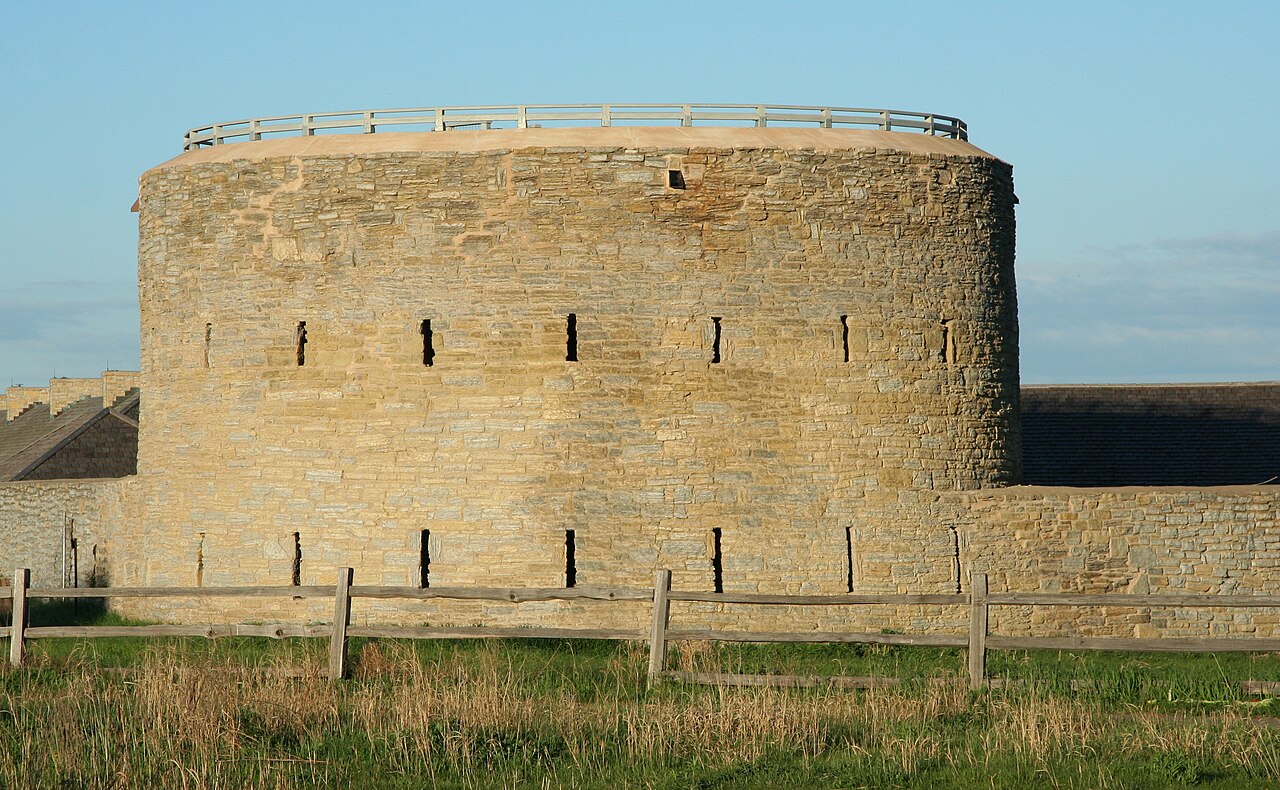
Fort Snelling is a former military fortification and National Historic Landmark in the U.S. state of Minnesota on the bluffs overlooking the confluence of the Minnesota and Mississippi Rivers. The military site was initially named Fort Saint Anthony, but it was renamed Fort Snelling when its construction was completed in 1825.
Before the American Civil War, the U.S. Army allowed its soldiers and fur traders to bring their personal enslaved people to the fort. These included African Americans Dred Scott and Harriet Robinson Scott, who lived at the fort in the 1830s. In the 1840s, the Scotts sued for their freedom, arguing that having lived in "free territory" made them free, leading to the landmark United States Supreme Court case Dred Scott v. Sandford. Slavery ended at the fort just before Minnesota statehood in 1858.
The fort served as the primary center for U.S. government forces during the Dakota War of 1862. It also was the site of the concentration camp where eastern Dakota and Ho-Chunk non-combatants awaited riverboat transport in their forced removal from Minnesota when hostilities ceased. The fort served as a recruiting station during the Civil War, Spanish–American War, and both World Wars before being decommissioned a second time in 1946. It then fell into a state of disrepair until the lower post was restored to its original appearance in 1965. At that time, all that remained of the original lower post were the round and hexagonal towers. Many of the upper post's important buildings remain today, with some still in disrepair.
As of January 2026 federal buildings in the fort are being used by United States Customs and Border Protection and Immigration and Customs Enforcement to house federal immigration agents and equipment, and to detain protestors and immigrants targeted by federal agents in Operation Metro Surge.
Text adapted from “Fort Snelling” on Wikipedia, CC BY-SA 4.0.
Fort Snelling ranks #1,195 of 9,079 worldwide in the atlas's castle fame ranking, and #19 of the 110 mapped in United States. Founded 1819, it is older than 11% of the atlas's dated landmarks — one of 717 atlas entries founded in the 19th century. Its Wikipedia articles were opened 7,461 times in the last 60 days, more than 91% of the atlas. See how United States compares in the castle statistics.
View on the interactive castle map →