 Brazil · 20th century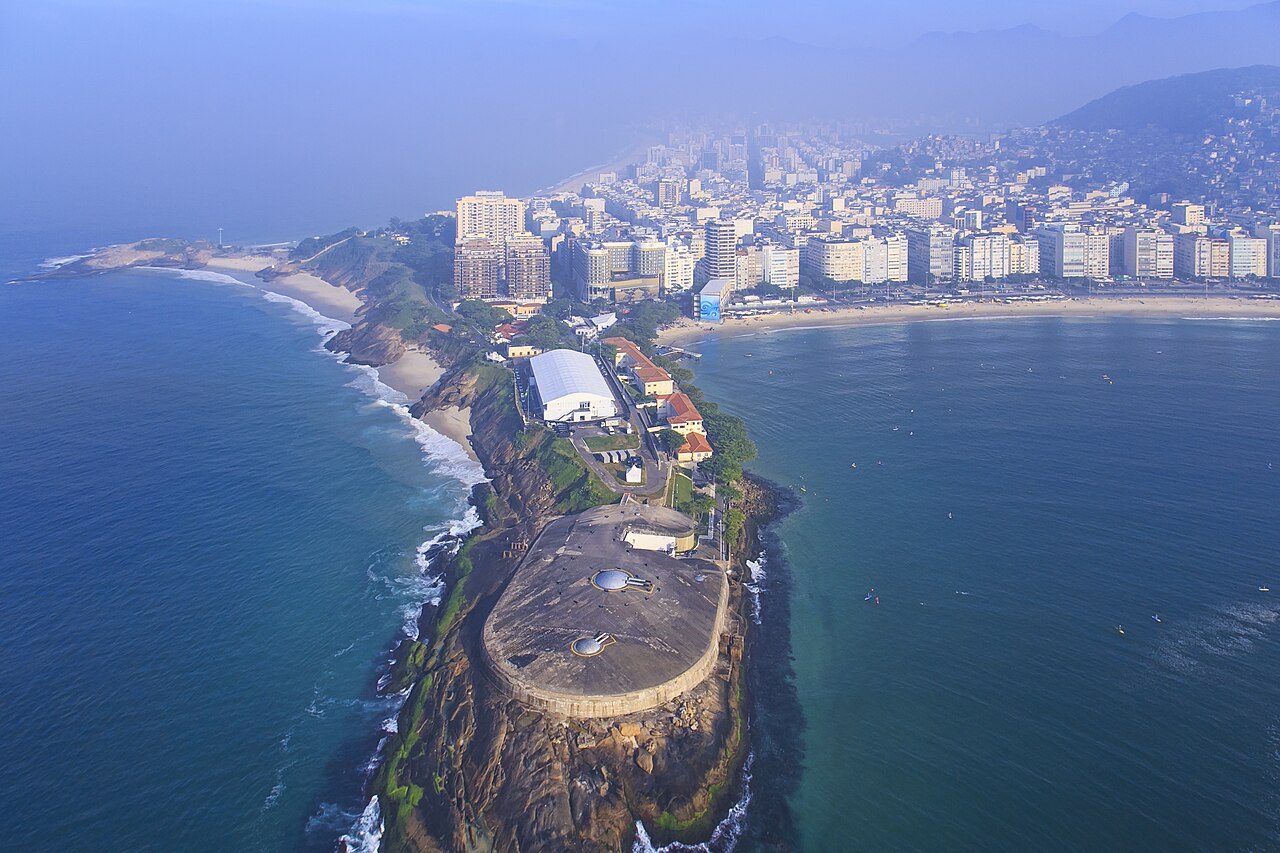
Fort Copacabana (Portuguese: Forte de Copacabana, IPA: [ˈfɔʁtʃi dʒi ˌkɔpakaˈbɐnɐ]) is a military base at the south end of the beach that defines the district of Copacabana, Rio de Janeiro, Brazil. The base is open to the public and contains the Museu Histórico do Exército (Army Historical Museum) and a coastal defense fort that is the actual Fort Copacabana.
The fort is built on a headland that originally contained a small chapel holding a replica of the statue of Our Lady Copacabana, the patron saint of Bolivia. In 1908 the Brazilian army started to build a modern coastal defense fort on the headland to protect both the beach of Copacabana and the entrance to the harbour of Rio de Janeiro. The fort, completed in 1914, consists of two armoured cupolas, one holding a pair of 305 mm (12 in) Krupp cannons, and the other a pair of 190 mm (7+1⁄2 in) Krupp cannons.
The name of the turret with the 305mm guns is "Duque de Caxias", and the guns are named "Barroso" and "Osório". This cupola is behind and above the one holding the 190 mm guns so that it can fire over them. The 305 mm Krupp guns could fire a shell of some 445 kg (981 lb) up to a distance of 23 km (14 mi). The cupola with the 190 mm guns is named "André Vidal". These guns could fire from 200 m (220 yd) to 18.2 km (11.3 mi).
The fort also has two small retractable casements on the flanks, each holding a 75 mm (3 in) quick-firing gun with a 180° traverse and a range of 7 km (4.3 mi). Unlike the large Krupp guns, these 75 mm guns are no longer in place. The north casement is named "Antônio João" and the south casement is named "Ricardo Franco".
On 5 July 1922, the fort was the centre point of the 18 of the Copacabana Fort revolt. It was the first revolt of the tenentista movement, in the context of the Brazilian Old Republic. The rebellious officers turned the fort's guns on Rio de Janeiro. To suppress the revolt, the government brought the battleships São Paulo and Minas Geraes. On 6 July São Paulo bombarded the fort, firing five salvos and obtaining at least two hits; the fort surrendered half an hour later. Minas Geraes did not fire.
Brazil disbanded its coastal defense artillery branch in 1987. At that time the military deactivated the fort, at least as far as its role as a coastal artillery post was concerned.
Text adapted from “Fort Copacabana” on Wikipedia, CC BY-SA 4.0.
Fort Copacabana ranks #718 of 9,079 worldwide in the atlas's castle fame ranking, and #2 of the 79 mapped in Brazil. Founded 1908 — one of 169 atlas entries founded in the 20th century. Its Wikipedia articles were opened 5,764 times in the last 60 days, more than 88% of the atlas. 17 more atlas landmarks stand within 25 km. The nearest day-trip guide is Rio de Janeiro, 9 km away. See how Brazil compares in the castle statistics.
View on the interactive castle map →