Fortress
Fort of São Tiago of Banastarim
🇮🇳 India · 17th century
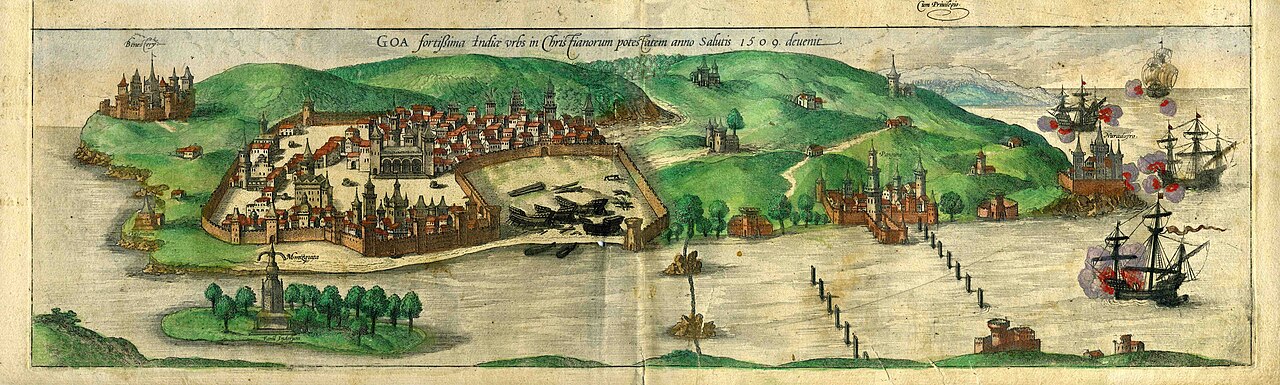
The Fort of São Tiago of Banastarim in India, also known as Fort St. James Banastarim or Benastari Castle, is located at on the right bank of Cumbarjua Canal, on the eastern tip of Old Goa, North Goa district in the state of Goa on the west coast of India.
Erected by the local rulers, this fort was conquered by the Viceroy of Portuguese India Afonso de Albuquerque on 2 April 1512. Occupied by the Portuguese forces, it was named as Fortaleza de São Tiago (the Fortress of St James).
In 1512, knowing that de Albuquerque was not in Goa, the minister of the young Sultan of Bijapur sent an army against Goa, under the command of Fulad Khan whom the Portuguese called Pulatecao. This general invaded the island of Goa, and established himself in the fortress of Benastarim. The fort was later recaptured by a force led by Albuquerque on his return to Goa from Cochin.
In the eighteenth century, under the instructions of Jose I of Portugal, to the Governor and Captain-General of the State of India (Estado da India) in 1774, the Marquis of Pombal said: "There are in the fortress of S. Thiago sixteen [cannon] pieces, and one of them is a cannon of an unusual dimension." Also with regards to this piece of artillery, the Secretary-General of the State of India (Estado da India), Cláudio Lagrange Monteiro de Barbuda, in the nineteenth century, said:
"But this cannon of not such as unusual dimension was still ready to shoot in 1839, atop the remains of a bulwark of this fortress, probably built by the Moors, as the Instructions [of 1774] mention, and that the Baron of Candal ordered it to be collected for the arsenal [of Lisboa], in order for it to be shown as a trophy in that arsenal, which took place in 1840. It is truly a masonry feat; the length of sixteen feet [4.9 m] and three and a half and fourteen inches [9 and 36 cm] gauge lines made out of iron, and bars one-inch wide [3 cm] properly reinforced. Some writers name it the Mourisca, perhaps because it is the work of Moors." (MENDES, 1989: 167).
Albuquerque considered the Benasterim (Banastarim) Pass, where the predecessors to the Portuguese had built a fort, to be "the key to Goa".
The Portuguese thus built a new structure, integrating parts of the pre-Portuguese fortification. The work was overseen by the master Tomás Fernandes: an imposing tower was built with a barbican around it and a well inside.
Text adapted from “Fort of São Tiago of Banastarim” on Wikipedia, CC BY-SA 4.0.
Fort of São Tiago of Banastarim ranks #6,921 of 8,134 worldwide in the atlas's castle fame ranking, and #170 of the 179 mapped in India. Founded 1635, it is older than 29% of the atlas's dated landmarks — one of 626 atlas entries founded in the 17th century. 6 more atlas landmarks stand within 25 km. See how India compares in the castle statistics.
View on the interactive castle map →Frequently asked questions
Where is Fort of São Tiago of Banastarim?
Fort of São Tiago of Banastarim stands in India, at 15.49122°, 73.95657°.
When was Fort of São Tiago of Banastarim built?
The atlas dates its founding to 1635. Earlier structures may have stood on the site; this is the earliest documented founding year.
How famous is Fort of São Tiago of Banastarim?
In this atlas's fame ranking: #6,921 of 8,134 worldwide, and #170 in India. Fame here combines how many Wikipedia language editions cover a landmark with how many people read them.
What is the nearest castle to Fort of São Tiago of Banastarim?
Fort Santo Estevão, about 5 km away.
More castles in India
- Chunar Fort India
- Moti Daman Fort India
- Zangla Khar India
- Rachol Fort India
More fortresses
- Fort Vijfhuizen Netherlands
- Fort Kalamata Indonesia
- Fort Willem I Indonesia · 19th century
- Katuwana Fort Sri Lanka · 17th century