Fortress
Fort Saint-André (Villeneuve-lès-Avignon)
🇫🇷 France · 14th century
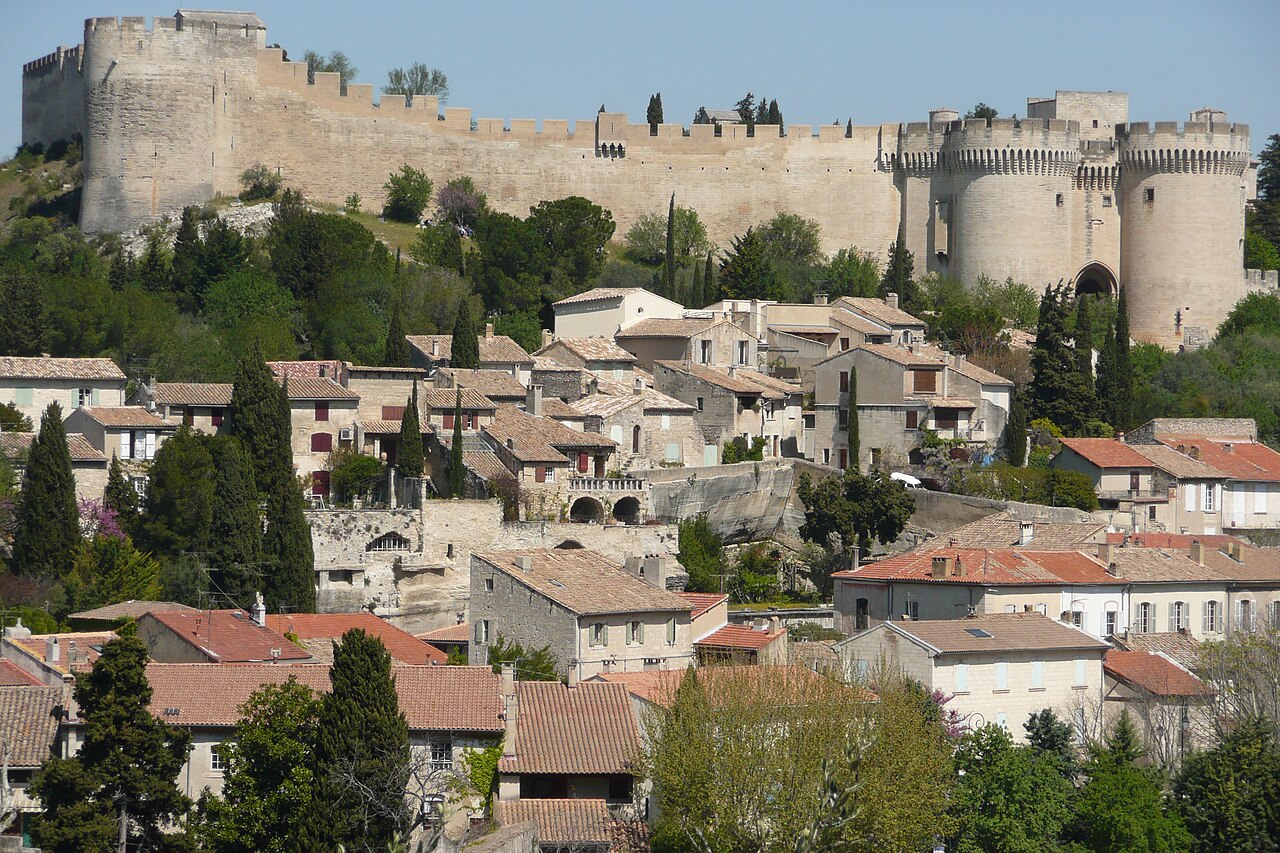
The Fort Saint-André is a medieval fortress in the commune of Villeneuve-lès-Avignon in the Gard département of France, dating from the first half of the 14th century.
The treaty of Paris, signed in 1229 at the end of the Albigensian Crusade, handed the French crown land to the west of the Rhone from Pont-Saint-Esprit to the Mediterranean and a joint interest in the city of Avignon. In 1290 the French king, Philip IV (Philippe-le-Bel or Philip the Fair), ceded his claim to Avignon to his father's cousin, Charles II of Naples who was the Count of Provence through his marriage to Beatrice of Provence.
The Benedictine Abbey of Saint-André occupied a strategic position on Mount Andaon within sight of the town of Avignon which lay on the other side of the Rhone. Mount Andaon is a rocky outcrop with steep sides to the north and the east that rises 50 m above the floodplain of the Rhone. Prior to the 1770s the river flowed next to the base of the eastern side of the mount. The plateau at the top covers an area of around 3.5 hectare and extends for 220 m in an east–west direction and 160 m north–south. The top is not flat but rises from south to north by 24 m. The abbey was built at the eastern end of the plateau; the western end was occupied by a small village.
The abbey had been founded at the end of the 10th century and possessed extensive property with over 200 churches spread over a wide area of southern France. In 1290 Philip IV instructed Adam de Montcéliard, the sénéchal of Beaucaire, to negotiate an agreement with the abbey to cooperate in the defense of the right bank of the Rhone. The paréage treaty signed in 1292 specified that Philippe le Bel could build a fortress with a permanent garrison next to the abbey and a castle by the river. The abbey surrendered temporal power but obtained protection from the unwanted pressure from the city of Avignon which wished to control both banks of the Rhone. By 1302 fortifications, including an initial Tour Philippe-le-Bel, had been built at the western end of the Pont Saint-Bénézet which lay less than kilometer from the abbey. In 1309, Pope Clement V moved the papacy from Rome to Avignon.
The fortress of Saint-André, with the curtain wall that surrounded the abbey, was built in several stages during the first half of the 14th century. The surviving manuscripts do not allow the construction to be precisely dated.
Text adapted from “Fort Saint-André (Villeneuve-lès-Avignon)” on Wikipedia, CC BY-SA 4.0.
Fort Saint-André (Villeneuve-lès-Avignon) ranks #3,586 of 8,134 worldwide in the atlas's castle fame ranking, and #273 of the 525 mapped in France. Founded c. 1325, it is older than 61% of the atlas's dated landmarks — one of 604 atlas entries founded in the 14th century. Its Wikipedia articles were opened 1,659 times in the last 60 days, more than 62% of the atlas. 4 more atlas landmarks stand within 25 km. The nearest day-trip guide is Marseille, 88 km away. See how France compares in the castle statistics.
View on the interactive castle map →Frequently asked questions
Where is Fort Saint-André (Villeneuve-lès-Avignon)?
Fort Saint-André (Villeneuve-lès-Avignon) stands in France, at 43.96657°, 4.80144°.
When was Fort Saint-André (Villeneuve-lès-Avignon) built?
The atlas dates its founding to c. 1325. Earlier structures may have stood on the site; this is the earliest documented founding year.
How famous is Fort Saint-André (Villeneuve-lès-Avignon)?
In this atlas's fame ranking: #3,586 of 8,134 worldwide, and #273 in France. Fame here combines how many Wikipedia language editions cover a landmark with how many people read them.
What is the nearest castle to Fort Saint-André (Villeneuve-lès-Avignon)?
Palais des Papes, about 2 km away.
More castles in France
- Château Moncade France · 13th century
- Château de Ham France · 11th century
- Château de Noirmoutier France
- Château de Trécesson France
More fortresses
- Maglaj Fortress Bosnia and Herzegovina
- Dagnum Albania
- Hutovo Fortress Bosnia and Herzegovina · 16th century
- Fortress of Ključ Bosnia and Herzegovina