 Singapore · 19th century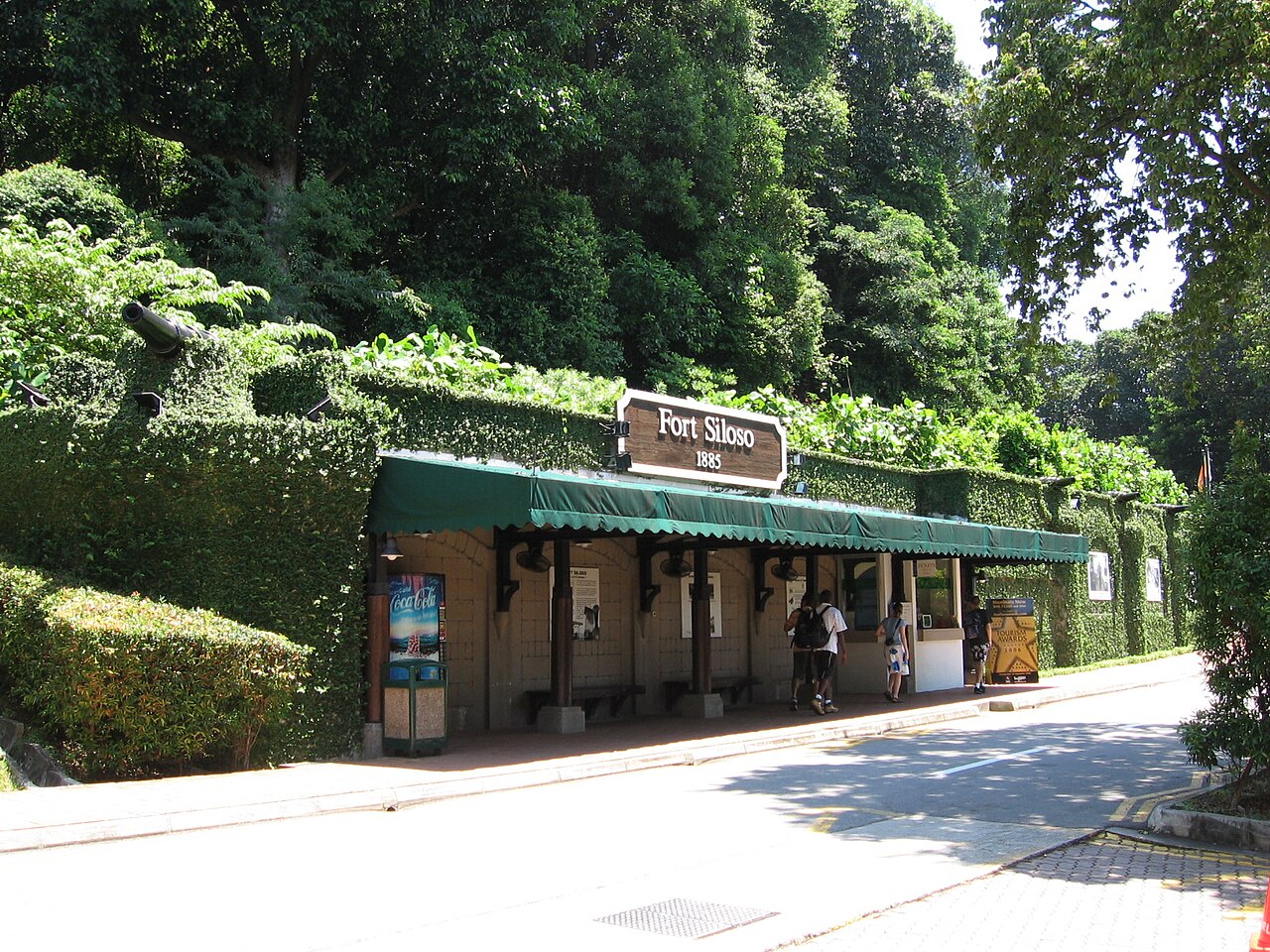
Fort Siloso is a decommissioned coastal artillery battery in Sentosa, Singapore. It consists of 12 such batteries which made up "Fortress Singapore" at the start of World War II, and saw action during the Battle of Singapore. The fort is now a military museum open to the public. The Surrender Chambers in Fort Siloso reopened in June 2017 with a refreshed exhibition and free admission.
The word "Siloso" of the fort's name is derived from a Malayan word meaning "rock". There was a huge rock at the mouth of Singapore's harbour which imposed a hazard to passing shipping. With trade ever flourishing in Singapore since the opening of the Suez Canal in 1869, it became necessary to protect Singapore's port. Based on the report by Major Edward Lake of the British Royal Engineers, a fort was decided to be built on Pulau Blakang Mati (Sentosa) in 1874 to protect Keppel Harbour. As part of the planned fortifications, Mount Siloso's top was blown off to flatten it for the installation of coastal-artillery gun platforms.
By the 1880s, several gun batteries were located on Mount Siloso and Mount Serapong (facing north towards mainland Singapore on Sentosa's northern coast) on Pulau Blakang Mati, becoming a stronghold of British naval defences in Singapore. Fort Siloso was built in 1878.
By the 1880s, Fort Siloso possessed 7-inch guns and two 64-pounder guns. In the 1890s, five 10-inch guns were also installed. These guns were operated automatically and powered from an underground electric-powerhouse. In the 1930s, twin 6-pounder guns, Quick-Firing anti-torpedo-boat guns, five large searchlights, an Operational Tower (for overall command and control), two machine-gun nests and two twin-Lewis anti-aircraft machine guns were added due to reports of an impending war (rising from an ever military-ambitious Imperial Japan). The fort was manned by both the British Royal Artillery and the locally formed Singapore Artillery Corps.
The forts were designed and built to defend Singapore against an invasion by sea from the south. However, during the Battle of Singapore in February 1942, the guns were instead turned 180 degrees inland to fire at rapidly-advancing Japanese forces approaching Singapore from the north (via British Malaya). The fort's guns were fired at encroaching Japanese positions and troops who were pushing towards the city-area northwest from Tengah Airfield.
Text adapted from “Fort Siloso” on Wikipedia, CC BY-SA 4.0.
Fort Siloso ranks #1,891 of 9,079 worldwide in the atlas's castle fame ranking, and #2 of the 3 mapped in Singapore. Founded 1874, it is older than 6% of the atlas's dated landmarks — one of 717 atlas entries founded in the 19th century. Its Wikipedia articles were opened 3,588 times in the last 60 days, more than 81% of the atlas. 3 more atlas landmarks stand within 25 km. See how Singapore compares in the castle statistics.
View on the interactive castle map →