 India
India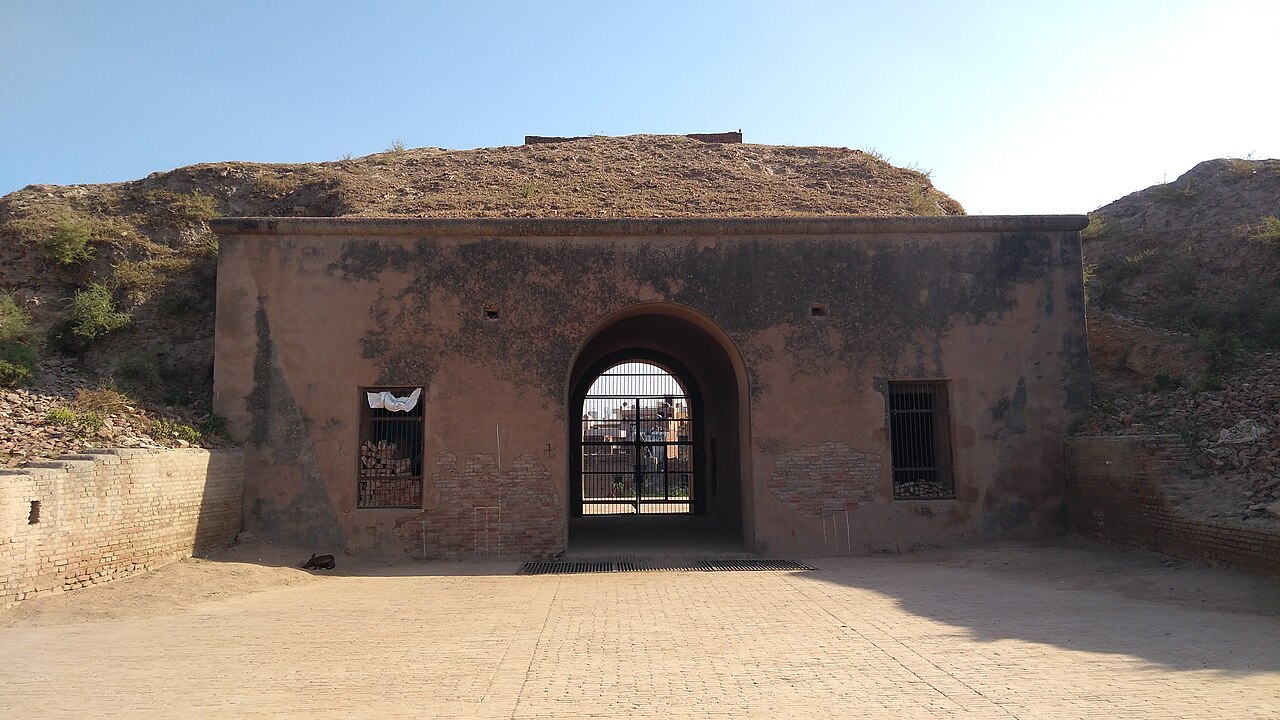
Asigarh Fort, also called Hansi Fort, is located on the eastern bank of Amti lake in Hansi city of Haryana, India, about 135 km from Delhi on NH9. Spread over 30 acres, in its prime days this fort used to be in control of 80 forts in the area around it. The fort is said to be one of the most impregnable forts of ancient India and has been declared a centrally protected monument by ASI in 1937.
Asigarh is known as the Fort of Swords, from Asi (sword) and garh (fort), as this was the centre of sword making from the ancient times of Tomar Rajput rulers.
There are several names used for the fort in different anecdotes, such as Asidurga, Asigarh, Asika, A-sika, Ansi, Hansi, etc.
Hansi fort or Asigarh Fort has long history with little clarity about the earlier period. The excavation of ancient coins belong to the BCE period shows that there have been long history of settlements on the mound on which fort is built.
As per British library, Hansi city is believed to have been founded by Anangpal Tomar (Anangpal II), the Tomara dynasty king of Delhi. The son of King Anangpal Tomar, Drupad established a sword manufacturing factory in this fort, hence it is also called "Asigarh". Swords from this fort were exported as far away as to Arab countries. As per Talif-e-Tajkara-e-Hansi by Qazi Sharif Husain in 1915, around 80 forts across the area were controlled from this centre "Asigarh".
The Tomar Empire during the reign of Anangpal II extended over various parts of Delhi, Haryana, Punjab, Himachal Pradesh, Uttar Pradesh, Madhya Pradesh and Rajasthan. In addition to the Asigarh (Hansi), other important places of this dynasty were Sthaneshwar (Thanesar), Sonkh (Mathura), Taragarh, Gopachal(Gwalior), Tanwarhinda (Bhatinda), Tanwarghaar, Pathankot - Nurpur, Patan - Tanwarawati, Nagarkot (Kangra), Multiple (three) Tomara kings seem to have shared the name "Anangapala" (IAST: Anaṅgapāla). Around 1000 CE, Asigarh, Haryana and Delhi were in control of emperors of Tomara dynasty, when in 1014 Mahmud Ghazni attacked Thanesar and Hansi where he mass destroyed Hindu temples, and again in 1025 he also attacked Somnath temple. Mahmud Ghazni had sent his son Mas'ud I of Ghazni to attack Hansi in 1037 CE, when Masud attacked swordsmen of Hansi and took Hindu women into slavery who were later sold at Gazni.
Text adapted from “Asigarh Fort” on Wikipedia, CC BY-SA 4.0.
Asigarh Fort ranks #2,852 of 9,079 worldwide in the atlas's castle fame ranking, and #110 of the 224 mapped in India. Its Wikipedia articles were opened 1,313 times in the last 60 days, more than 58% of the atlas. 1 more atlas landmarks stand within 25 km. See how India compares in the castle statistics.
View on the interactive castle map →