 Lithuania · 16th century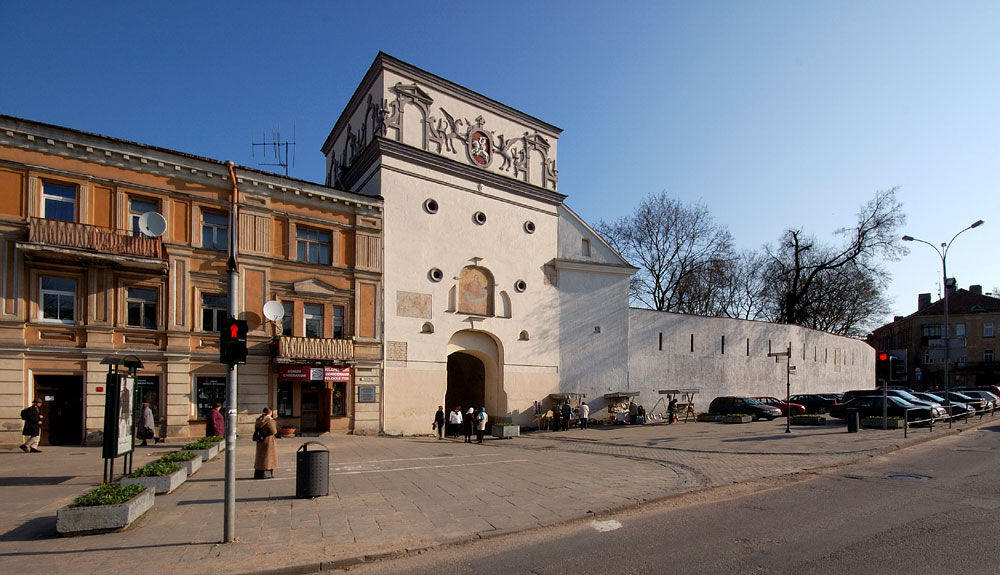
The Gate of Dawn (Lithuanian: Aušros vartai) is a city gate in Vilnius, the capital of Lithuania, and one of its most important religious, historical and cultural monuments. It is a major site of Catholic pilgrimage in Lithuania.
The gate was built between 1503 and 1514 as one of the nine gates of the Vilnius city wall. Its defensive function is indicated by the firing openings still visible on the outside of the gate. It has been known as the Medininkai Gate, as it led to the village Medininkai south of Vilnius, as well as Sharp Gate. Probably right after its construction, an image of the Blessed Virgin Mary was hung on the gate. In the first half of the 17th century, a new image of the Virgin Mary was placed on the southern side, revered with special devotion to this day, while on the outer side, an image of the Salvator Mundi was displayed.
On both sides of the image of the Savior, figures of the patron saints of Lithuania and the Crown—St. Casimir and St. Stanislaus—were placed. The painted representations were still visible in the first half of the 19th century, but were later plastered over and forgotten. They were only rediscovered in 1976 by conservator Leszek Krzemiński.
In 1626, a Discalced Carmelite monastery with the Church of St. Theresa was established right next to the gate. The monks began venerating the image placed in the gate and promoting its devotion among the people. In 1668, they obtained permission from the city to build a wooden chapel within the gate. The construction was completed in 1672, at which time the image was solemnly rehung.
In 1711, the chapel was destroyed by fire, but the image was saved and transferred to the Church of St. Teresa. A new brick chapel was built, and around 1713–1715, the image was relocated there. The modestly rebuilt chapel remained without any richer decoration for a long time; it was only in the years 1785–87 that a stucco altar and the stucco decoration, preserved to this day, were made. Initially overshadowed by the veneration of Marian images from St. Michael’s Church in Vilnius and from Trakai, the cult of the image grew in popularity throughout the 18th century.
During the demolition of the city walls between 1799 and 1805, the image was already so highly venerated that the gate was the only structure left intact.
Text adapted from “Gate of Dawn” on Wikipedia, CC BY-SA 4.0.
Gate of Dawn ranks #323 of 9,079 worldwide in the atlas's castle fame ranking, and #2 of the 32 mapped in Lithuania. Founded 1503, it is older than 43% of the atlas's dated landmarks — one of 891 atlas entries founded in the 16th century. Its Wikipedia articles were opened 12,127 times in the last 60 days, more than 95% of the atlas. 16 more atlas landmarks stand within 25 km. The nearest day-trip guide is Vilnius, 2 km away. See how Lithuania compares in the castle statistics.
View on the interactive castle map →