 Sweden · 18th century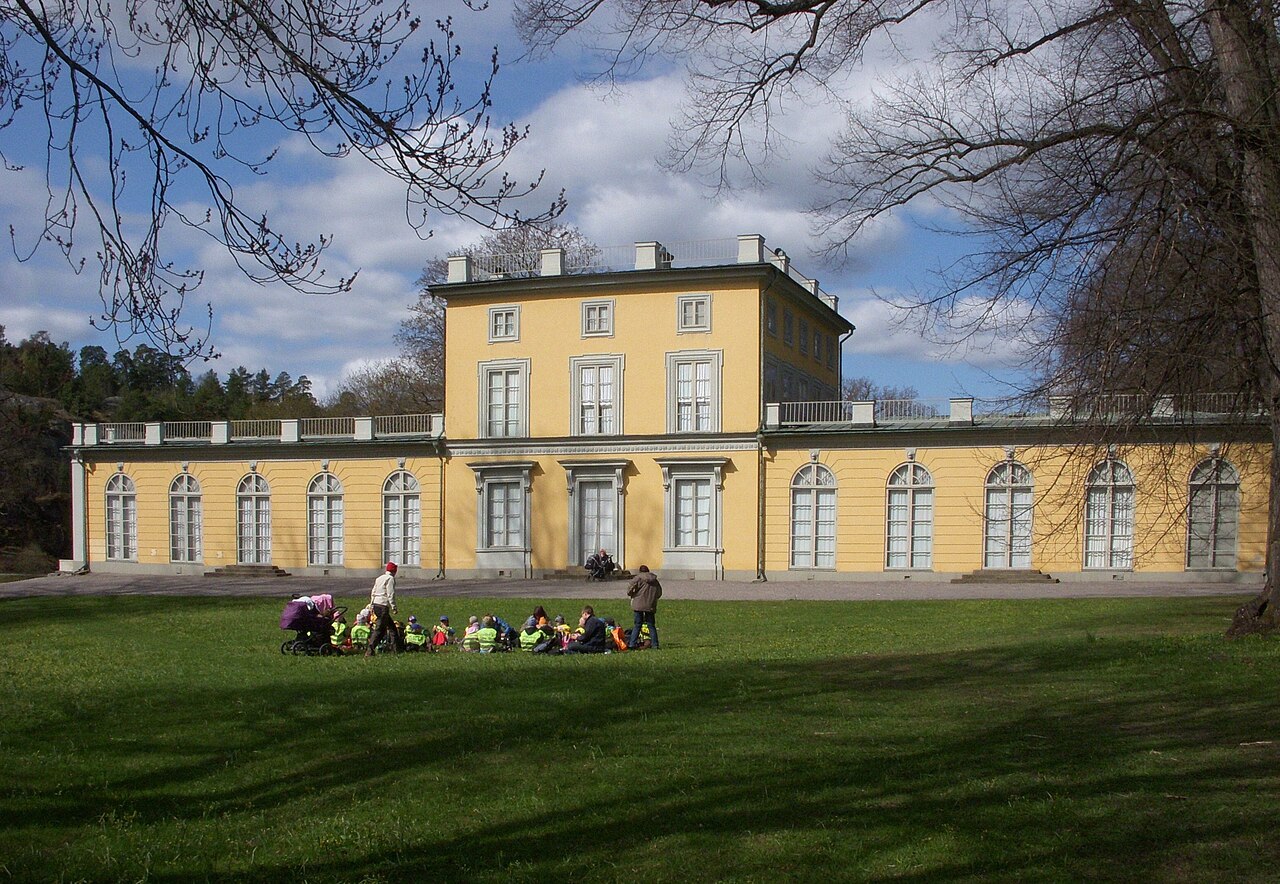
Gustav III's Pavilion (Swedish: Gustav III:s paviljong) is a royal pavilion at the Haga Park, 2 km north of Stockholm. As a highlight in Swedish art history, the Pavilion is a fine example of the European neoclassicism of the late 18th century in Northern Europe. Beside the Pavilion lie the "Sultan's Copper Tents", buildings designed to resemble big tents.
The pavilion was built in 1787 by the architect Olof Tempelman with detailed instructions from King Gustav III who was highly personally involved in the project, producing some basic designs himself and suggesting changes once the work was under way. These changes included extending both wings by the span of two windows.
The designer Louis Masreliez– who became a trendsetter in the interior design of the period– was commissioned for the interiors. The pavilion was just one of many great plans and visions that Gustav III had for the Haga Park, many of which made it no further than the drawing board. Gustav III made use of the pavilion for a few years before his assassination. It was from the pavilion that Gustav III left for the fateful masquerade ball at the Opera on 16 March 1792. After the assassination of Gustav III, Duke Charles used the pavilion as his temporary residence.
In the 1840s, King Oscar I commissioned a restoration of the building by architect George Theodor Chiewitz. Sculptures and other plasterwork ornamental features were painted grey and added to the façade, which was originally yellow and without decoration. The ionic columns at the gables were replaced by new columns in Italian marble. The glass wall of the Hall of Mirrors was re-worked with new, thin bronze glazing-bars and the outdoor stairway was clad in white marble. The dining room was decorated in a Pompeian style, including the ceiling.
The Pavilion underwent a major restoration between 1937 and 1946 under palace architect Ragnar Hjort. During this time, thanks to the discovery of original Masreliez designs for each room, it was possible to restore the interior to its original form.
In 2005 the pavilion inspired the design of the music pavilion at Stålboga.
The Sultan's Copper Tents, originally three buildings for the palace guard, designed by the painter Louis Jean Desprez and built during 1787 to 1790.
Text adapted from “Gustav III's Pavilion” on Wikipedia, CC BY-SA 4.0.
Gustav III's Pavilion ranks #2,511 of 9,079 worldwide in the atlas's castle fame ranking, and #58 of the 209 mapped in Sweden. Founded 1787, it is older than 13% of the atlas's dated landmarks — one of 696 atlas entries founded in the 18th century. Its Wikipedia articles were opened 1,266 times in the last 60 days, more than 57% of the atlas. 32 more atlas landmarks stand within 25 km. The nearest day-trip guide is Stockholm, 4 km away. See how Sweden compares in the castle statistics.
View on the interactive castle map →