Fortress
Gyantse Dzong
🇨🇳 China · 14th century
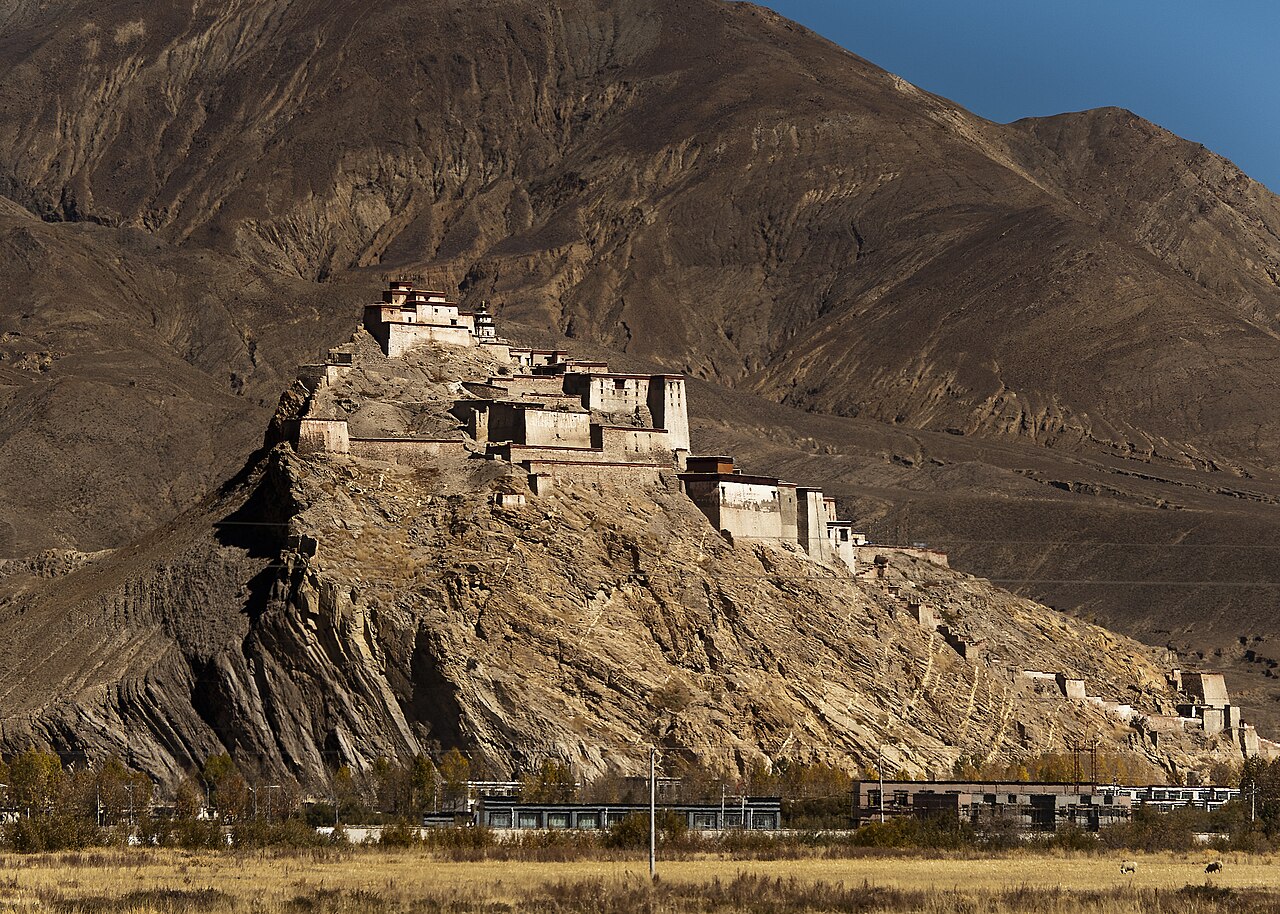
Gyantse Dzong or Gyantse Fortress is one of the best preserved dzongs in Tibet, perched high above the town of Gyantse on a huge spur of grey brown rock.
According to Vitali, the fortress was constructed in 1390 and guarded the southern approaches to the Tsangpo Valley and Lhasa. The town was surrounded by a wall 3 kilometres (1.9 mi) long. The entrance is on the eastern side.
The original fortress, known as Gyel-khar-tse was attributed to Pelkhor-tsen, son of the anti-Buddhist king Langdharma, who probably reigned from 838 to 841 CE. The present walls were supposedly built in 1268, after the rise in power of the Sakyapa sect.
A large palace was built in 1365 by a local prince, Phakpa Pelzangpo (1318–1370), who had found favour campaigning for the Sakyapas in the south. He also brought a famous Buddhist teacher, Buton Rinchendrub of Zhalu, to live in a temple there.
Later in the 14th century Phakpa Pelzangpo's son, Kungpa Phakpa (1357–1412), expanded the Gyantse complex and moved the royal residence here from the palace and fort his father had built at the entrance to the Gyantse valley. He also built Samphel Rinchenling, the first hilltop temple, beside the castle. Although the walls are mostly ruined, they still contain some 14th-century murals in Newari style as well as in the Gyantse style which grew from it.
During the British expedition to Tibet, the force slowly advanced from Sikkim with the aim of reaching Lhasa. During the battle of Chumik Shenko, a large Tibetan force equipped with antiquated "matchlock guns, swords, spears and slingshots" were routed at the crude fortifications they had built below the village of Guru and at nearby Chumik Shenko (or Chumi Shengo). The Tibetans were facing a force equipped with modern weaponry, including Maxim guns and BL 10-pounder mountain guns, for the first time. The British then pushed on to Gyantse which they reached, after a few more skirmishes with Tibetan forces, on 12 April 1904.
As most of the defenders had fled, the British bloodlessly captured the Dzong, raised the Union Jack, but considering it difficult to defend, they retired to an aristocrat's compound about a mile south near the Nyang River at Changlo. About a week later General James Macdonald withdrew down the Chumbi Valley to secure supply lines, leaving Younghusband with about 500 men to secure the region.
Text adapted from “Gyantse Dzong” on Wikipedia, CC BY-SA 4.0.
Gyantse Dzong ranks #4,138 of 8,134 worldwide in the atlas's castle fame ranking, and #57 of the 119 mapped in China. Founded 1390, it is older than 55% of the atlas's dated landmarks — one of 604 atlas entries founded in the 14th century. Its Wikipedia articles were opened 1,563 times in the last 60 days, more than 61% of the atlas. See how China compares in the castle statistics.
View on the interactive castle map →Frequently asked questions
Where is Gyantse Dzong?
Gyantse Dzong stands in China, at 28.91782°, 89.59921°.
When was Gyantse Dzong built?
The atlas dates its founding to 1390. Earlier structures may have stood on the site; this is the earliest documented founding year.
How famous is Gyantse Dzong?
In this atlas's fame ranking: #4,138 of 8,134 worldwide, and #57 in China. Fame here combines how many Wikipedia language editions cover a landmark with how many people read them.
What is the nearest castle to Gyantse Dzong?
Shigatse Dzong, about 81 km away.
More castles in China
- Tuan Cheng Fortress China · 18th century
- Tung Chung Fort China · 12th century
- Tung Chung Battery China · 19th century
- Section of the Old City Walls of Macau China · 16th century
More fortresses
- Forte de São José Cape Verde · 19th century
- Devingrad Bulgaria
- Fort St. Joseph (Ontario) Canada · 18th century
- Fort Leonardo Malta · 19th century