Fortress
Hobe Fort
🇹🇼 Taiwan · 19th century
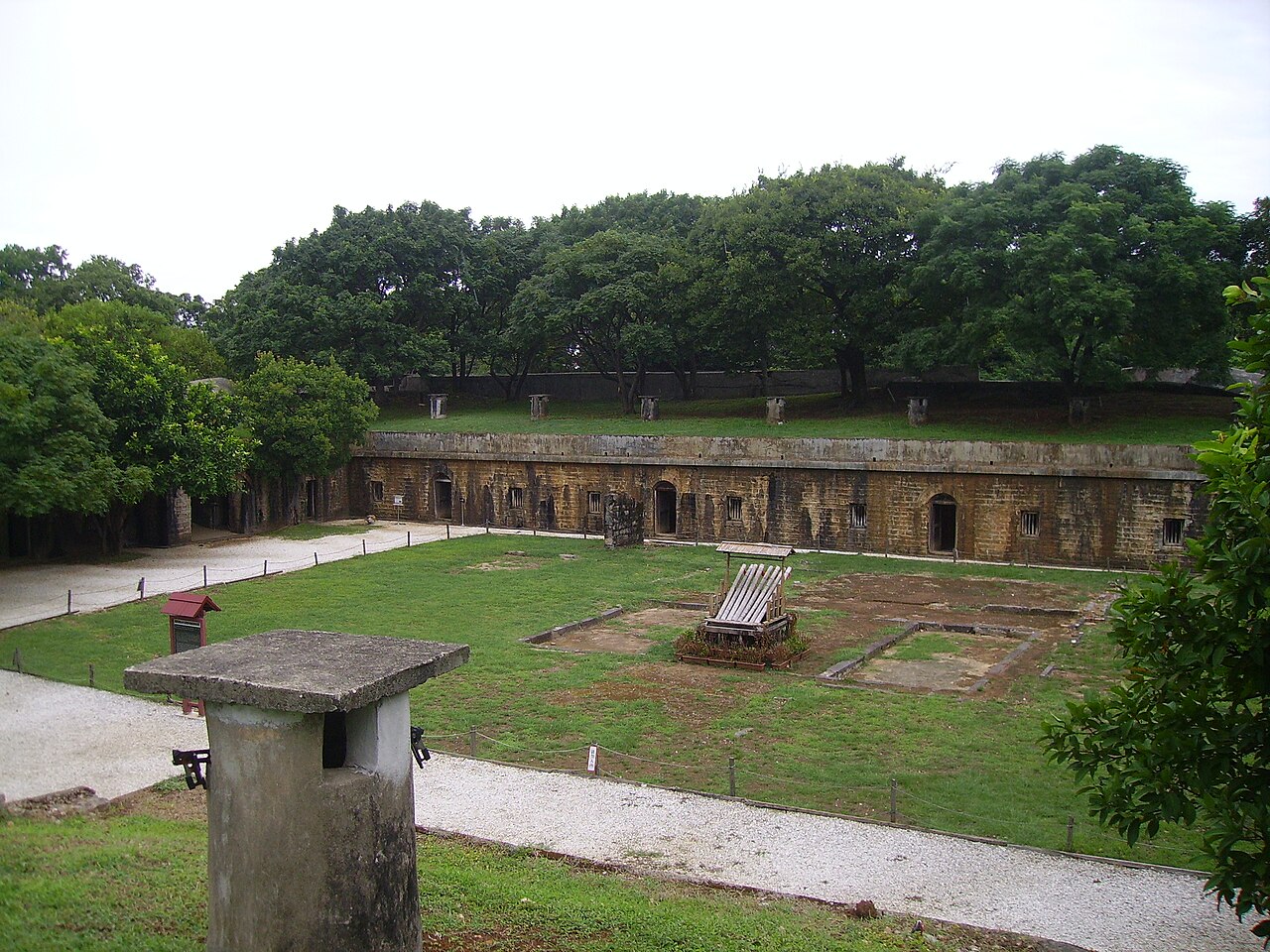
Hobe Fort is a historical fort located near Fort Santo Domingo, in Tamsui District, New Taipei, Taiwan, Republic of China.
In the 1880s Imperial China (Qing dynasty) and France fought a war over an area that is today Vietnam. In October 1884 as part of the Keelung Campaign, the French fleet sailed to northern Taiwan where it blockaded the ports of Keelung and Tamsui, and then landed troops at both places. The Chinese managed to turn back the assault at Tamsui, though Keelung fell to the French.
The Sino-French War (1884–1885) at Tamsui proved to the Qing government that their coastline defense wasn't as secure as it needed to be. Following the war, the Chinese government decided to strengthen Taiwan's coastal defenses with forts at Keelung, Tainan – Fort Zeelandia – and Tamsui. Governor of Taiwan Liu Mingchuan was ordered to strengthen the defenses on the Taiwan Strait. Governor Liu planned to build forts at every major estuary in order to facilitate defense. He adopted the military strategy of "Learn from foreigners to defeat foreigners". In particular, he employed a German expert Lieut Max E. Hecht to help set up ten new forts at the estuaries of Penghu, Keelung, Hobe (Tamsui), Anping and Cihou (Cijin). There were two forts in Hobe, the "Key to the North Gate" which was Hobe Fort and the "Defense of the East". However, the latter no longer exists.
Hobe Fort was finished in 1888 (the Guang-Xu 12th year of the Qing dynasty), taking western forts as a reference to design blueprint. So far it is the best preserved fort built by Liu Mingchuan in Taiwan.
At that time Governor Liu purchased 31 "Armstrong" cannons and German "Krupp" cannons from the British through the Jardine Matheson Holdings Limited and set up these cannons at ten new forts in Taiwan. The installation of these cannons was completed in 1889 (the Guang-Xu 15th year of the Qing dynasty). However Hobe Fort never saw action during wartime, hence its fairly good shape.
During the Japanese colonial period, the Imperial Japanese Army (IJA) withdrew four cannons from Hobe Fort and turned the place into an exercise field for artillery practice. After Taiwan came under Chinese Nationalist (KMT) administration, Nationalist troops were stationed in Hobe Fort. It was not until 1985 that Hobe Fort was designated by the Ministry of the Interior, Executive Yuan, as a National Level 2 Ancient Monument.
Text adapted from “Hobe Fort” on Wikipedia, CC BY-SA 4.0.
Hobe Fort ranks #4,034 of 8,134 worldwide in the atlas's castle fame ranking, and #5 of the 21 mapped in Taiwan. Founded 1889 — one of 607 atlas entries founded in the 19th century. Its Wikipedia articles were opened 1,155 times in the last 60 days, more than 52% of the atlas. 1 more atlas landmarks stand within 25 km. The nearest day-trip guide is New Taipei City, 19 km away. See how Taiwan compares in the castle statistics.
View on the interactive castle map →Frequently asked questions
Where is Hobe Fort?
Hobe Fort stands in Taiwan, at 25.1793°, 121.429°.
When was Hobe Fort built?
The atlas dates its founding to 1889. Earlier structures may have stood on the site; this is the earliest documented founding year.
How famous is Hobe Fort?
In this atlas's fame ranking: #4,034 of 8,134 worldwide, and #5 in Taiwan. Fame here combines how many Wikipedia language editions cover a landmark with how many people read them.
What is the nearest castle to Hobe Fort?
Fort Santo Domingo, about 1 km away.
More castles in Taiwan
- Cihou Fort Taiwan · 18th century
- Jinguitou Fortress Taiwan · 19th century
- Takao Fortress Taiwan
- Fengguiwei Fort Taiwan · 17th century
More fortresses
- Zindan Fortress Azerbaijan · 18th century
- Horom Citadel Armenia
- Ertij Fort Armenia · 13th century
- Fort Loudoun United States · 18th century