Ruin
Hochjuvalt Castle
🇨🇭 Switzerland · 13th century
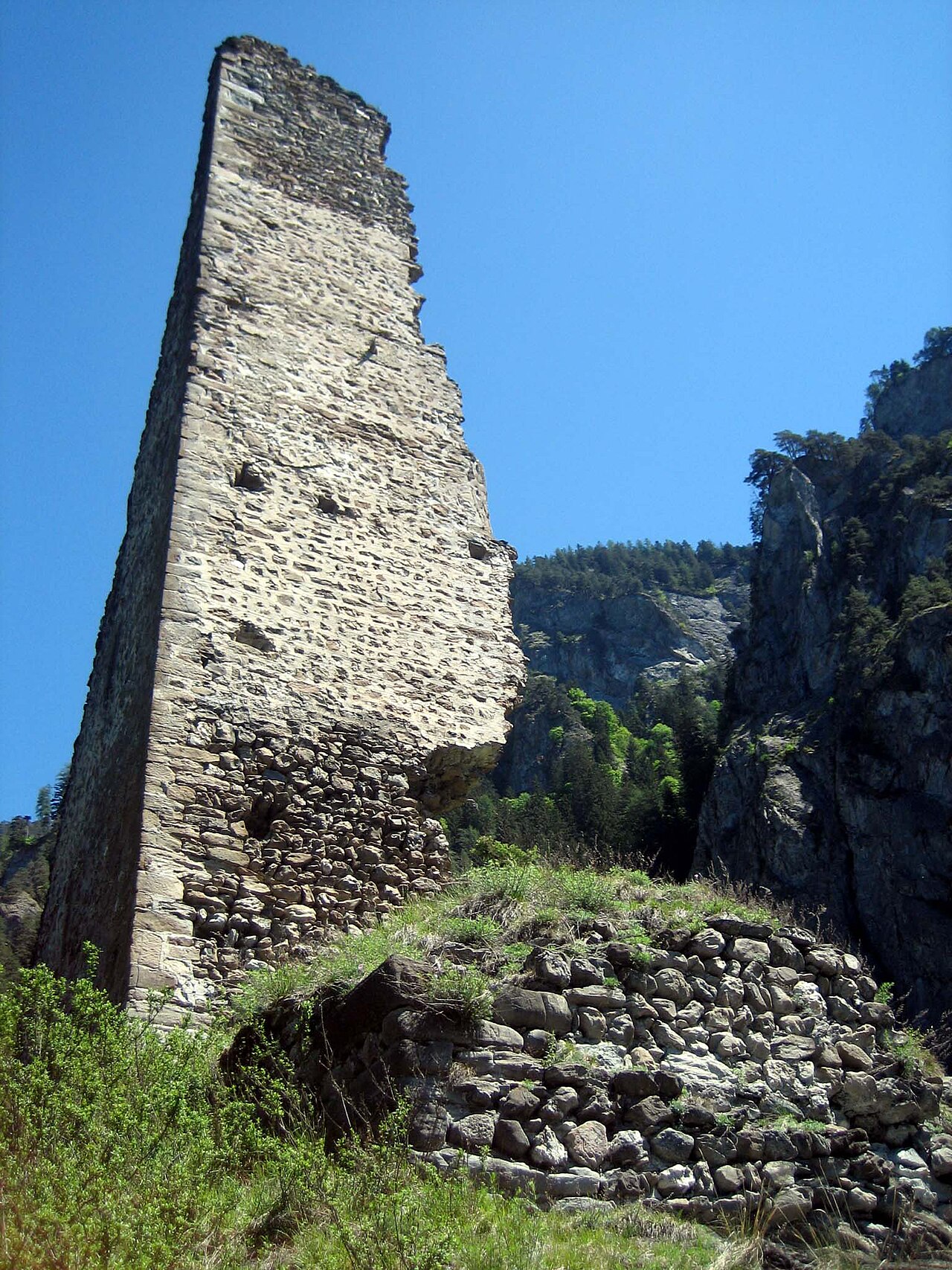
Hochjuvalt Castle (also Niderjuvalt or Ausser-Juvalt) is a castle in the municipality of Rothenbrunnen of the Canton of Graubünden in Switzerland. It is a Swiss heritage site of national significance.
The castle consists of two sections, the upper castle on a rocky spur above the valley and the lower castle along the trade road on the valley floor. The spur created a natural pinch point in the valley, forcing traffic from the Septimer, Splügen and San Bernardino Passes to pass through the customs post in the lower castle. The von Juvalt family first appears in records in 1140 and the castle is first mentioned in 1149. The von Juvalt family were vassals of the Bishop of Chur and had estates from Feldis/Veulden to Scharans. Around 1250 they built Innerjuvalt Castle about 2 km (1.2 mi) south-east of Hochjuvalt to improve their control over the area.
By the 14th century the castle passed, probably through inheritance, to the Rietberg family. Following the death of the last male heir, Johann von Reitberg, in 1349 the castle was supposed to pass to his relative, the Freiherr von Landenberg. However, the Bishop of Chur claimed Hochjuvalt as well as other Reitberg estates in the region. In 1352 the Bishop forced the Landenbergs to sign away their claims to the castle. Another claimant, the Freiherr of Lumbrein agreed to drop his claims for 250 gulden. Over the following century, the Bishops used the castle and its estates as collateral for loans from a number of wealthy families. In 1451 a war broke out between the residents of the Schams valley and Counts of Werdenberg-Sargans. Several castles in the area were partially destroyed in the war, though it is unknown if Hochjuvalt was one of them. It was last granted to Eberhard Ringg von Baldenstein in 1454, though its condition was not recorded. By 1500 the castle was completely abandoned and around 1550 was described as a ruin.
During World War II the site was reoccupied and fortified. In 1940 guns were emplaced near the old upper castle and tank barriers were added around the lower.
In 2011-12 the castle was reinforced and repaired and a new footpath was added to the upper castle.
The oldest part of the castle is the residence tower high above the valley. Most of three sides of the tower have collapsed, leaving an L-shaped five-story wall still standing.
Text adapted from “Hochjuvalt Castle” on Wikipedia, CC BY-SA 4.0.
Hochjuvalt Castle ranks #6,475 of 8,134 worldwide in the atlas's castle fame ranking, and #129 of the 201 mapped in Switzerland. Founded 1216, it is older than 76% of the atlas's dated landmarks — one of 861 atlas entries founded in the 13th century. 15 more atlas landmarks stand within 25 km. The nearest day-trip guide is Lugano, 92 km away. It is one of the 24 landmarks on the atlas's regional map of Graubünden. See how Switzerland compares in the castle statistics.
View on the interactive castle map →Frequently asked questions
Where is Hochjuvalt Castle?
Hochjuvalt Castle stands in Switzerland, at 46.77778°, 9.42083°.
When was Hochjuvalt Castle built?
The atlas dates its founding to 1216. Earlier structures may have stood on the site; this is the earliest documented founding year.
How famous is Hochjuvalt Castle?
In this atlas's fame ranking: #6,475 of 8,134 worldwide, and #129 in Switzerland. Fame here combines how many Wikipedia language editions cover a landmark with how many people read them.
What is the nearest castle to Hochjuvalt Castle?
Rhäzüns castle, about 3 km away.
More castles in Switzerland
- Alt-Haldenstein Castle Switzerland · 11th century
- Besserstein ruins Switzerland
- Gottlieben Castle Switzerland · 13th century
- Serviezel Castle Switzerland · 12th century
More ruins
- Schaesberg Castle Netherlands
- Citadel of Homs Syria
- Zamok Borki Russia · 20th century
- Castle Millen Netherlands · 14th century