 Austria · 15th century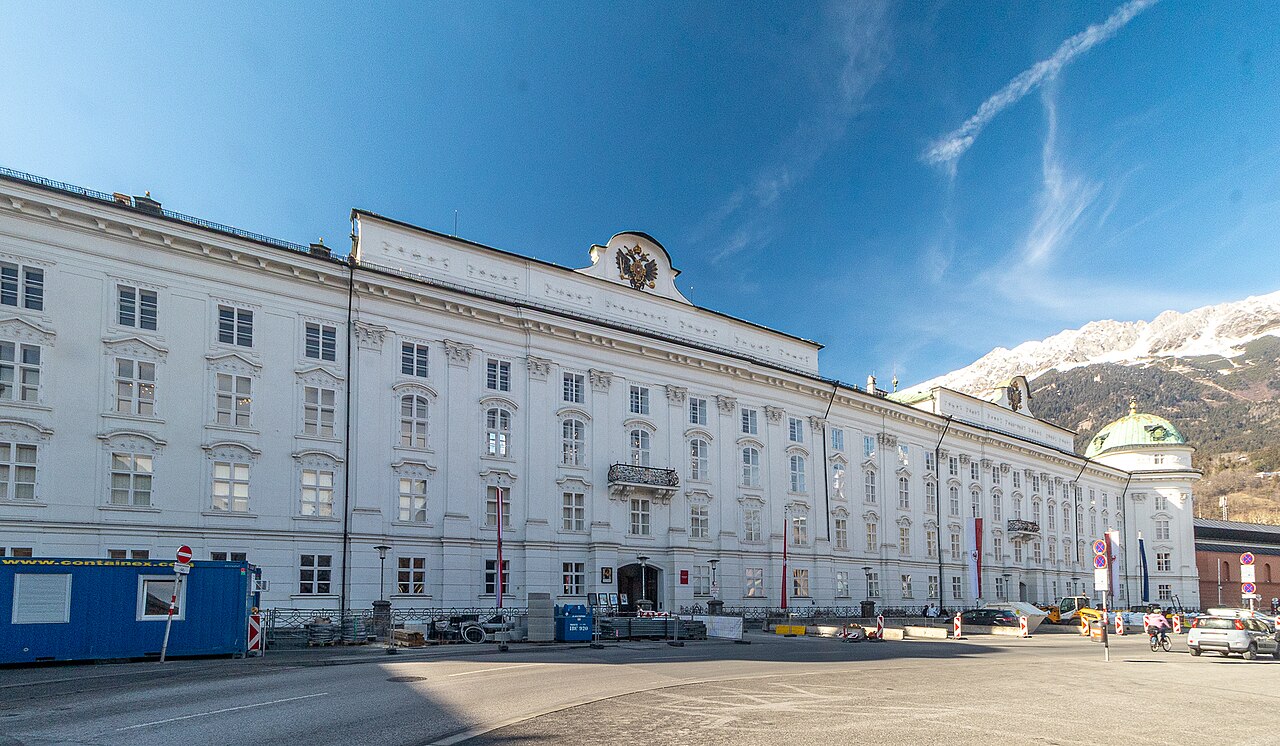
The Hofburg (English: Court Castle) is a former Habsburg palace in Innsbruck, Austria, and considered one of the three most significant cultural buildings in the country, along with the Hofburg Palace and Schönbrunn Palace in Vienna. The Hofburg is the main building of a large residential complex once used by the Habsburgs that still includes the Noblewomen's Collegiate Foundation, the Silver Chapel, the Hofkirche containing Emperor Maximilian's cenotaph and the Schwarzen Mandern, the Theological University, the Tyrolean Folk Art Museum, Innsbruck Cathedral, the Congress, and the Hofgarten (Court Garden).
The original Hofburg palace was constructed from several elements under Archduke Sigismund around 1460. This structure included sections of medieval fortifications that ran along the eastern city wall. The building incorporated the Rumer Gate, which was later converted into the Heraldic Tower in 1499 by Jörg Kölderer under Emperor Maximilian I. The palace was expanded several times during the next 250 years. Between 1754 and 1773, the Hofburg palace underwent two stages of Baroque structural changes under Empress Maria Theresa: the south tract was constructed (1754–1756) on the Hofgasse according to plans by J. M. Gumpp the Younger, and the main façade was added (1766–1773) on the Rennweg according to plans by C. J. Walter.
During this period, the Giants' Hall was completed with ceiling frescoes by Franz Anton Maulbertsch, and the Imperial Chapel was built (1765) in the room where Maria Theresa's husband Emperor Francis I had died.
Today, the Hofburg contains five themed museum areas: Maria Theresa's Rooms from the eighteenth century, Empress Elisabeth's Apartment from the nineteenth century, a Furniture Museum, an Ancestral Gallery, and a Painting Gallery.
Text adapted from “Hofburg, Innsbruck” on Wikipedia, CC BY-SA 4.0.
Hofburg, Innsbruck ranks #773 of 9,079 worldwide in the atlas's castle fame ranking, and #17 of the 240 mapped in Austria. Founded c. 1460, it is older than 46% of the atlas's dated landmarks — one of 554 atlas entries founded in the 15th century. Its Wikipedia articles were opened 6,819 times in the last 60 days, more than 90% of the atlas. 4 more atlas landmarks stand within 25 km. The nearest day-trip guide is Innsbruck, 1 km away. See how Austria compares in the castle statistics.
View on the interactive castle map →