 Germany · 12th century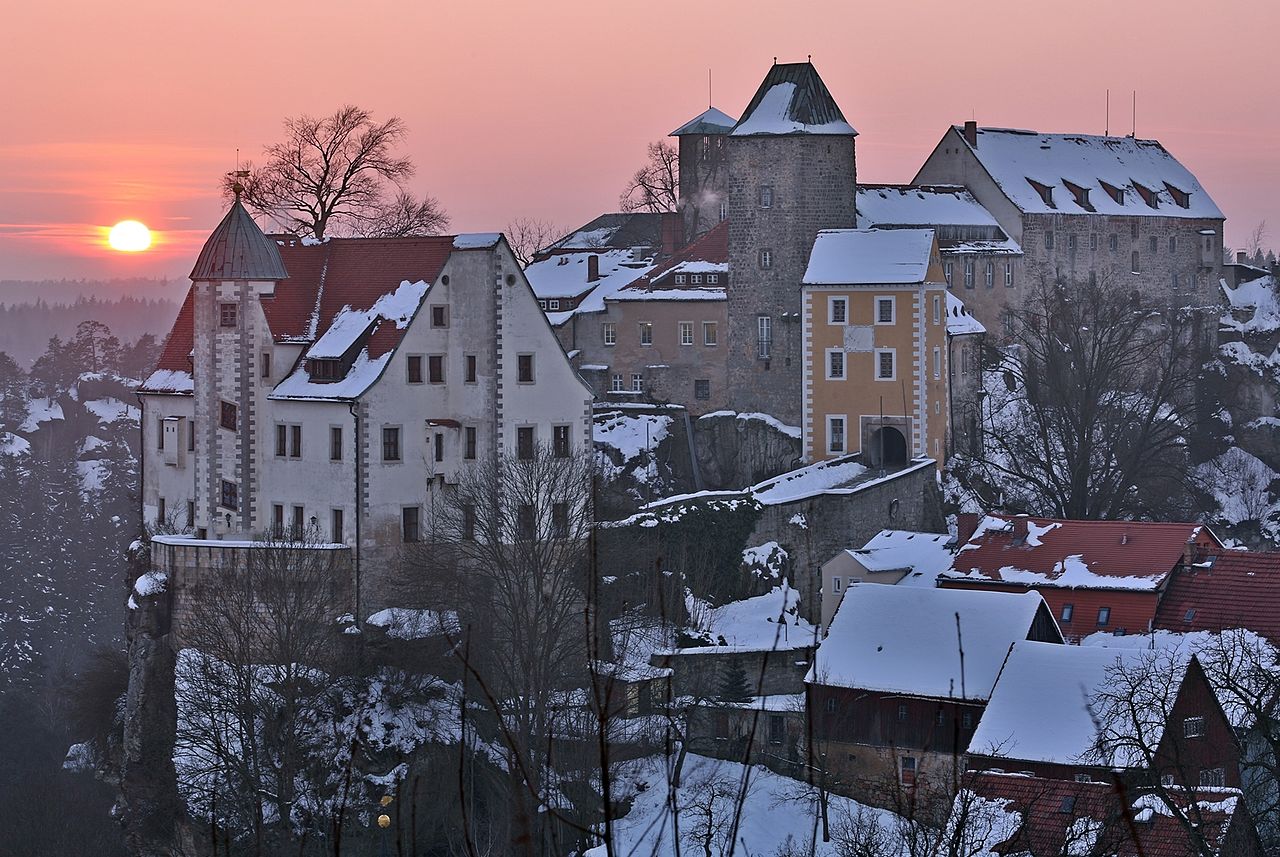
Hohnstein Castle (German: Burg Hohnstein) is a medieval castle in the village of the same name, Hohnstein in Saxon Switzerland in the Free State of Sachsen in eastern Germany.
The castle is located on a hard sandstone slab, 140 metres above the Polenz valley and is the major landmark of the small town.
Hohnstein Castle was probably built around 1200 or earlier as a Bohemian border fortress for the Margravate of Meissen to defend it against Saxony. In 1353 the castle went into the possession of the Bohemian nobleman, Hynek Berka of Dubá, whose coat of arms with crossed oak branches decorates the entranceway to the second courtyard. In 1443 the Berkas of Dubá lost the estate through exchanges and purchase, only mentioned for the first time under their name, to the Electorate of Saxony under Frederick the Humble, although it remained a Bohemian fief until 1806. The Wettins used it as a base for hunting and for salmon spearing (Lachsstechen).
In the succeeding centuries the castle acted alternately as a seat of administration (electoral Amt), a court and a prison. The original wooden structures were gradually replaced during the 17th and 18th centuries by the present stone buildings and even successfully withstood a Swedish siege in 1639.
After the dissolution of the Amt in 1861 the castle served as a men's correctional institute (Männerkorrektionsanstalt) and from 1919 as a juvenile prison.
In 1925 the mighty castle became a youth hostel (Jugendburg) and was one of the largest and most attractive youth hostels in Germany (with about 1,000 bedspaces). The Hohnsteiner Kasper puppet theatre is named after the town and castle and put on its first performance in 1928 in the castle. In the years 1933/34 a Nazi concentration camp was established here for so-called protective custody prisoners (Schutzhäftlinge), in practice 5,600 political prisoners. During the German invasion of Poland at the start of World War II, in September 1939, the Oflag IV-A prisoner-of-war camp for Polish officers was established in the castle, and from 1940 it also held French and Belgian officers and orderlies.
In 1941, the Oflag IV-A was dissolved, and the Stalag IV-A POW camp was relocated to the castle from Elsterhorst. It held Polish, French, British, Belgian, Serbian, Dutch, Soviet, Italian, American, Slovak, Czech and Bulgarian POWs, and was liberated by the Soviets in April 1945.
Text adapted from “Hohnstein Castle (Saxon Switzerland)” on Wikipedia, CC BY-SA 4.0.
Hohnstein Castle ranks #3,194 of 9,035 worldwide in the atlas's castle fame ranking, and #258 of the 709 mapped in Germany. Founded 1200, it is older than 75% of the atlas's dated landmarks, one of 763 atlas entries founded in the 12th century. Its Wikipedia articles were opened 2,166 times in the last 60 days, more than 71% of the atlas. 14 more atlas landmarks stand within 25 km. The nearest day-trip guide is Děčín, 24 km away. See how Germany compares in the castle statistics.
View on the interactive castle map →