 Germany · 11th century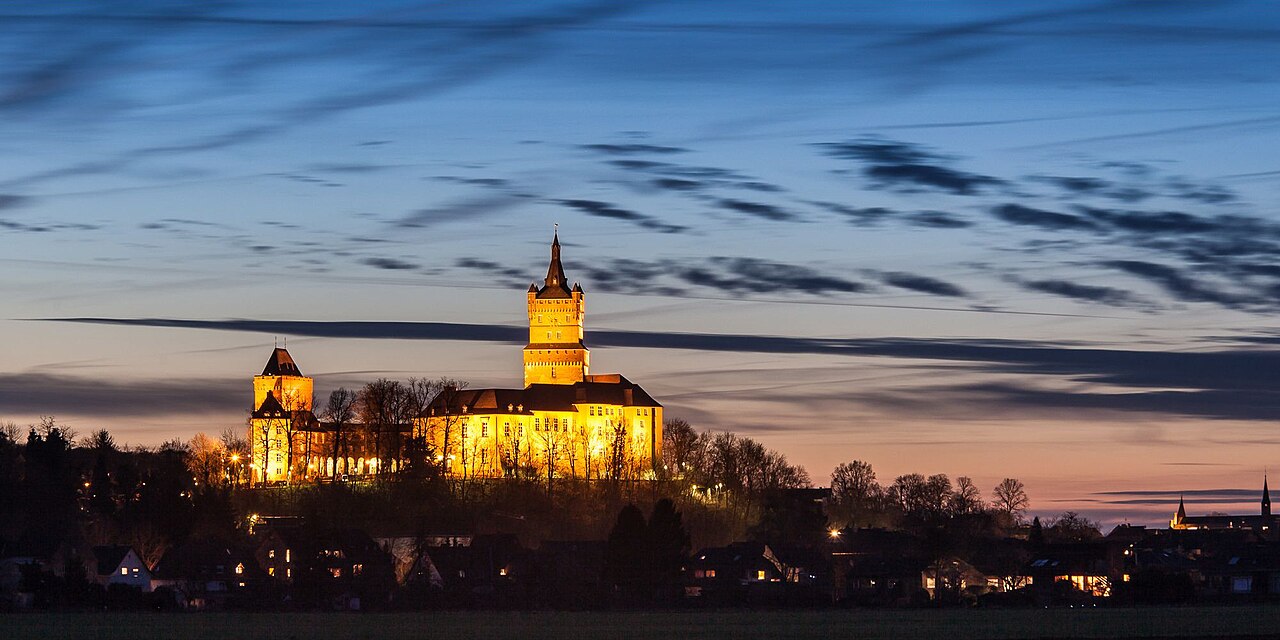
The Schwanenburg Castle (English: Swan Castle), in North Rhine-Westphalia, where the Dukes of Cleves resided, was founded on a steep hill. It is located at the northern terminus of the Kermisdahl where it joins with the Spoykanal, which was previously an important transportation link to the Rhine.
It is already conceivable that in Roman times there was a military base at this point, high above the Rhine, halfway between Xanten and Nijmegen.
The Swan Castle was first mentioned in 1020 in the monastery annals. The Swan Tower collapsed on 7 October 1439. "300 years before God's birth Caesar has built this". This can be read on an inscription above the entrance of the Swan Tower, which was installed by Adolph I, Duke of Cleves after the tower was rebuilt.
The knight's hall, built around 1170, stood where today the car park surrounded by lime trees is located in the outer courtyard. Remains of the richly decorated hall have been excavated in the courtyard of the castle and can be seen today.
In 1663, the Stadtholder of the Great Elector; John Maurice, Prince of Nassau-Siegen approved a renovation of the Schwanenburg in the Dutch Baroque style by architect Pieter Post and commissioned the construction of extensive gardens that greatly influenced European landscape design of the 17th century. Significant amounts of his original plan for Kleve were put into effect and have been maintained to the present, a particularly well-loved example of which is the Forstgarten.
In the middle of the 18th century, the building was reduced by collapse and demolition to its present size. Since then, the judicial authorities are located at the castle, and today the castle is the seat of the district and district court of Kleve. In the Swan Tower, a small geological museum is located.
On 7 October 1944, Kleve was subjected to a huge bombardment. These attacks resulted in huge damage to the town. The bombardment destroyed the historic centre of Kleve, including the Swan tower. The castle was rebuilt between 1948 and 1953.
The old castle has a massive tower, the Schwanenturm (Swan tower) 180 feet (55 m) high, that is associated in legend with the Knight of the Swan, immortalized in Richard Wagner's Lohengrin.
Lohengrin first appears as "Loherangrin", the son of Parzival and Condwiramurs in Wolfram von Eschenbach's Parzival.
Text adapted from “Schwanenburg Castle” on Wikipedia, CC BY-SA 4.0.
Schwanenburg ranks #2,917 of 9,035 worldwide in the atlas's castle fame ranking, and #228 of the 709 mapped in Germany. Founded 1020, it is older than 91% of the atlas's dated landmarks, one of 439 atlas entries founded in the 11th century. Its Wikipedia articles were opened 3,025 times in the last 60 days, more than 78% of the atlas. 14 more atlas landmarks stand within 25 km. The nearest day-trip guide is Arnhem, 27 km away. See how Germany compares in the castle statistics.
View on the interactive castle map →