Fortress
Hushan Great Wall
🇨🇳 China · 15th century
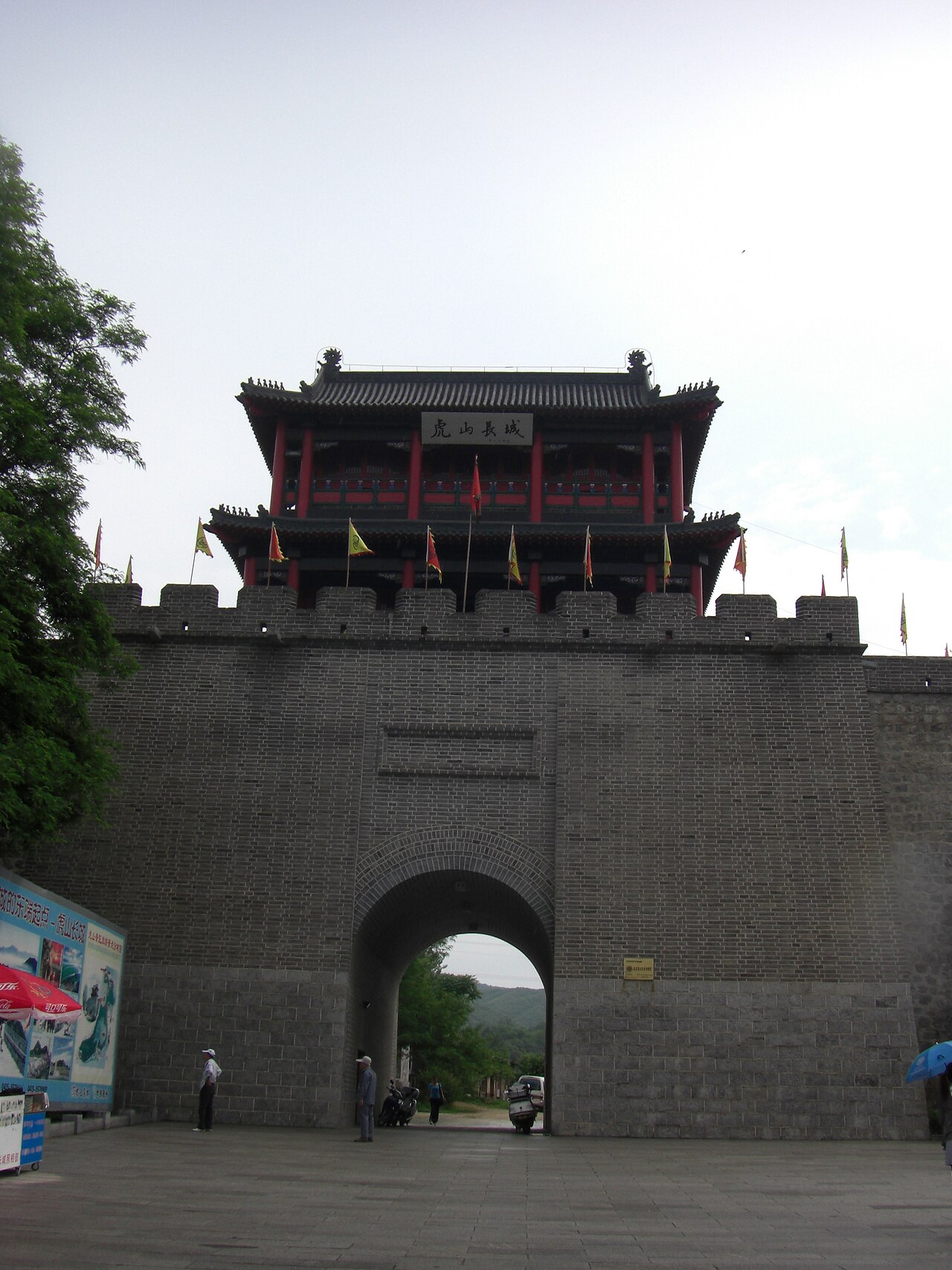
The Hushan or Tiger Mountain Great Wall (Chinese: 虎山长城; pinyin: Hǔshān Chángchéng), is a section of the Ming Great Wall in Kuandian Manchu Autonomous County, Liaoning, China. The wall runs for about 1,200 metres over Hushan ("Tiger Mountain").
The wall starts 15 km northeast of Dandong city, directly beside the China–North Korea border. It then climbs steeply up to a height of 146.3 metres before descending on the other side of Hushan and finishing at a car park.
Numerous Ming dynasty records and poems mentioned a "border wall" (边墙) that reached the banks of Yalu River, forming a part of Ming's defense system on the northern frontier. This wall was meant to defend against Jurchen bandits who frequently raided Ming and Joseon villages from the Northeast. The date of its construction was documented by the Ming Shilu as the 15th year of Chenghua era (AD 1479). Archives of Andong (Dandong) county put the wall's location to the north of the Ai River (叆河), in the Hushan area. A series of surveys in late 1980s and early 1990s led by architectural historian Luo Zhewen identified the ruins at Hushan as the site of the eastern terminus of this Great Wall section. An 1,250 metres (4,100 ft) long section was restored in 1992.
Ruins of older fortresses have been identified at Hushan, dating back to the Four Commanderies of Han and Goguryeo eras. In order to defend against nomadic tribes to the north, many of these fortresses and walls were built during those times. Similar sites have also been discovered elsewhere in Liaoning, as well as in North Pyongan and Chagang provinces, North Korea. The site of a historical city known as Posuo (婆娑) or Bakjak (泊汋, 박작) lies in proximity at present-day Jiuliancheng, to the south of Hushan.
On the other hand, North and South Korea academics show skepticisms on the historical existence of the Hushan great wall due to lack of evidence.
Text adapted from “Hushan Great Wall” on Wikipedia, CC BY-SA 4.0.
Hushan Great Wall ranks #1,645 of 8,134 worldwide in the atlas's castle fame ranking, and #34 of the 119 mapped in China. Founded 1469, it is older than 48% of the atlas's dated landmarks — one of 455 atlas entries founded in the 15th century. Its Wikipedia articles were opened 3,456 times in the last 60 days, more than 78% of the atlas. See how China compares in the castle statistics.
View on the interactive castle map →Frequently asked questions
Where is Hushan Great Wall?
Hushan Great Wall stands in China, at 40.22384°, 124.51544°.
When was Hushan Great Wall built?
The atlas dates its founding to 1469. Earlier structures may have stood on the site; this is the earliest documented founding year.
How famous is Hushan Great Wall?
In this atlas's fame ranking: #1,645 of 8,134 worldwide, and #34 in China. Fame here combines how many Wikipedia language editions cover a landmark with how many people read them.
What is the nearest castle to Hushan Great Wall?
Pyongyang Castle, about 171 km away.
More castles in China
- Yungbulakang Palace China · 7th century
- Tong Pass China · 2nd century
- Diaoyu Fortress China
- Tongwan China · 5th century
More fortresses
- Torres de Quart Spain · 15th century
- Kangra Fort India
- Chesters Roman Fort England
- Castrum Segedunum England