Ruin
Inverlochy Castle
SCT Scotland · 13th century
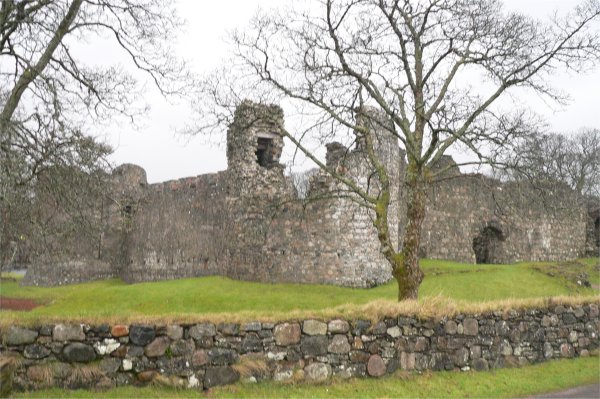
Inverlochy Castle (Scottish Gaelic: Caisteal Inbhir Lòchaidh) is a ruined, 13th-century castle near Inverlochy and Fort William, Highland, Scotland. The site of two battles, the castle remains largely unchanged since its construction. It is now in the care of Historic Environment Scotland.
Inverlochy Castle was built circa 1270–1280 by John "the Black" Comyn, Lord of Badenoch and Lochaber, and chief of the Clan Comyn. It may have been built on the site of an earlier Pictish fortification and settlement, which the historian Hector Boece (1465–1536) records as a "city" that was destroyed by Vikings. After Robert the Bruce succeeded to the Scottish throne in 1306, he captured and burned the castle the following year. The Comyns were thus dispossessed, and the ruined castle was unoccupied for a time. In 1431, clansmen of Alexander MacDonald, Lord of the Isles, defeated King James I's larger army in the first Battle of Inverlochy, fought close by the castle. It came under control of the Clan Cameron until 1501.
In 1505, the partially ruined castle was granted to Alexander Gordon, 3rd Earl of Huntly, who was charged by King James IV with repairing the castle for use as a Royal garrison. His brother William Gordon, Laird of Gight, became master of Inverlochy, and was slain commanding the Camerons at Flodden. In 1645, the castle served as a stopping-off point for the royalist army of James Graham, 1st Marquess of Montrose during his campaign against the Covenanter forces of the Marquess of Argyll. This culminated in a victory for the royalists in the second Battle of Inverlochy, on 2 February 1645. In the 19th century, the estate was bought by James Scarlett, 1st Baron Abinger, who built a Scottish baronial style mansion to the north-west, which is now the Inverlochy Castle Hotel. Minor enhancements, including the restoration of loops and battlements, were carried out by Lord Abinger in advance of the visit of Queen Victoria in 1873.
Inverlochy is now a ruin, but is unusual because it has remained unaltered since it was built in the reign of King Alexander III. The castle is sited on the south bank of the River Lochy, at the strategically important entrance to the Great Glen, a key passage through the Scottish Highlands. With one side defended by the river, the castle's other three sides were originally protected by a water-filled ditch.
Text adapted from “Inverlochy Castle” on Wikipedia, CC BY-SA 4.0.
Inverlochy Castle ranks #2,960 of 8,134 worldwide in the atlas's castle fame ranking, and #100 of the 168 mapped in Scotland. Founded c. 1270, it is older than 68% of the atlas's dated landmarks — one of 861 atlas entries founded in the 13th century. Its Wikipedia articles were opened 2,125 times in the last 60 days, more than 68% of the atlas. The nearest day-trip guide is Inverness, 89 km away. It is one of the 57 landmarks on the atlas's regional map of the Scottish Highlands. See how Scotland compares in the castle statistics.
View on the interactive castle map →Frequently asked questions
Where is Inverlochy Castle?
Inverlochy Castle stands in Scotland, at 56.83229°, -5.0823°.
When was Inverlochy Castle built?
The atlas dates its founding to c. 1270. Earlier structures may have stood on the site; this is the earliest documented founding year.
How famous is Inverlochy Castle?
In this atlas's fame ranking: #2,960 of 8,134 worldwide, and #100 in Scotland. Fame here combines how many Wikipedia language editions cover a landmark with how many people read them.
What is the nearest castle to Inverlochy Castle?
Castle Stalker, about 34 km away.
More castles in Scotland
- Carnasserie Castle Scotland · 16th century
- Tolquhon Castle Scotland · 16th century
- Hailes Castle Scotland · 14th century
- Aberdeen Castle Scotland
More ruins
- Barry Castle Wales · 12th century
- Carsluith Castle Scotland
- Turnberry Castle Scotland · 13th century
- Claxton Castle England