Ruin
Carnasserie Castle
SCT Scotland · 16th century
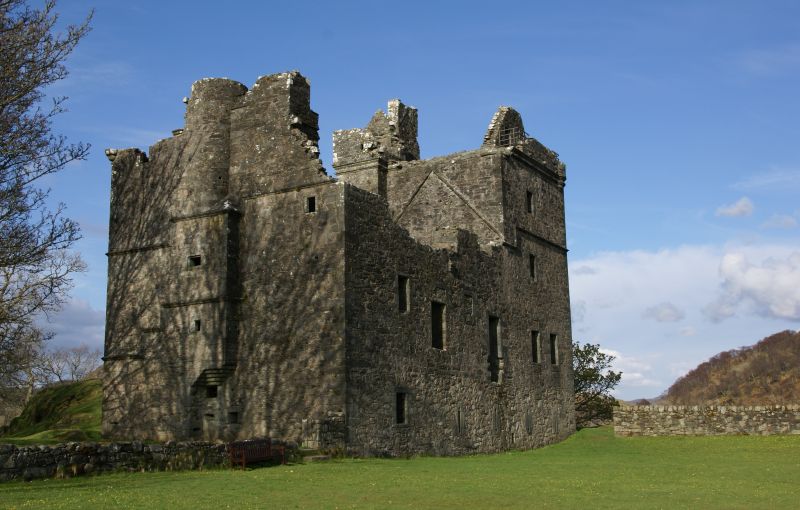
Carnasserie Castle (also spelled Carnassarie) is a ruined 16th-century tower house, noted for its unusual plan and renaissance detailing. It is located around 2 kilometres (1+1⁄4 miles) north of Kilmartin, in Argyll and Bute, western Scotland, at grid reference NM837009.
The castle was built by reforming churchman John Carswell, who was Rector of Kilmartin, Chancellor of the Chapel Royal at Stirling, and later titular Bishop of the Isles. Carswell published the first book to be printed in Scottish Gaelic, a translation of John Knox's Book of Common Order. Construction began in 1565 using masons brought from Stirling; although notionally built for Carswell's patron, the Earl of Argyll, he intended it as a personal residence for himself.
On Carswell's death in 1572, the castle passed to the Earl of Argyll and was sold in 1643 to Donald Campbell of Auchinleck. His successor Duncan Campbell was one of the few to actively support Argyll's Rising against James VII in 1685.
During the rising, the castle was garrisoned for the Earl of Argyll under the command of Dugald MacTavish of Dunardry, 14th Hereditary Chief of Clan MacTavish. The castle was captured and partly blown up by a Royalist force commanded by MacLean of Torloisk. When the castle was surrendered under terms of peaceful capitulation, the besieging forces violated those terms, and Dugald MacTavish, aged 21, was hanged within bow-draught of the castle gateway immediately after the surrender.
The Atholl Raid that followed the failure of the Rising devastated large parts of Argyllshire; despite recovering his estates in 1689, Duncan Campbell was financially ruined. In 1690, he petitioned Parliament claiming Maclean clansmen burnt Carnasserie Castle, stole 2,000 cattle and murdered his uncle Alexander Campbell of Strondour. Although the outer walls remain largely undamaged, Carnasserie was never rebuilt and the Auchinbrecks eventually went bankrupt.
In the 19th century the estate was sold to the Malcolms of Poltalloch, who also own nearby Duntrune Castle. Today the castle and its surroundings are protected as a scheduled monument. The castle is in the care of Historic Environment Scotland and is open to the public.
Carnasserie has only ever been slightly altered, in the late 17th century, and so presents an accurate picture of 16th-century architecture.
Text adapted from “Carnasserie Castle” on Wikipedia, CC BY-SA 4.0.
Carnasserie Castle ranks #4,157 of 8,134 worldwide in the atlas's castle fame ranking, and #141 of the 168 mapped in Scotland. Founded 1565, it is older than 37% of the atlas's dated landmarks — one of 755 atlas entries founded in the 16th century. 2 more atlas landmarks stand within 25 km. The nearest day-trip guide is Glasgow, 83 km away. See how Scotland compares in the castle statistics.
View on the interactive castle map →Frequently asked questions
Where is Carnasserie Castle?
Carnasserie Castle stands in Scotland, at 56.1515°, -5.4809°.
When was Carnasserie Castle built?
The atlas dates its founding to 1565. Earlier structures may have stood on the site; this is the earliest documented founding year.
How famous is Carnasserie Castle?
In this atlas's fame ranking: #4,157 of 8,134 worldwide, and #141 in Scotland. Fame here combines how many Wikipedia language editions cover a landmark with how many people read them.
What is the nearest castle to Carnasserie Castle?
Duntrune Castle, about 7 km away.
More castles in Scotland
- Tolquhon Castle Scotland · 16th century
- Hailes Castle Scotland · 14th century
- Aberdeen Castle Scotland
- Carsluith Castle Scotland
More ruins
- Barry Castle Wales · 12th century
- Turnberry Castle Scotland · 13th century
- Claxton Castle England
- Baconsthorpe Castle England · 15th century