 Germany · 18th century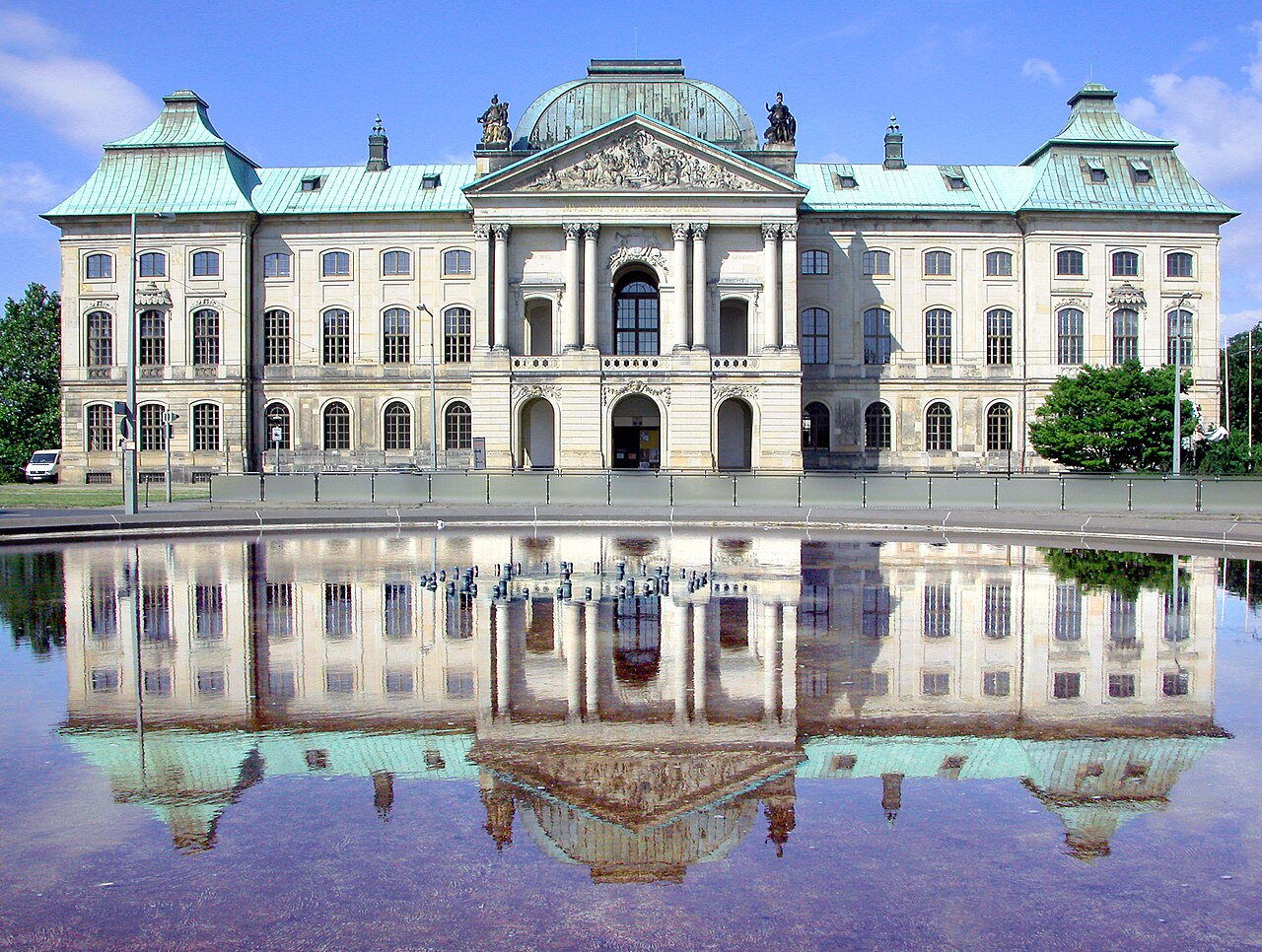
The Japanese Palace (German: Japanisches Palais) is a Baroque building in Dresden, Saxony, Germany. It is located on the Neustadt bank of the river Elbe.
Built in 1715, the palace was extended from 1729 until 1731 to house the Japanese porcelain collection of King Augustus the Strong, which is now part of the Dresden Porcelain Collection. More Japanese crafts collections were intended to be housed there. Despite this intention, it was never used for the collection and instead served as the Saxon Library. The palace was designed by architects Pöppelmann, Longuelune and de Bodt.
The Japanese Palace was damaged during the allied bombing raids on 13 February 1945. The restoration of much of the building and its gardens was completed in the 1980s by the French government.
Today, it houses three museums: the Museum of Ethnology Dresden, the State Museum for Pre-History (Landesmuseum für Vorgeschichte) and the Senckenberg Natural History Collection (Senckenberg Naturhistorische Sammlungen Dresden).
Text adapted from “Japanese Palace” on Wikipedia, CC BY-SA 4.0.
Japanisches Palais ranks #2,376 of 9,079 worldwide in the atlas's castle fame ranking, and #182 of the 711 mapped in Germany. Founded 1715, it is older than 20% of the atlas's dated landmarks — one of 696 atlas entries founded in the 18th century. Its Wikipedia articles were opened 2,461 times in the last 60 days, more than 74% of the atlas. 11 more atlas landmarks stand within 25 km. The nearest day-trip guide is Dresden, 1 km away. See how Germany compares in the castle statistics.
View on the interactive castle map →