 Germany · 18th century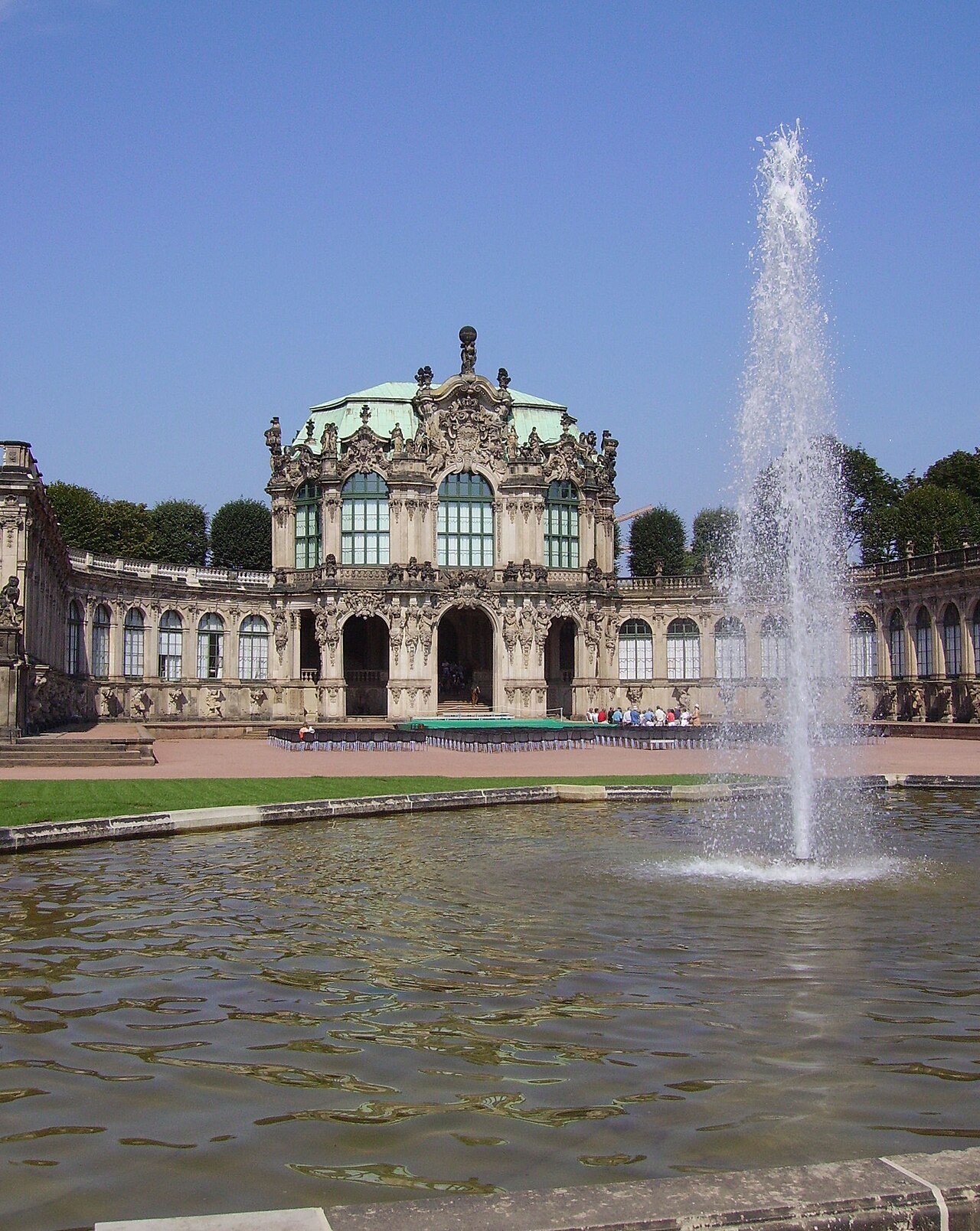
The Zwinger (German: Dresdner Zwinger, IPA: [ˈdʁeːzdnɐ ˈt͡svɪŋɐ]) is a palatial complex with gardens in Dresden, Germany. Designed by architect Matthäus Daniel Pöppelmann, it is one of the most important buildings of the Baroque period in Germany. Along with the Frauenkirche, the Zwinger is the most famous architectural monument of Dresden.
The name "Zwinger" goes back to the name used in the Middle Ages for a fortress part between the outer and inner fortress walls, even though the Zwinger no longer had a function corresponding to the name at the start of construction.
The Zwinger was built in 1709 as an orangery and garden as well as a representative festival area. Its richly decorated pavilions and the galleries lined with balustrades, figures and vases testify to the splendor during the reign of Augustus the Strong, Elector of Saxony and elected King of Poland. In the original conception of the elector, the Zwinger was the forecourt of a new castle that would take up the area between it and the Elbe; therefore, the Zwinger remained undeveloped on the Elbe side (provisionally closed with a wall). The plans for a new castle were abandoned after the death of Augustus the Strong, and with the departure from the Baroque period, the Zwinger initially lost importance. It was only over a century later that the architect Gottfried Semper completed it with the Semper Gallery towards the Elbe.
The Sempergalerie, opened in 1855, was one of the most important German museum projects of the 19th century and made it possible to expand the use of the Zwinger as a museum complex, which had grown under the influence of time since the 18th century. The Bombing of Dresden on February 13 and 14, 1945 hit the Zwinger extensively and led to extensive destruction.
Text adapted from “Zwinger (Dresden)” on Wikipedia, CC BY-SA 4.0.
Zwinger ranks #130 of 9,079 worldwide in the atlas's castle fame ranking, and #15 of the 711 mapped in Germany. Founded 1711, it is older than 21% of the atlas's dated landmarks — one of 696 atlas entries founded in the 18th century. Its Wikipedia articles were opened 23,604 times in the last 60 days, more than 98% of the atlas. 11 more atlas landmarks stand within 25 km. The nearest day-trip guide is Dresden, 1 km away. See how Germany compares in the castle statistics.
View on the interactive castle map →