 Germany · 16th century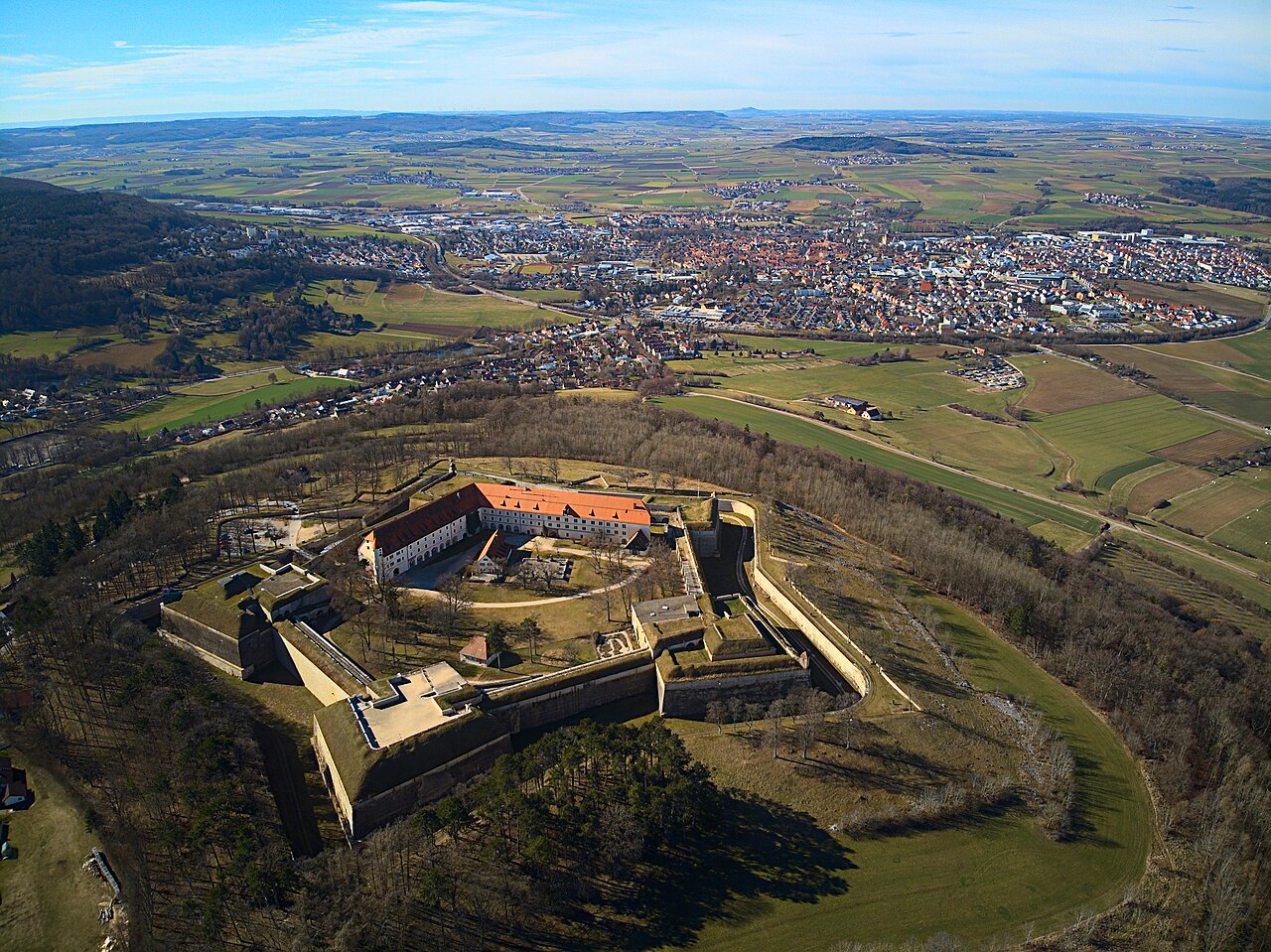
Wülzburg is a historical fortress of the Renaissance-age in Germany. It is about two kilometres (one mile) east of the center of Weißenburg in Bayern. It stands on a hill 200 metres (660 ft) above Weißenburg, at an elevation of 630.5 metres (2,069 ft), and was originally a Benedictine monastery dating from the 11th century.
It is one of the best-preserved Renaissance fortresses in Germany. Today it is as Ortsteil (locality) a part of the city of Weißenburg. It was converted into a fortress from 1588 to 1605 by George Frederick, Margrave of Brandenburg-Ansbach.
In the 19th century it was a garrison of the Bavarian Army. During World War I, Charles DeGaulle was imprisoned at the Wülzburg. The Nazis also used it as a prison camp during World War II; it was here that the Czech composer Erwin Schulhoff was held for over a year before he died of TB. After the war it was a refugee camp.
Text adapted from “Wülzburg” on Wikipedia, CC BY-SA 4.0.
Wülzburg ranks #2,648 of 9,079 worldwide in the atlas's castle fame ranking, and #200 of the 711 mapped in Germany. Founded 1588, it is older than 33% of the atlas's dated landmarks — one of 891 atlas entries founded in the 16th century. Its Wikipedia articles were opened 2,692 times in the last 60 days, more than 76% of the atlas. 4 more atlas landmarks stand within 25 km. See how Germany compares in the castle statistics.
View on the interactive castle map →