 Hungary · 19th century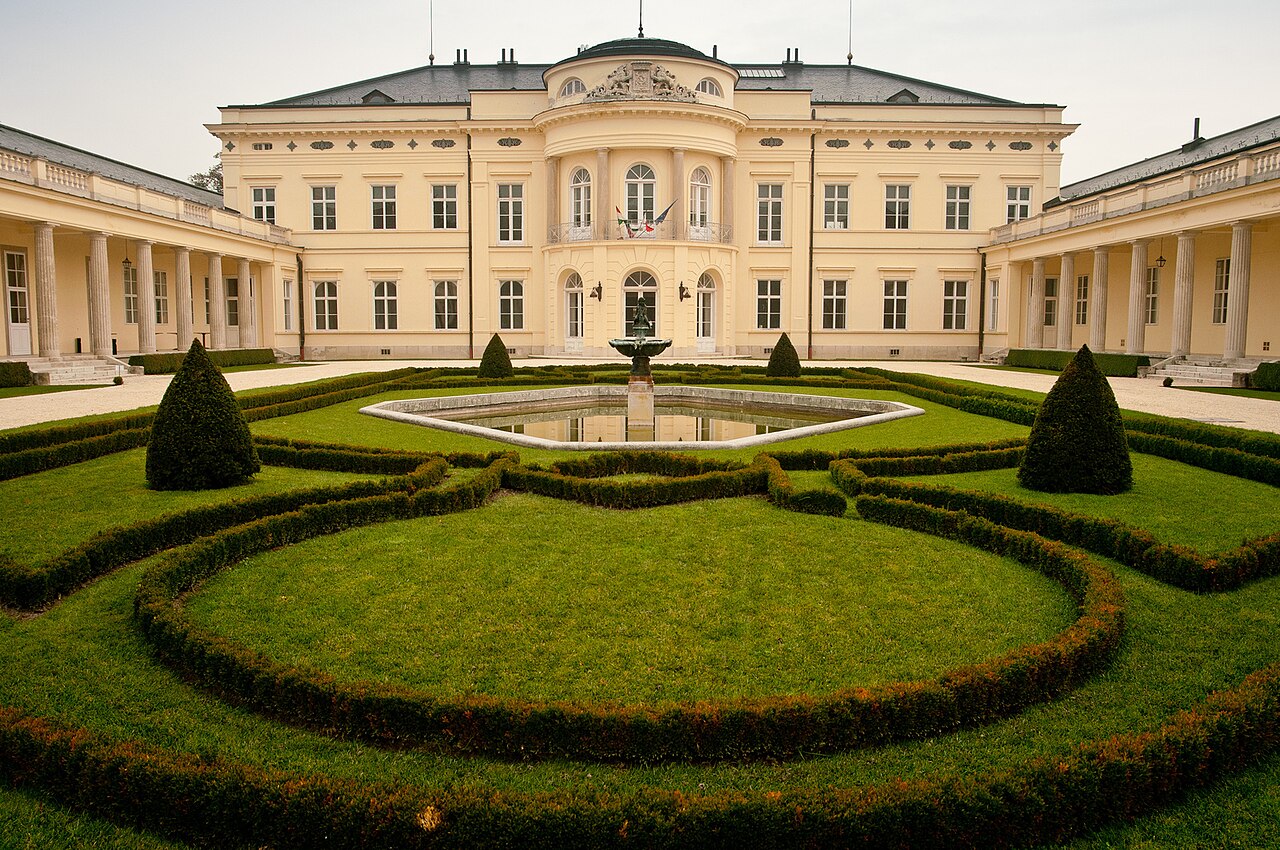
Károlyi Castle is a 19th-century castle located in Fehérvárcsurgó, Mór District, Fejér County, Hungary. The castle was built in classicist and eclectic style by György Károlyi, a descendant of the Károlyi family, and was designed by architects Henrich Koch and Miklós Ybl. The building currently houses a 23-room hotel, but can be visited with a guided tour.
The first owner of the Fehérvárcsurgó estate was the Hochburg family from 1691, then the Berényi family inherited it through marriage with a Hochburg daughter, and later the Perényi family. According to records, the baroque castle of Baron Ignác Perényi stood on the site of the present castle before 1786. In 1834, the estate was mortgaged by Imre Perényi to Count György Károlyi, who in 1825 was one of the founding members of the Hungarian Academy of Sciences by offering 40,000 forints at the reform parliament.
In 1853, the land was officially purchased by the Károlyi family. The castle was built between 1844 and 1851, construction coinciding with Károlyi's marriage to Countess Karolina Zichy, according to the plans of Henrich Koch, who also rebuilt the Károlyi Palace in Pest in the English classicist style. The architect, who lived in Vienna, was represented by Miklós Ybl, who, as the architect of the Károlyi family, participated in the planning related to the artistic direction. The castle was built with a central projection and a tympanum. A 30-meter-high tower rises on the side of the castle, with a small turret at each of the four corners, with a balustrade between them. A French garden was created in the castle courtyard.
After Károlyi's death in 1877, the castle was inherited by his second son, Viktor. By 1888, the castle was owned by Gyula Károlyi, the organizer and first president of the Hungarian Red Cross Society. His eldest son was the politician Mihály Károlyi, and his younger son was József Károlyi, who was the grandfather of the current trustee, György Károlyi. József Károlyi, the Lord Governor of Fejér County and Székesfehérvár, and a member of parliament, is responsible for the eclectic, baroque transformation of the façade of the building facing the courtyard around 1910, which changed the overall effect of the façade with the curved elliptical extension planned in the middle of the U shape. At that time, the library room was added to the middle part.
Text adapted from “Károlyi Castle (Fehérvárcsurgó)” on Wikipedia, CC BY-SA 4.0.
Károlyi Mansion, Fehérvárcsurgó ranks #6,060 of 9,035 worldwide in the atlas's castle fame ranking, and #38 of the 135 mapped in Hungary. Founded 1844, it is older than 8% of the atlas's dated landmarks, one of 705 atlas entries founded in the 19th century. Its Wikipedia articles were opened 1,044 times in the last 60 days, more than 52% of the atlas. 10 more atlas landmarks stand within 25 km. The nearest day-trip guide is Székesfehérvár, 15 km away. See how Hungary compares in the castle statistics.
View on the interactive castle map →