 Syria · 11th century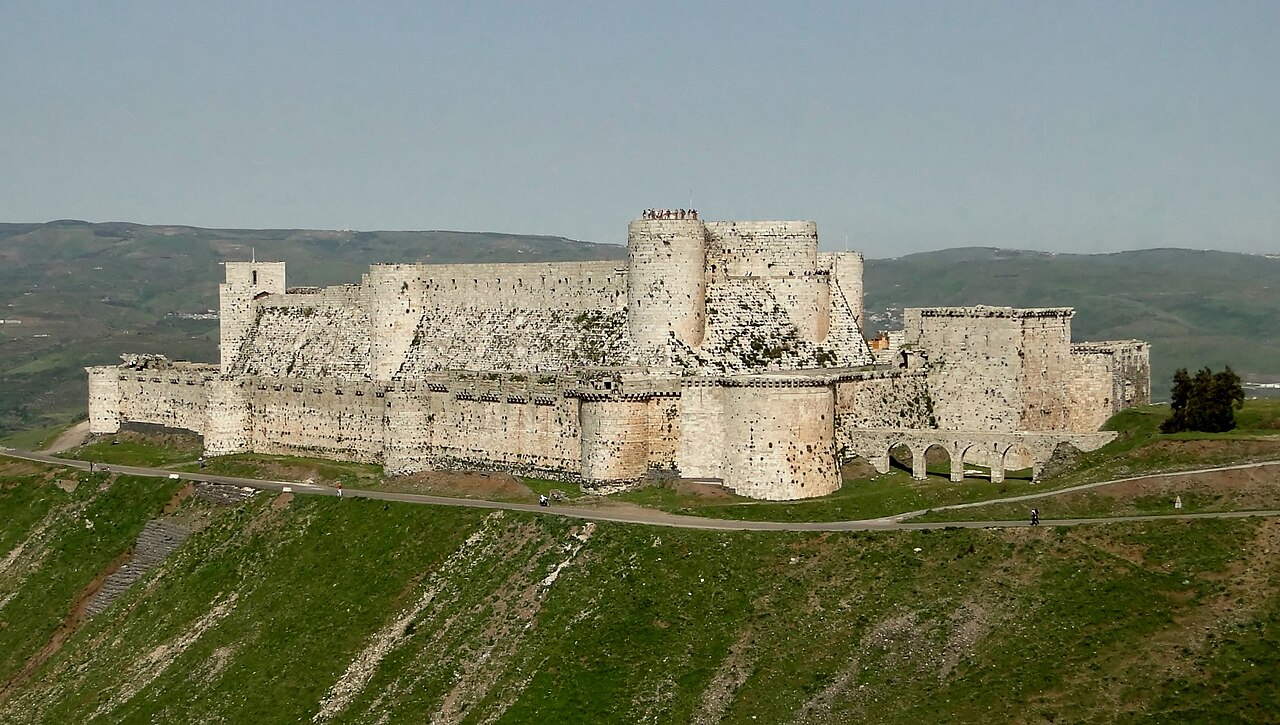
Krak des Chevaliers (French: [kʁak de ʃ(ə)valje]; Arabic: قلعة الحصن, romanized: Qalʿat al-Ḥiṣn, Arabic: [ˈqalʕat alˈħisˤn]; Old French: Crac des Chevaliers or Crac de l'Ospital, lit. 'karak [fortress] of the hospital'; from Classical Syriac: ܟܪܟܐ, romanized: karəḵā, lit. 'walled city') is a medieval castle in Syria and one of the most important preserved medieval castles in the world. The site was first inhabited in the 11th century by Kurdish troops garrisoned there by the Mirdasids. In 1142 it was given by Raymond II, Count of Tripoli, to the order of the Knights Hospitaller. It remained occupied by them until it was reconquered by the Muslims in 1271.
The Hospitallers began rebuilding the castle in the 1140s and were finished by 1170 when an earthquake damaged the castle. The order controlled castles along the border of the County of Tripoli, a state founded after the First Crusade. Krak des Chevaliers was among the most important and acted as a center of administration as well as a military base. After a second phase of building was undertaken in the 13th century, Krak des Chevaliers became a concentric castle. This phase created the outer wall and gave the castle its current appearance. The first half of the century has been described as Krak des Chevaliers' "golden age".
At its peak, Krak des Chevaliers housed a garrison of around 2,000. Such a large garrison allowed the Hospitallers to exact tribute from a wide area. From the 1250s the fortunes of the Knights Hospitaller took a turn for the worse and in 1271 the Mamluk Sultanate captured Krak des Chevaliers after a siege lasting 36 days, supposedly by way of a forged letter purportedly from the Hospitallers' Grand Master that caused the knights to surrender.
Renewed interest in Crusader castles in the 19th century led to the investigation of Krak des Chevaliers, and architectural plans were drawn up.
Text adapted from “Krak des Chevaliers” on Wikipedia, CC BY-SA 4.0.
Krak des Chevaliers ranks #50 of 9,079 worldwide in the atlas's castle fame ranking, and #1 of the 38 mapped in Syria. Founded 1031, it is older than 91% of the atlas's dated landmarks — one of 436 atlas entries founded in the 11th century. Its Wikipedia articles were opened 35,197 times in the last 60 days, more than 99% of the atlas. 4 more atlas landmarks stand within 25 km. The nearest day-trip guide is Homs, 39 km away. It is one of the 106 landmarks on the atlas's regional map of the Levant. It is stop 2 of 7 on the Crusader castles of the Levant, the Syrian coast to southern Jordan. See how Syria compares in the castle statistics.
View on the interactive castle map →