 Czech Republic · 16th century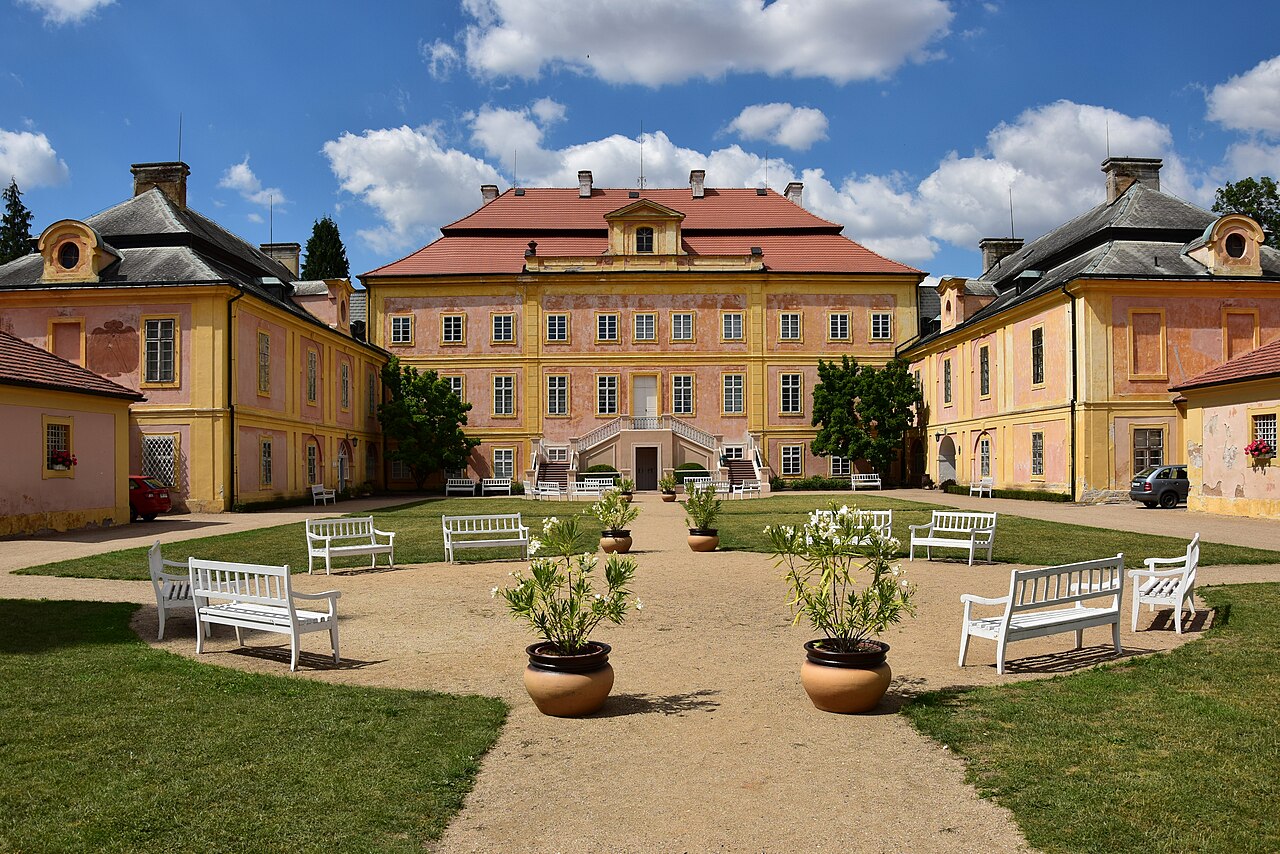
Krásný Dvůr Castle (Czech: zámek Krásný Dvůr; German: Schönhof) is a Baroque castle in Krásný Dvůr, Ústí nad Labem Region, Czech Republic. It has a 250-acre (1.0 km2) English-style landscape park and a garden inspired by that of Versailles. It is protected as a national cultural monument.
The first records of Krásný Dvůr date back to the 14th century, since then numerous aristocratic families (e.g. Kolowrats) held possession of it until Count Hermann Czernin bought it in the middle of the 17th century. Count Franz Josef Czernin decided to start an extensive reconstruction on a Renaissance villa built on the site of a Gothic stronghold originally constructed by Jan Maštovský of Kolovraty at the end of the 16th century.
The reconstruction project was undertaken by Czech architect František Maxmilián Kaňka and was distinctly influenced by the French architecture; construction went on between 1720 and 1724. Some alterations of the castle buildings were made at the end of the 18th century. In 1783 the chapel was erected, in 1791–1792 two-pair staircases were built in the court and in the northern garden and ground arcades were walled at the same time.
Eighteen rooms and lobby galleries are open to the public. Valuable paintings by Czech and European artists are installed here (some of the most well-known being Petr Brandl, Karel Škréta, Ludvík Kohl, Joseph Bergler, Filip Kristian Benthum, Kristian Brand and Élisabeth Vigée-Lebrun), and a number of graphic arts, porcelain, china, glass, earthenware, clocks, original Adam fireplaces, furniture and other samples of historical craftsmen's skills are to be seen. Some thematic collections are also remarkable (e.g. an extensive Baroque pictorial anthology of dog-portrayals by artist Petr Václav.
The castle park in Krásný Dvůr park with an area of 250 acres (1.0 km2) was founded in 1783–1793 by Johann Rudolf Czernin. He was influenced partly by his botanic inclinations and then also by his journey around Western Europe, which he undertook in 1779. In those days a new park trend had begun expanding into Europe from England. Natural scenery was to be brought into the very neighbourhood of buildings according to this trend. The principle of the landscape park is based directly on the condition of a natural landscape, not an artificially man-made one.
Text adapted from “Krásný Dvůr Castle” on Wikipedia, CC BY-SA 4.0.
Krásný Dvůr Castle ranks #3,676 of 9,035 worldwide in the atlas's castle fame ranking, and #99 of the 243 mapped in Czech Republic. Founded c. 1600, it is older than 31% of the atlas's dated landmarks, one of 886 atlas entries founded in the 16th century. Its Wikipedia articles were opened 1,068 times in the last 60 days, more than 52% of the atlas. Wikidata records about 11,000 visitors in 2022. 4 more atlas landmarks stand within 25 km. The nearest day-trip guide is Chomutov, 24 km away. It is one of the 189 landmarks on the atlas's regional map of Bohemia. See how Czech Republic compares in the castle statistics.
View on the interactive castle map →