 Estonia · 14th century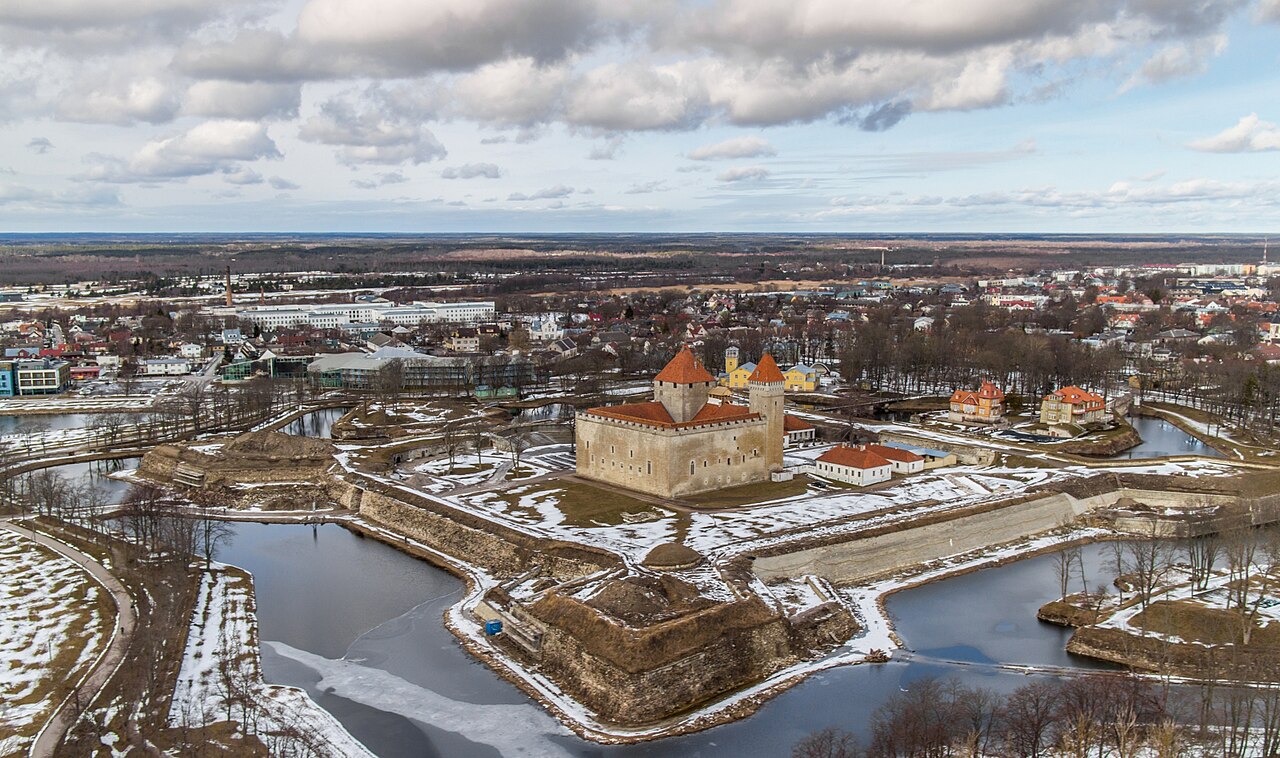
Kuressaare Castle (Estonian: Kuressaare linnus; German: Schloss Arensburg), also Kuressaare Episcopal Castle (Estonian: Kuressaare piiskopilinnus), is a castle in Kuressaare on Saaremaa island, in western Estonia.
The earliest written record mentioning Kuressaare castle is from the 1380s, when the Teutonic Order began its construction for the bishops of Ösel-Wieck. Some sources claim that the first castle was built of wood. As the inhabitants of Saaremaa put up stiff resistance to foreign efforts to Christianise them, the castle was undoubtedly built as part of a wider effort by the crusaders to gain control over the island. From the outset, it was a stronghold belonging to the bishop of Saare-Lääne (German: Ösel-Wiek) and remained one of the most important castles of the Bishopric until its dissolution during the Livonian War.
In 1559, Denmark-Norway seized control over Saaremaa and Kuressaare castle. During this time, the fortifications were modernised. Following the Peace of Brömsebro, which ended the 1643-1645 war between Sweden and Denmark-Norway, Saaremaa passed into Swedish hands. The Swedes continued the modernisation of the fortress until 1706. Following the Great Northern War, Saaremaa and Kuressaare castle became a part of the Russian Empire.
As the frontiers of the Russian Empire gradually pushed further west, Kuressaare lost its strategic value. Especially after the Finnish War and the Third Partition of Poland, military focus shifted away from Estonia. In 1836, following the construction of the fortress of Bomarsund on Åland, the Russian garrison at Kuressaare withdrew. The fact that Kuressaare castle was not employed by the armies who fought in the Crimean War is also indicative of its lost strategic importance. In the 19th century, the castle was used as a poorhouse.
In 1904–12 the castle was restored by architects Karl Rudolf Hermann Seuberlich and Wilhelm Neumann.
In 1941, the castle was used as a stronghold by occupying Soviet forces, who executed 90 civilians on the castle yard. The subsequent Nazi invasion and occupation saw over 300 killed on the castle grounds.
It underwent a second restoration in 1968, this time led by architect Kalvi Aluve. Today the castle houses the Saaremaa Museum.
Kuressaare castle is considered one of the best preserved medieval fortifications in Estonia.
Text adapted from “Kuressaare Castle” on Wikipedia, CC BY-SA 4.0.
Kuressaare Castle ranks #586 of 9,079 worldwide in the atlas's castle fame ranking, and #3 of the 36 mapped in Estonia. Founded c. 1350, it is older than 55% of the atlas's dated landmarks — one of 755 atlas entries founded in the 14th century. Its Wikipedia articles were opened 5,078 times in the last 60 days, more than 87% of the atlas. See how Estonia compares in the castle statistics.
View on the interactive castle map →