 Switzerland · 10th century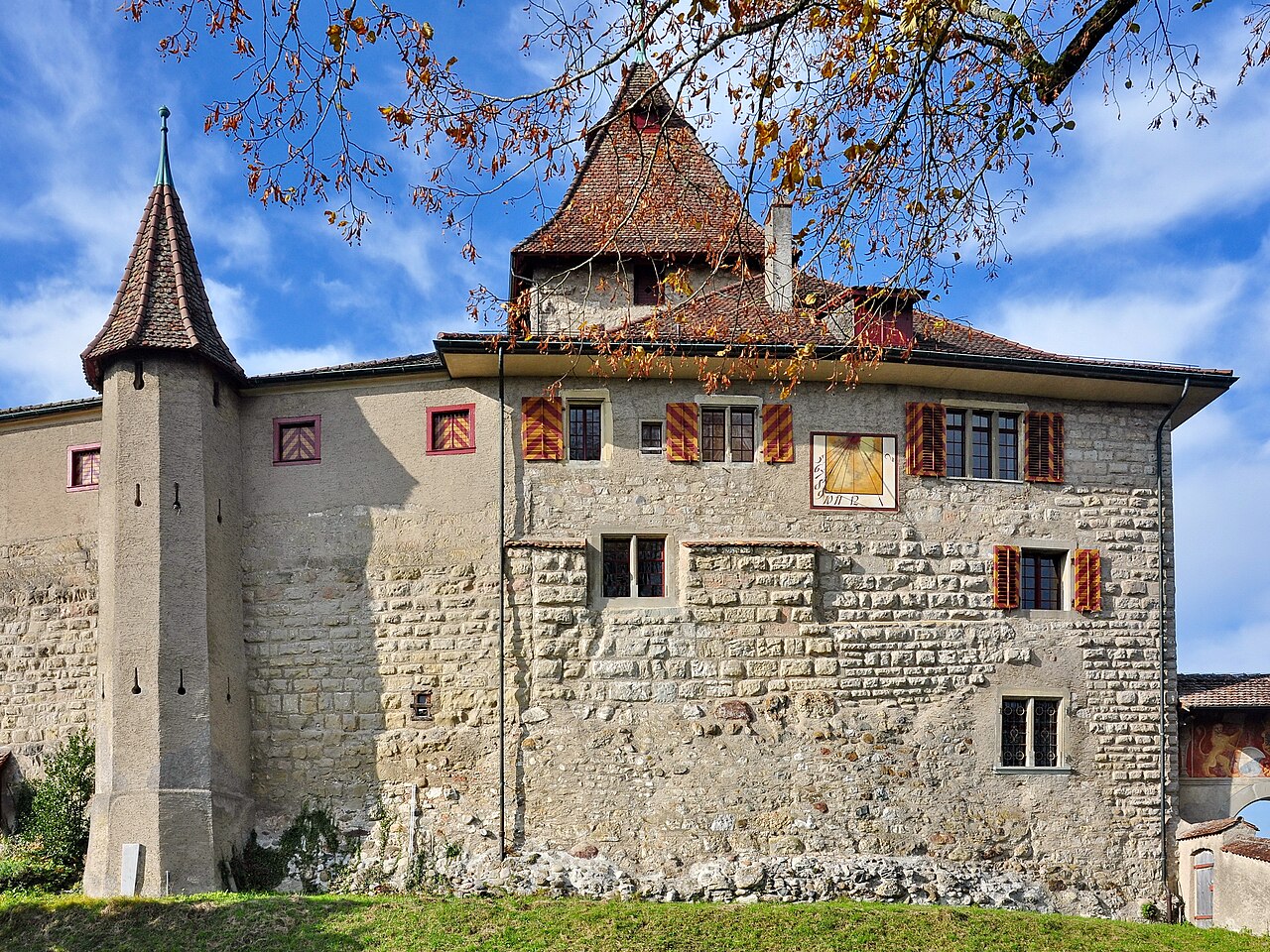
Kyburg Castle (German: Schloss Kyburg) is a castle in Switzerland, overlooking the Töss river about 3 km south-east of Winterthur, in Kyburg municipality, canton of Zürich. It is a Swiss heritage site of national significance.
The first fortification at this site was likely built in the second half of the 10th century by the counts of Winterthur.
It is first mentioned in 1027 under the name of Chuigeburg ("cows-fort"), which name points to an original use as a refuge castle for livestock. The modern spelling Kyburg first occurs in the 1230s (other spellings of the 11th to 13th century include Chiuburch, Cogiburk, Kuiburc, Chuͦweburg, Chyburc, Qwiburg, Kiburc, Chiburg, Kibor, Kyburc, Kiburg).
The early castle was destroyed in 1028 or 1030 by emperor Conrad II. It was rebuilt and soon became the center of the county of Kyburg which was formed in 1053 as a possession of the counts of Dillingen. In 1079, during the Investiture Controversy, the castle was attacked and partially destroyed by Abbot Ulrich II of St. Gall. By 1096, the counts of Dillingen included a count of Kyburg as one of their titles. By 1180, the counts of Kyburg emerged as a cadet line of the Dillingen family. They rose to be the most important noble family in the Swiss plateau beside the Habsburg and the House of Savoy by the 13th century.
After the death of the last count in 1264, Rudolph of Habsburg claimed the inheritance for his family. With one interruption, the Imperial Regalia of the Holy Roman Empire were kept in the castle between 1273 and 1322.
In 1349, 330 Jews were burned within the fortress. This was one of the deadliest pogroms in Swiss areas.
The core of the extant castle originates in the 13th century, with the addition of substantial parts in the course of the 13th and 14th centuries. It is among the largest surviving medieval castle complexes in Switzerland, consisting of a bergfried and palas with additional residential and economic buildings and a chapel, all connected by a ring wall enclosing a large courtyard.
In 1424, the city of Zürich bought the county, and the castle became the seat of the reeve.
The dilapidated castle was substantially renovated at this time. The chapel has substantial late Gothic frescoes commissioned by Zürich.
Substantial changes to the structure were made under reeve Hans Rudolf Lavater during 1527/8.
Text adapted from “Kyburg (castle)” on Wikipedia, CC BY-SA 4.0.
Kyburg Castle ranks #1,634 of 9,079 worldwide in the atlas's castle fame ranking, and #11 of the 213 mapped in Switzerland. Founded c. 950, it is older than 92% of the atlas's dated landmarks — one of 193 atlas entries founded in the 10th century. Its Wikipedia articles were opened 2,065 times in the last 60 days, more than 70% of the atlas. 8 more atlas landmarks stand within 25 km. The nearest day-trip guide is Winterthur, 5 km away. See how Switzerland compares in the castle statistics.
View on the interactive castle map →