Palace
Lalgarh Palace
 India · 20th century
- Founded
- 1902
- Architect
- Samuel Swinton Jacob
- Location
- Bikaner
- Coordinates
- 28.04108°, 73.33166°
- Open data
- Wikidata Q2771350
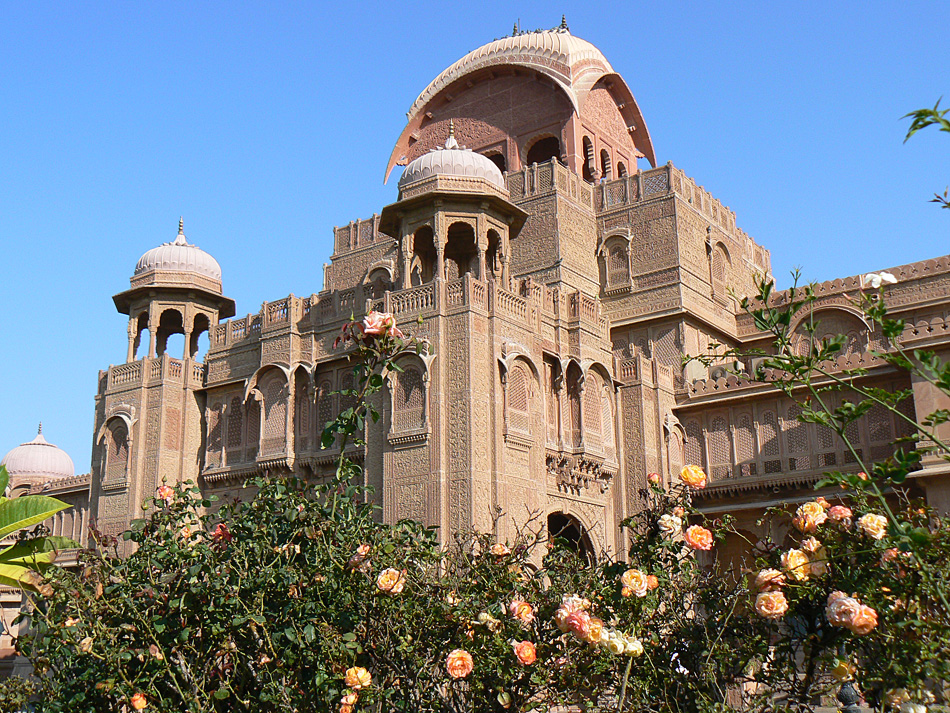
Description
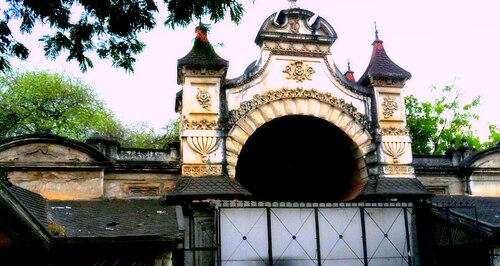
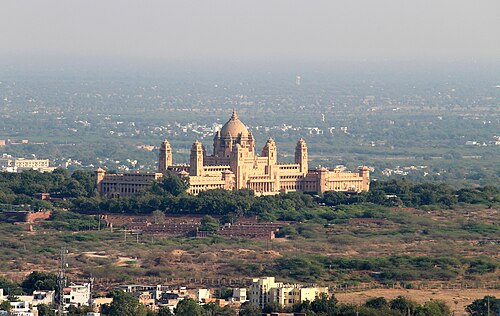
Lalgarh Palace is a palace and heritage hotel in Bikaner, in the Indian state of Rajasthan, built for Sir Ganga Singh, Maharaja of Bikaner, between 1902 and 1926. Laxmi Niwas Palace is a part of Lalgarh Palace but it has been given on lease and recently is being used as a heritage hotel and marriage garden.
The palace was built between 1902 and 1926 in the Indo-Saracenic style. The building was commissioned by the British-controlled regency for Maharaja Ganga Singh (1881–1942) while he was still in his minority as they considered the existing Junagarh Fort unsuitable for a modern monarch. Ganga Singh decided that the palace should be named in memory of his father Maharaj Lal Singh.
Ganga Singh was legendary for his shikars (hunts), his hunts are preserved at Gajner Palace, in particular, his Imperial Sand Grouse hunts at Christmas. As a result, the palace hosted many guests including Georges Clemenceau in 1920, Queen Mary, King George V, Lord Harding, and Lord Irwin. Lord Curzon was the palace's first notable guest.
Stanley Reed, the official reporter of the 1905-06 India tour of the Prince and Princess of Wales (later King George V and Queen Mary of Great Britain) noted that "The Laxmi Niwas Palace is the most perfect modern building in the Indo-Saracenic style in India - an entirely graceful pile of carved red sandstone, nobly proportioned and harmonising entirely with its environment. Their Royal Highnesses have not been more splendidly housed since they landed in Bombay".
In 1972, Karni Singh, M.P., the Maharaja of Bikaner, established the Ganga Singhji Charitable Trust. The Maharaja endowed a part of Lallgarh Palace to be used in service of the trust. Two wings were converted into independent hotels with the income from The Lallgarh Palace Hotel, a heritage hotel used to support the trust. Currently, Lallgarh Palace is owned, and the hotel is run, by his daughter Maharajkumari (Princess) Rajyashree Kumari.
The complex was designed by the British architect Sir Samuel Swinton Jacob. After a ritual blessing ceremony construction commenced in 1896 on empty land 5 miles from the existing Junagarh Fort on what is now Dr. Karni Singhji Road. The palace was arranged around two courtyards with the first wing, Laxmi Niwas completed in 1902. The remaining three wings were completed in stages with final completion of the complex accomplished in 1926.
Text adapted from “Lalgarh Palace” on Wikipedia, CC BY-SA 4.0.
In the rankings
Lalgarh Palace ranks #2,578 of 9,040 worldwide in the atlas's castle fame ranking, and #98 of the 223 mapped in India. Founded 1902, one of 161 atlas entries founded in the 20th century. Its Wikipedia articles were opened 1,978 times in the last 60 days, more than 69% of the atlas. 1 more atlas landmarks stand within 25 km. It is one of the 30 landmarks on the atlas's regional map of Rajasthan. See how India compares in the castle statistics.
Castles nearby
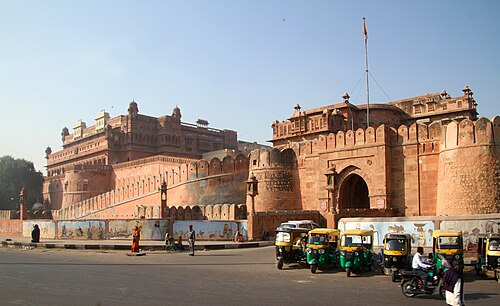
- Junagarh Fort3 km · India
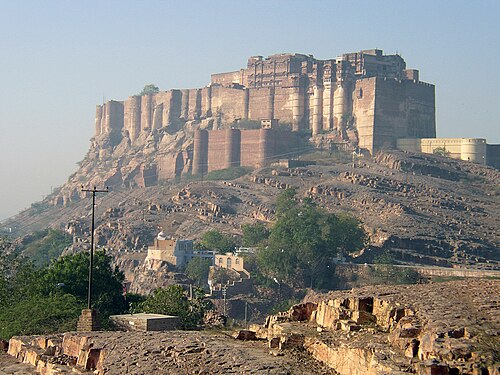
- Mehrangarh Fort196 km · India
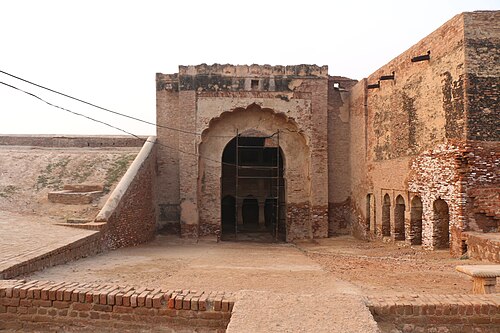
- Bhatner Fort197 km · India
- Umaid Bhawan Palace198 km · India
More castles in India
- King Kothi PalaceIndia
- Castella de AguadaIndia · 17th century
- Diu FortressIndia · 16th century
- Purandar FortIndia